
Rise of Dictators Quiz
How the Scales are Structured
Who Usually Takes This Test?
See How You Compare
Below is a preview of how scores are typically distributed across each scale.
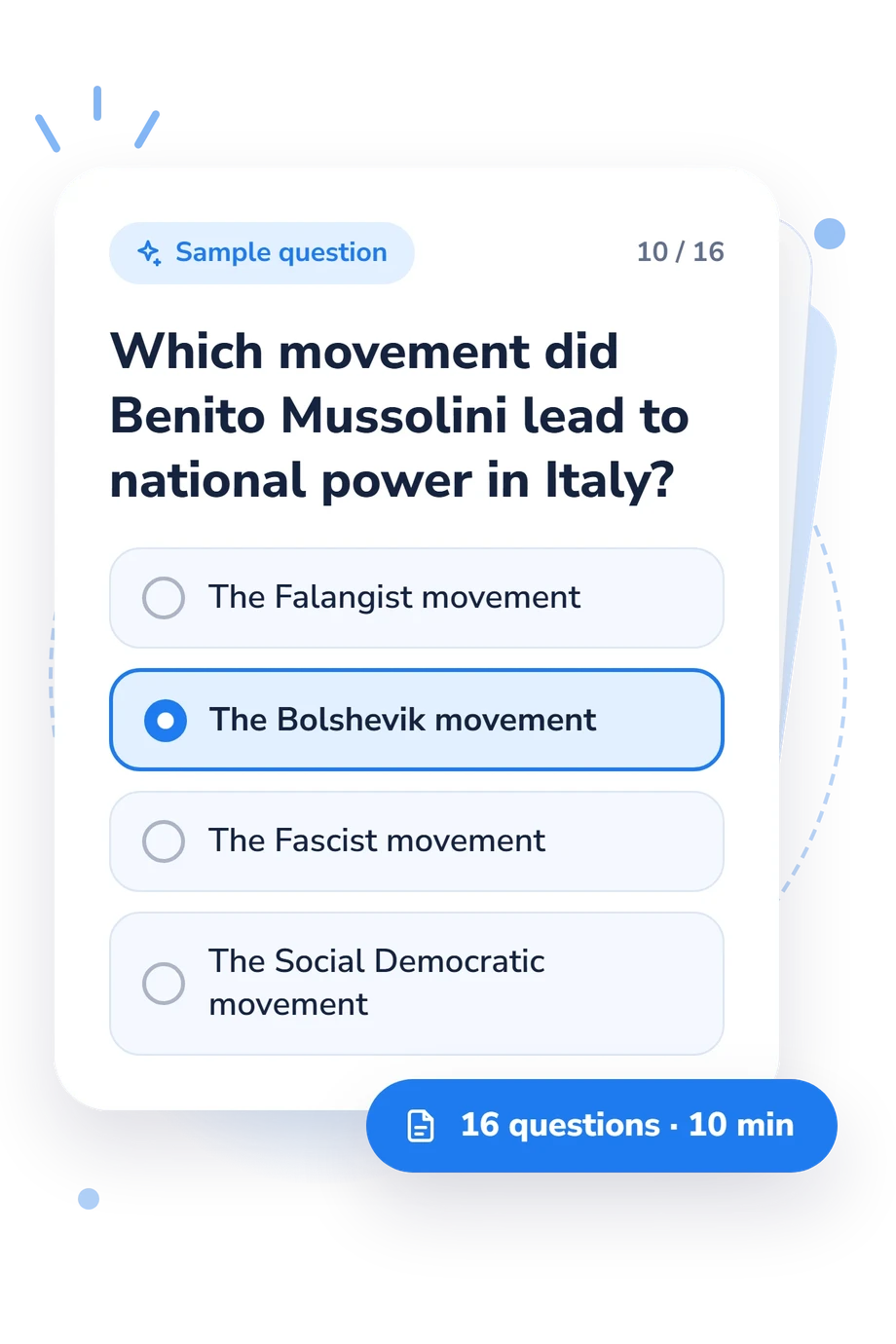
Example Questions From the Test
- The Spanish Civil War
- The Italian unification wars
- The Russo-Japanese War
- The Greco-Turkish War
- Il Duce
- Führer
- Caudillo
- Commissar
- King Victor Emmanuel III invited Mussolini to form a government
- Mussolini personally defeated the Italian army
- Italy became a republic under Fascist control
- The Communist Party gained control of parliament
Rise of Dictators Quiz - Description and methodology of the test
Designed for readers who want to check their grasp of interwar authoritarian politics, this 4.10 Quiz: The Rise of Dictators turns major leaders, institutions, ideologies, and turning points into a focused historical knowledge assessment. It suits students, general history readers, and anyone revisiting how dictators gained and secured power. A quiz on the rise of dictators can show which parts of the period deserve closer review.
What This Assessment Measures
The assessment checks whether readers can connect interwar crises with the leaders, institutions, ideologies, and tactics that shaped dictatorship. It covers Franco, Mussolini, Hitler, and Stalin, with broader attention to propaganda, coercion, economic direction, and political repression.
Framed as an interwar dictators quiz, it measures historical knowledge rather than personality or political attitudes. The result points to areas needing review, such as chronology, comparison, terminology, or cause and effect.
The questions cover four areas:
- Political access and consolidation show how leaders entered office and removed democratic restraints.
- Ideology and propaganda identify racial doctrines, personality cults, and competing visions.
- Economic control and militarization cover rearmament, collectivization, industrial planning, and state direction.
- Chronology and comparison show whether events can be ordered and regimes distinguished.
The displayed scale is Rise of Dictators Knowledge (0-16): Foundations to Build (0-6), Developing Knowledge (7-12), and Strong Knowledge (13-16). These bands indicate increasing command of the period.
Methodology and Evidence Base
Each item presents a historical prompt with four answer choices. Some require direct identification of a leader, law, title, or event; others ask the reader to infer policy, order developments, or compare regimes. The format therefore tests factual recall alongside relationships among facts.
Scoring is criterion-based: one point is awarded for each correct answer, and the total is interpreted directly rather than against a norm group. It is a structured online knowledge check, not a standardized psychological scale.
Lee (2016) supplies the closest historical frame for the leaders, institutions, economic policies, and consolidation processes represented here. Besier and Stokłosa support comparison across twentieth-century dictatorships, while Friedrich and Brzezinski provide a framework for concentrated power, propaganda, coercion, and weakened pluralism. The questionnaire is conceptually consistent with these works, not an adaptation of them.
Used as a dictatorship history quiz, it is most informative when answered without outside help. Prior study, memory, wording, and current concentration can affect performance, so the score is a snapshot of present historical knowledge and a guide to topics worth revisiting.
- Stephen J. Lee, European Dictatorships 1918-1945, 4th ed. Abingdon: Routledge, 2016. 494 pp. ISBN 978-0-415-73614-5.
- Gerhard Besier and Katarzyna Stokłosa, European Dictatorships: A Comparative History of the Twentieth Century. Newcastle upon Tyne: Cambridge Scholars Publishing, 2013. ISBN 978-1-4438-5129-9.
- Carl Joachim Friedrich and Zbigniew Brzezinski, Totalitarian Dictatorship and Autocracy, 2nd rev. ed. Cambridge, Massachusetts: Harvard University Press, 1965. 439 pp. ISBN 978-0-674-89565-2. 10.4159/harvard.9780674332607.
Updated: