
Are You a Spy Quiz
How the Scales are Structured
Who Usually Takes This Test?
See How You Compare
Below is a preview of how scores are typically distributed across each scale.
Example Questions From the Test
- I usually spot changes quickly and can name the precise detail
- I may sense that something is different without knowing what
- I rarely compare their appearance before and after lunch
- I tend to identify it after looking for a moment
- I register it but stay focused unless someone else reacts
- I briefly identify its direction and likely source, then reassess
- I keep reading because waiting rooms contain many ordinary noises
- I look up and check what changed in the room
- Whether the atmosphere feels comfortable and welcoming
- The person I am meeting and the table they chose
- The basic layout, entrances, and busiest areas
- The layout, sightlines, staff movement, and anything unusual
Are You a Spy Quiz - Description and methodology of the test
People who want to examine how they react when plans shift, information is incomplete, or social cues matter may find the Are You a Spy Quiz useful as structured self-reflection. It focuses on adapting under pressure, communicating precisely, protecting boundaries, and noticing surroundings. For anyone treating it as a can-I-be-a-spy quiz, the result separates playful curiosity from a judgment about professional ability.
What This Assessment Explores
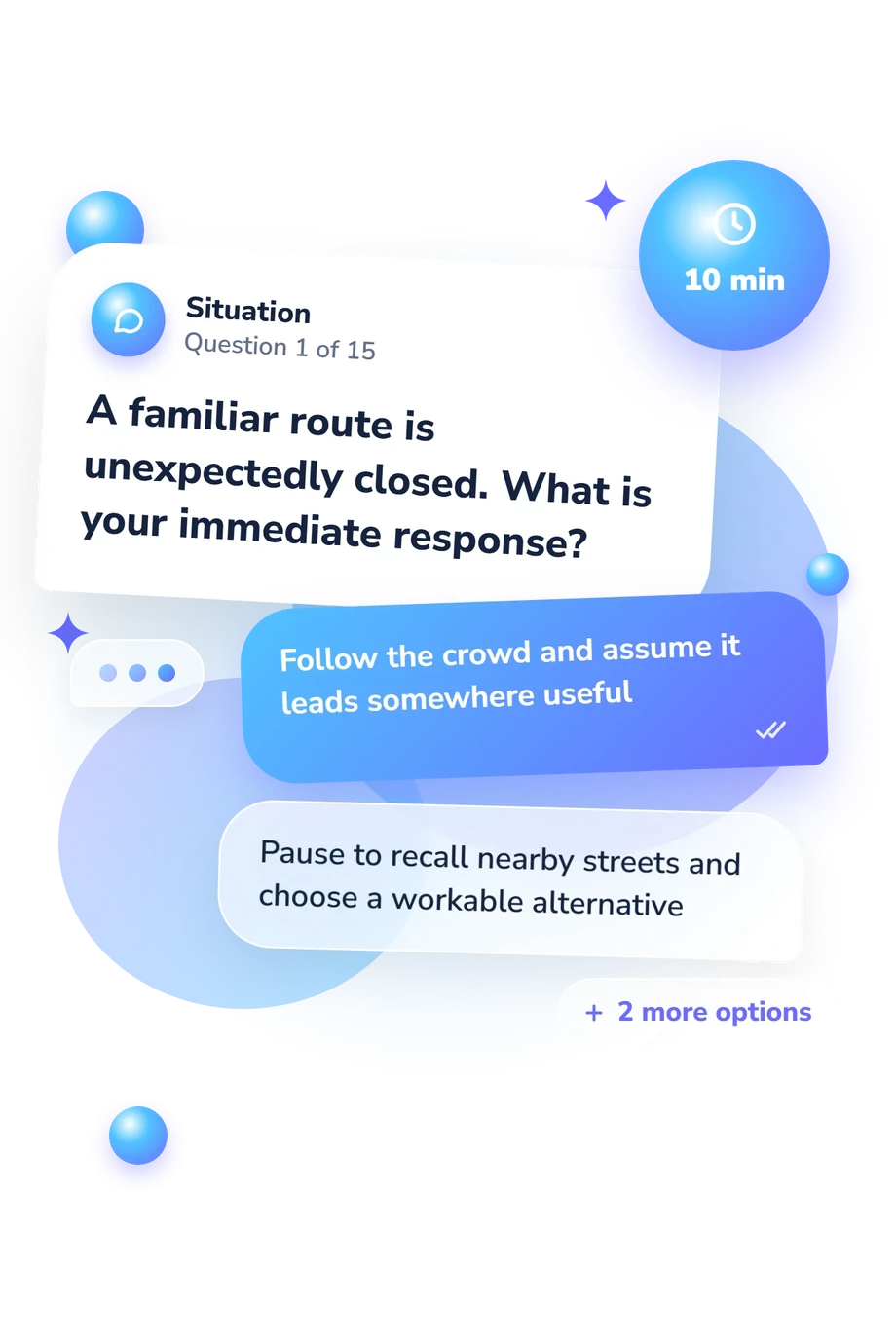
Everyday scenarios cover route changes, conflicting instructions, unfamiliar places, mistakes, disclosure requests, and brief conversations. You choose what you would notice, prioritize, communicate, remember, or do next, so the exercise examines practical judgment without requiring specialist experience.
The result offers a reflective profile of tendencies in the items. Someone taking this spy quiz can compare steadiness, information control, and environmental attention without treating the bands as proof of trustworthiness, surveillance skill, or intelligence-work readiness.
The three result dimensions are:
- Composure and Adaptability (0-15) shows adjustment under pressure: Deliberate Stabilizer (0-5), Flexible Responder (6-10), or Calm Improviser (11-15).
- Discretion and Clear Communication (0-15) reflects sensitive, precise sharing: Open Communicator (0-5), Contextual Gatekeeper (6-10), or Disciplined Communicator (11-15).
- Situational Awareness (0-15) reflects noticing and organizing details: Broad-Focus Observer (0-5), Selective Scanner (6-10), or Detail Mapper (11-15).
Methodology and Evidence Base
Each item presents a situation and four response choices. Options favor different approaches: immediate action, clarification, privacy, observation, or broader context. This situational-judgment format examines preferred responses to practical dilemmas rather than factual recall.
Männiste et al. (2019) is the closest conceptual reference: its work examines decision-making through realistic scenarios. This questionnaire is conceptually consistent with that approach, not an adaptation of the study. Endsley’s situation-awareness model clarifies the attention theme, and Petronio’s privacy-boundary framework relates to disclosure choices.
The questionnaire groups selected responses into three displayed scores, each ranging from 0-15, with descriptive bands. It is not standardized against population norms, so the bands are not hiring standards or a validated measure of intelligence-work ability. Anyone wondering whether they could be a spy should read the result as a snapshot of stated preferences, not a prediction.
Webster et al. (2020) shows why situational-judgment patterns can be informative while still depending on an instrument’s design and validation. Viewed as a spy test quiz, this exercise is affected by impression management, limited self-awareness, and current mood or context. Honest answers improve reflection, but consequential decisions require broader evidence.
- Männiste, Tõnis, Margus Pedaste, and Roland Schimanski. “Situational Judgment Test for Measuring Military Tactical Decision-Making Skills.” Military Psychology 31, no. 6 (2019): 462-473. 10.1080/08995605.2019.1664366
- Endsley, Mica R. “Toward a Theory of Situation Awareness in Dynamic Systems.” Human Factors 37, no. 1 (1995): 32-64. 10.1518/001872095779049543
- Webster, Elin S., Lewis W. Paton, Paul E. S. Crampton, and Paul A. Tiffin. “Situational Judgement Test Validity for Selection: A Systematic Review and Meta-analysis.” Medical Education 54, no. 10 (2020): 888-902. 10.1111/medu.14201
- Petronio, Sandra. Boundaries of Privacy: Dialectics of Disclosure. Albany, NY: State University of New York Press, 2002.
Updated: