
Could I Date Harry Styles Quiz
How the Scales are Structured
Who Usually Takes This Test?
See How You Compare
Below is a preview of how scores are typically distributed across each scale.
Example Questions From the Test
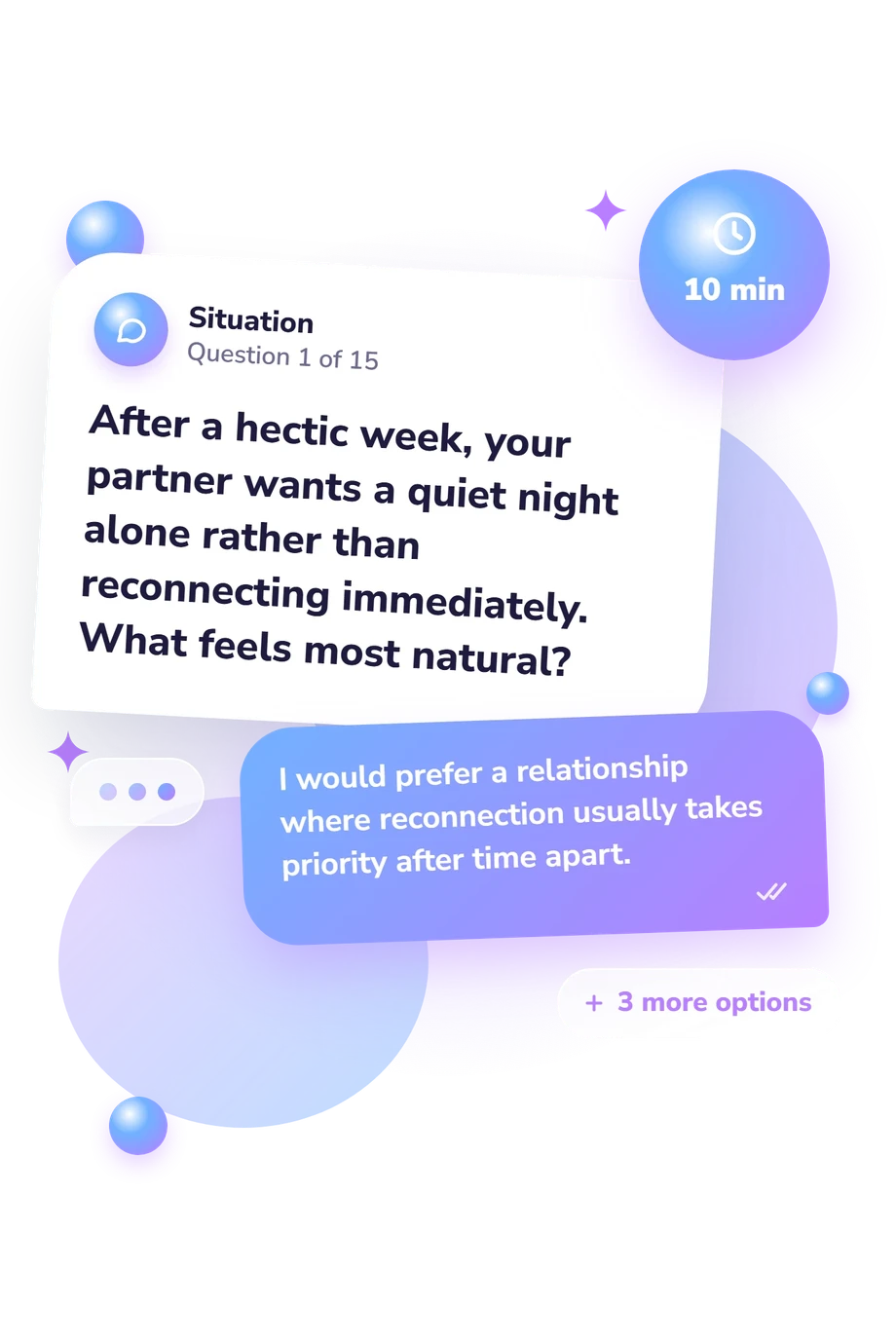
- I would prefer a relationship where reconnection usually takes priority after time apart.
- I could give them the evening, though I would want reassurance and a firm plan soon.
- I would respect the request and arrange time together once both of us had recovered.
- I would welcome parallel downtime and use the evening for my own interests.
- Near-total separation between the relationship and anything public.
- Rare public appearances, with most shared experiences kept private.
- A mix of private life and occasional intentional visibility.
- Flexible boundaries that can accommodate frequent public-facing moments.
- I would keep the original plan because predictability helps me enjoy my evening.
- I might go if the timing were easy and I already liked the performer.
- I would usually welcome the surprise, provided tomorrow was not too demanding.
- I would be energized by the spontaneous chance to experience something creative.
Could I Date Harry Styles Quiz - Description and methodology of the test
Fans exploring whether their preferences fit a relationship shaped by creativity, independence, travel, and public visibility can use the Could I Date Harry Styles Quiz as a prompt for self-reflection. It suits people examining dating preferences, particularly those drawn to celebrity culture while recognizing that public image cannot reveal a private person. A Harry Styles dating quiz becomes useful here because the result focuses on lifestyle fit, not prediction.
What This Assessment Explores
This celebrity relationship compatibility test treats public image as a prompt, not proof of private compatibility. It examines routines, creativity, time apart, emotional openness, and public attention across three dimensions:
- Creative & Expressive Lifestyle Affinity (0-15) measures attraction to arts-centered, experimental dating; Grounded simplicity (0-5) means familiar routines, Curious participant (6-10) allows selected creativity, and Expressive explorer (11-15) welcomes strong artistic and emotional openness.
- Independent Relationship Rhythm (0-15) measures comfort with separate ambitions and time apart; Close-knit rhythm (0-5) prioritizes regular presence, Balanced autonomy (6-10) combines independence with steady contact, and Highly self-directed (11-15) accepts substantial space.
- Public Attention & Privacy Flexibility (0-15) measures fit with visible dating; Private-by-preference (0-5) favors firm privacy, Selectively adaptable (6-10) tolerates protected visibility, and Visibility-flexible (11-15) fits frequent public-facing moments.
Together, the bands describe lifestyle fit rather than a better or worse way to date.
Methodology and Evidence Base
Each item presents a scenario with four ordered responses, moving from preference for routine, privacy, or immediate reconnection toward comfort with spontaneity, independence, emotional expression, or visibility. Choosing the response closest to your usual reaction creates a profile across the three scales. It functions as a relationship compatibility quiz built from imagined situations, not a factual prediction.
Its conceptual reference point is the Celebrity Attitude Scale (McCutcheon et al., 2002), which frames interest in public figures without treating it as evidence of a real relationship. The questionnaire is conceptually consistent with that work, while McCutcheon et al. (2016) adds context for celebrity attitudes and intimate expectations. Fox et al. (2014) relates to privacy and online boundaries, and Knee et al. (2005) to autonomy and conflict in romantic relationships.
These sources support the themes, not a claim that this questionnaire is a validated adaptation; its ranges are descriptive bands rather than population norms or clinical cutoffs, and self-report, mood, imagined circumstances, and self-knowledge can shape the result, so read it as a snapshot of perceived fit rather than a prediction of Harry Styles's feelings or a future relationship.
- McCutcheon, L. E., Gillen, M. M., Browne, B. L., Murtagh, M. P., & Collisson, B. (2016). Intimate relationships and attitudes toward celebrities. Interpersona: An International Journal on Personal Relationships, 10(1), 77-89. 10.5964/ijpr.v10i1.208
- Fox, J., Osborn, J. L., & Warber, K. M. (2014). Relational dialectics and social networking sites: The role of Facebook in romantic relationship escalation, maintenance, conflict, and dissolution. Computers in Human Behavior, 35, 527-534. 10.1016/j.chb.2014.02.031
- Knee, C. R., Lonsbary, C., Canevello, A., & Patrick, H. (2005). Self-determination and conflict in romantic relationships. Journal of Personality and Social Psychology, 89(6), 997-1009. 10.1037/0022-3514.89.6.997
- McCutcheon, L. E., Lange, R., & Houran, J. (2002). Conceptualization and measurement of celebrity worship. British Journal of Psychology, 93(1), 67-87. 10.1348/000712602162454
Updated: