
Blue Quiz
How the Scales are Structured
Who Usually Takes This Test?
See How You Compare
Below is a preview of how scores are typically distributed across each scale.
Example Questions From the Test
- To circulate blood to the brain, heart, and other vital organs
- To determine whether the heart rhythm is shockable
- To restart breathing by expanding the lungs
- To prevent all rib or chest injuries during resuscitation
- A medication tray
- A bag-mask ventilation device
- A portable suction unit
- A defibrillator
- A shockable ventricular rhythm identified by the defibrillator
- Ventricular fibrillation
- Pulseless ventricular tachycardia
- Asystole
Blue Quiz - Description and methodology of the test
Designed for readers who want to check their understanding of hospital emergency response, the Blue Quiz focuses on decisions made during a suspected cardiac or respiratory arrest. It is suitable as a Code Blue test for learners, healthcare workers revising core concepts, and visitors who want a clearer picture of Code Blue procedures. Its single result gives an overall educational knowledge band for reflection before formal training or supervised practice.
What This Assessment Explores
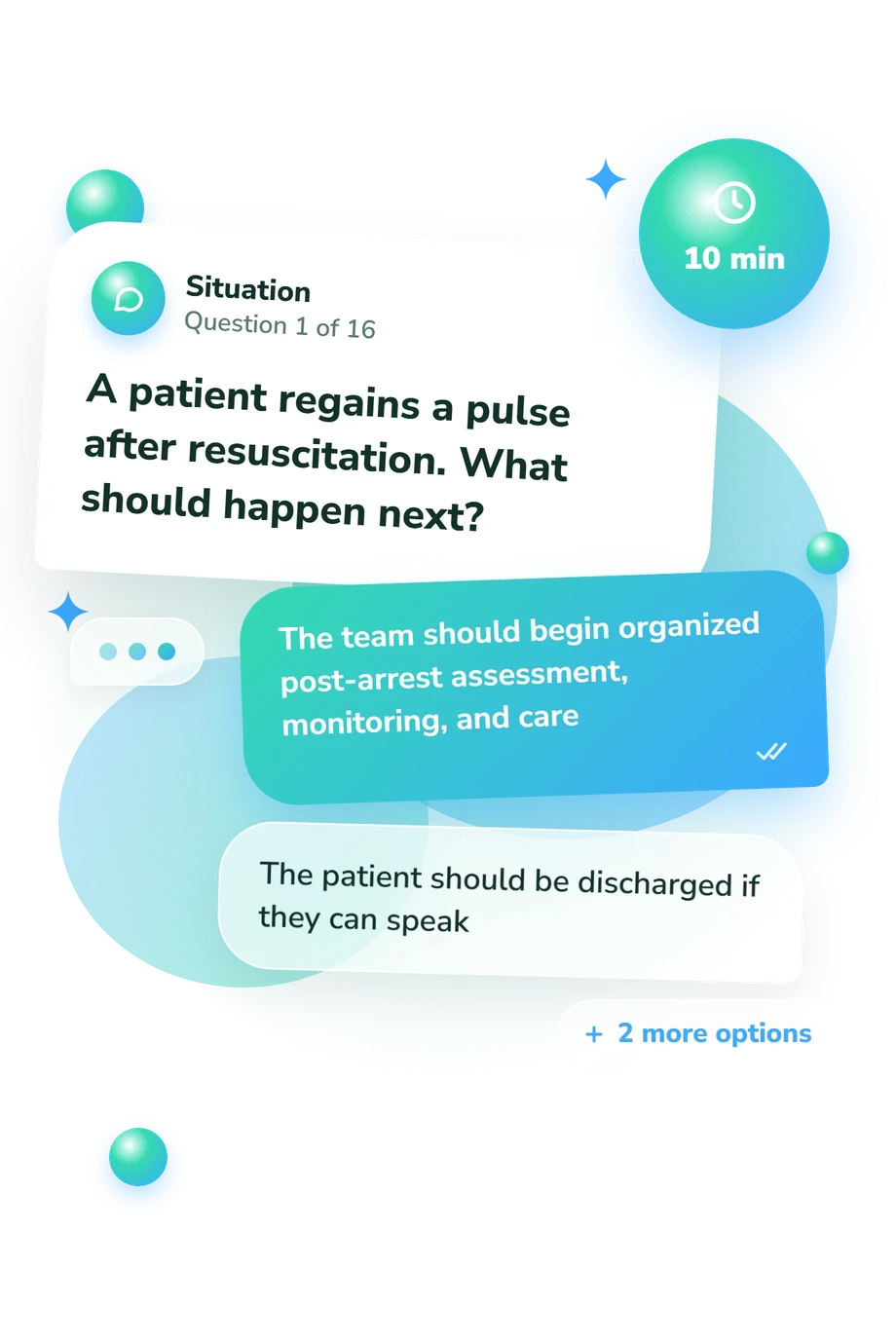
The assessment covers arrest recognition, help activation, CPR priorities, rhythm and defibrillation, post-arrest care, pediatric considerations, safety, ethical instructions, and team communication. The quiz questions about Code Blue combine short clinical situations with direct knowledge checks, linking individual actions to coordinated emergency work.
The main themes are:
- Arrest recognition shows whether you identify when help and CPR should begin.
- Resuscitation shows understanding of circulation, rhythm, shocks, and ventilation support.
- Teamwork and safety show grasp of communication, precautions, and debriefing.
- Special situations show awareness of pediatric differences, treatment limits, and post-arrest care.
The result uses the Code Blue Knowledge scale from 0-16: Foundation to build (0-6), Developing knowledge (7-12), or Strong knowledge (13-16). This single band reports an overall knowledge level; the questions may help you notice themes to revisit, but they do not provide separate scores for arrest recognition, teamwork, safety, or special situations.
Methodology and Scientific Basis
Each item presents a prompt with four answer choices. Across the set, the questions test recognition, principles, interpretation, prioritization, and appropriate actions in emergency scenarios. The scoring display summarizes performance across the questionnaire; no separate weighting rule is specified, so answer contributions should not be inferred from the range.
As a Code Blue knowledge assessment, the questionnaire is conceptually consistent with the Ten Steps IHCA framework (Nallamothu et al., 2023), emphasizing preparation, prompt response, team performance, and review. Adult items align with 2025 American Heart Association guidance; pediatric content aligns with 2025 AHA and American Academy of Pediatrics guidance; post-arrest items correspond to 2025 AHA guidance on care after circulation returns. This is a conceptual relationship, not a claim that the questionnaire reproduces any one guideline.
Interpret the result as an educational snapshot with one overall knowledge band, not separate subscores for the themes above. The score is unvalidated and is not certification or proof of clinical readiness; follow current training and facility protocols. Memory, wording, current training, and local protocols can affect performance.
- Nallamothu BK, Greif R, Anderson T, Atiq H, Couto TB, Considine J, De Caen AR, Djärv T, Doll A, Douma MJ, Edelson DP, Xu F, Finn JC, Firestone G, Girotra S, Lauridsen KG, Leong CKL, Lim SH, Morley PT, Morrison LJ, Moskowitz A, Mullasari Sankardas A, Mohamed MTM, Myburgh MC, Nadkarni VM, Neumar RW, Nolan JP, Athieno Odakha J, Olasveengen TM, Orosz J, Perkins GD, Previdi JK, Vaillancourt C, Montgomery WH, Sasson C, Chan PS. Ten Steps Toward Improving In-Hospital Cardiac Arrest Quality of Care and Outcomes. Circulation: Cardiovascular Quality and Outcomes. 2023;16(11):793-806. 10.1161/CIRCOUTCOMES.123.010491
- Kleinman ME, Buick JE, Huber N, Idris AH, Levy M, Morgan SG, Nassal MJ, Neth MR, Norii T, Nunnally ME, Rodriguez AJ, Walsh BK, Drennan IR. Part 7: Adult Basic Life Support: 2025 American Heart Association Guidelines for Cardiopulmonary Resuscitation and Emergency Cardiovascular Care. Circulation. 2025;152(suppl 2):S448-S478. 10.1161/CIR.0000000000001369
- Joyner BL, Dewan M, Bavare A, de Caen A, DiMaria K, Donofrio-Odmann J, Fosse G, Haskell S, Mahgoub M, Meckler G, Requist J, Schexnayder SM, Olech Smith M, Werho D, Raymond TT. Part 6: Pediatric Basic Life Support: 2025 American Heart Association and American Academy of Pediatrics Guidelines for Cardiopulmonary Resuscitation and Emergency Cardiovascular Care. Circulation. 2025;152(suppl 2):S424-S447. 10.1161/CIR.0000000000001370
- Hirsch KG, Amorim E, Coppler PJ, Drennan IR, Elliott A, Gordon AJ, Jentzer JC, Johnson NJ, Moskowitz A, Mumma BE, Presciutti AM, Rodriguez AJ, Yen AK, Rittenberger JC. Part 11: Post-Cardiac Arrest Care: 2025 American Heart Association Guidelines for Cardiopulmonary Resuscitation and Emergency Cardiovascular Care. Circulation. 2025;152(suppl 2):S673-S718. 10.1161/CIR.0000000000001375
Updated: