
Lesbian Terminology Quiz
How the Scales are Structured
Who Usually Takes This Test?
See How You Compare
Below is a preview of how scores are typically distributed across each scale.
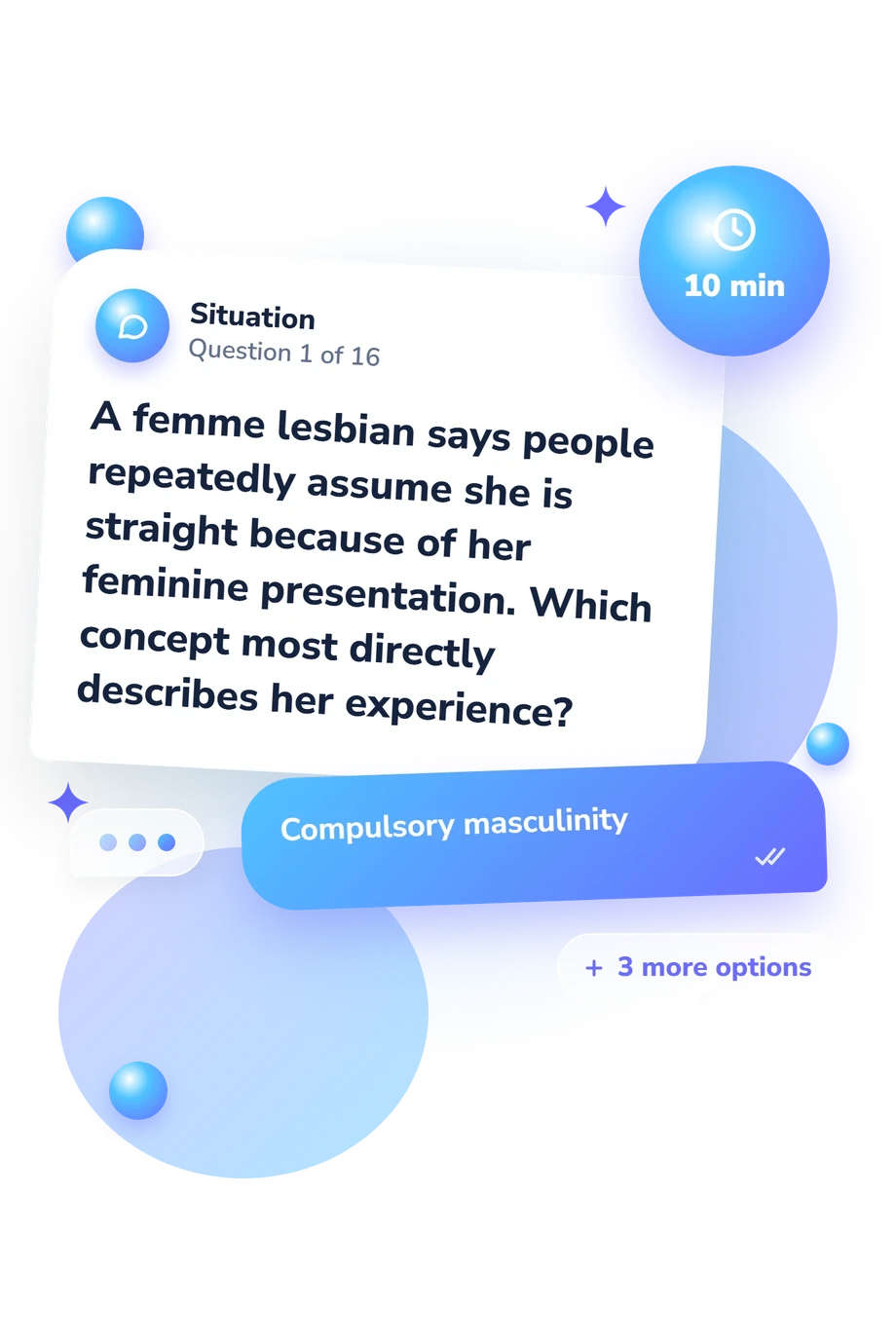
Example Questions From the Test
- Compulsory masculinity
- Gender fluidity
- Stud erasure
- Femme invisibility
- Coming out
- Being visibly queer
- Outing
- Lesbian erasure
- Women who love women
- Women learning about womanhood
- Women living without partners
- Women with lesbian wives
Lesbian Terminology Quiz - Description and methodology of the test
People who want to understand lesbian and sapphic language can use this assessment to check recognition of terms, cultural references, and distinctions without reducing identity to a score. The lesbian terminology quiz is intended for curious learners, community members, allies, and anyone seeking more precise language for respectful conversations. This LGBTQ vocabulary quiz builds understanding through attention to meaning and context.
What This Assessment Explores
Questions cover identity, presentation, relationships, boundaries, community language, and social pressure. Scenarios distinguish femme invisibility, outing, lesbian erasure, chosen family, compulsory heterosexuality, and sapphic as a broad descriptor. Other items test whether terms such as stud and stem depend on cultural context rather than applying universally.
The result is organized around one knowledge dimension:
- Lesbian Terminology Knowledge (0-16) reflects familiarity with common lesbian and sapphic terminology, not identity or belonging.
- Foundation-building (0-6) indicates that meanings and cultural context need review.
- Developing fluency (7-12) indicates broad recognition with room for nuanced usage.
- Strong fluency (13-16) indicates broad knowledge of definitions, context, and respectful application; language evolves, and individual preferences should take priority.
Because the items include community-specific expressions, the assessment also functions as an LGBT slang quiz, offering an opportunity to review contextual usage without treating one preference as universal.
Methodology and Evidence Base
Each item presents a brief definition or situation with four answer choices. Selecting the term that best fits the context tests recognition among related concepts, so the format measures vocabulary knowledge in this questionnaire rather than identity, sexuality, presentation, or community membership. Answers are judged by fit with the scenario, and the displayed result summarizes that recognition in one knowledge scale. As a lesbian terminology test, it supports self-directed learning through focused terminology recognition.
The terminology items are conceptually consistent with Morgan (2017) on lesbian slang and community meaning, but the questionnaire is not identified as an adaptation of that work. Items on butch-femme identities and subcultures are also conceptually consistent with Puckett and Levitt (2015), while the treatment of compulsory heterosexuality aligns with Rich (1980). UCSF (2024) supplies current glossary context for terminology.
Read the bands as descriptive levels of familiarity. Prior exposure, interpretation of context, and answer selection can affect performance, while terminology varies across communities. The questionnaire helps identify topics for further review, and the result describes performance on these items across three familiarity bands rather than establishing a population comparison or clinical inference.
- Morgan, Taralee. 2017. "Lesbian Lingo: Slang Terminology in English and Spanish Spoken by Lesbian Communities in the United States." Master's thesis, DePaul University.
- Puckett, Julia A., and Heidi M. Levitt. 2015. "Lesbian, Gay, Bisexual and Trans-sexual Butch-Femme Subcultures." In International Encyclopedia of the Social and Behavioral Sciences, 2nd ed., edited by James D. Wright, 870-875. Elsevier. 10.1016/B978-0-08-097086-8.10237-5.
- Rich, Adrienne. 1980. "Compulsory Heterosexuality and Lesbian Existence." Signs: Journal of Women in Culture and Society 5(4): 631-660. 10.1086/493756.
- University of California, San Francisco LGBTQ Resource Center. 2024. "LGBTQIA+ Glossary." Updated March 2024.
Updated: