
Science Quiz Bee for Grade 1
How the Scales are Structured
Who Usually Takes This Test?
See How You Compare
Below is a preview of how scores are typically distributed across each scale.
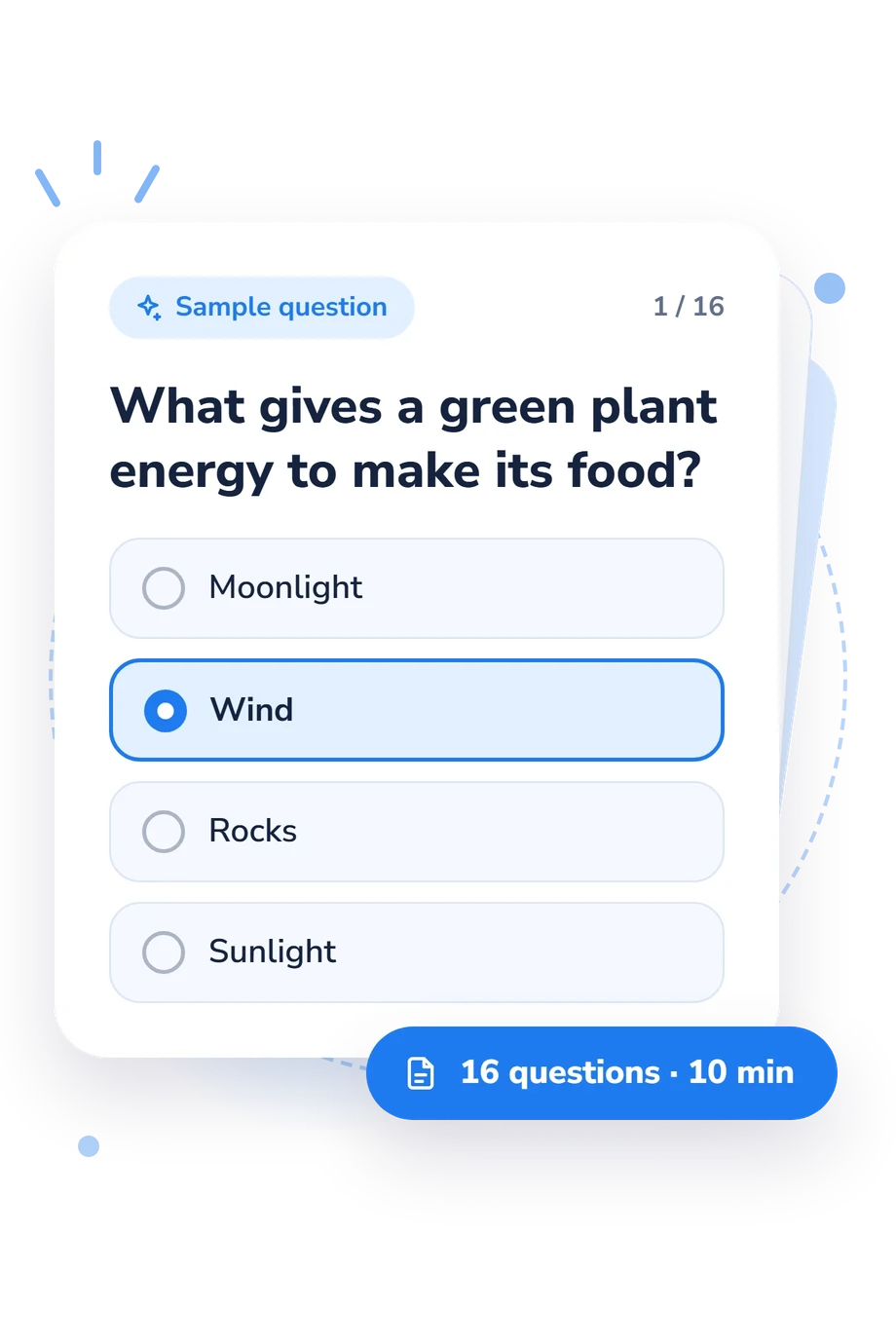
Example Questions From the Test
- Moonlight
- Wind
- Rocks
- Sunlight
- An earthquake
- Snowy weather
- Rainy weather
- Clear, sunny weather
- Nose
- Ears
- Eyes
- Tongue
Science Quiz Bee for Grade 1 - Description and methodology of the test
For children building a first map of the natural world, the Science Quiz Bee for Grade 1 offers a focused way to check familiar classroom ideas. Parents and teachers can use the result from this Grade 1 science quiz to identify concepts that need more practice and choose suitable activities. Results identify which sampled concepts are secure and which merit review.
What This Assessment Explores
Children encounter familiar situations when answering science quiz questions for Grade 1, with topics including plants, weather, body parts, living things, animals, materials, magnets, hygiene, shadows, changes of state, and growth. The assessment suits Grade 1 learners, while adults can use the result to select review activities.
One scale is reported: Grade 1 Science Knowledge (0-16). Emerging Foundation (0-6) indicates a need to review basic ideas; Developing Knowledge (7-12) reflects understanding that can be strengthened through application; Strong Grade 1 Knowledge (13-16) shows a strong grasp of the sampled concepts.
The main themes are:
- Life science shows whether the learner recognizes living things, animal features, body functions, and plant changes.
- Earth and weather shows how the learner identifies sunlight, clouds, rain, and outdoor conditions.
- Physical science shows whether the learner reasons about materials, magnets, shadows, sinking, melting, and everyday choices.
Methodology and Scientific Basis
Each item offers four answer choices, and the learner selects the response that best fits the situation. One point is awarded for each correct answer, so the total reflects performance across the sampled content. This Grade 1 science assessment provides a snapshot of current classroom understanding across the sampled topics.
Its content is conceptually consistent with the Science Learning Assessment (SLA), which uses accessible science ideas and everyday contexts to examine developing understanding. The relationship is conceptual: this online questionnaire is not presented as an adaptation or direct validation of the SLA.
The displayed bands are catalogue-defined categories for performance on this quiz. Interpretation should stay close to the displayed band and the questions represented here: a higher total means more sampled items were answered correctly, while a lower total identifies topics worth revisiting. The catalogue-defined category can guide topic-specific review by directing attention to basic ideas, application in new situations, or consolidation of the sampled concepts. Reading comprehension, attention, guessing, and recent instruction can influence performance, so the result is best read as a snapshot of these science topics.
- Samarapungavan, Ala, Panayota Mantzicopoulos, Helen Patrick, and Brian French. The Development and Validation of the Science Learning Assessment (SLA): A Measure of Kindergarten Science Learning. Journal of Advanced Academics, 20(3), 502-535, 2009. 10.1177/1932202X0902000306
- Department of Education, Republic of the Philippines. K to 12 Basic Education Curriculum: Science Curriculum Guide. August 2016.
- National Research Council. A Framework for K-12 Science Education: Practices, Crosscutting Concepts, and Core Ideas. Committee on a Conceptual Framework for New K-12 Science Education Standards. National Academies Press, 2012. 10.17226/13165
Updated: