
Elf Personality Quiz
How the Scales are Structured
Who Usually Takes This Test?
See How You Compare
Below is a preview of how scores are typically distributed across each scale.
Example Questions From the Test
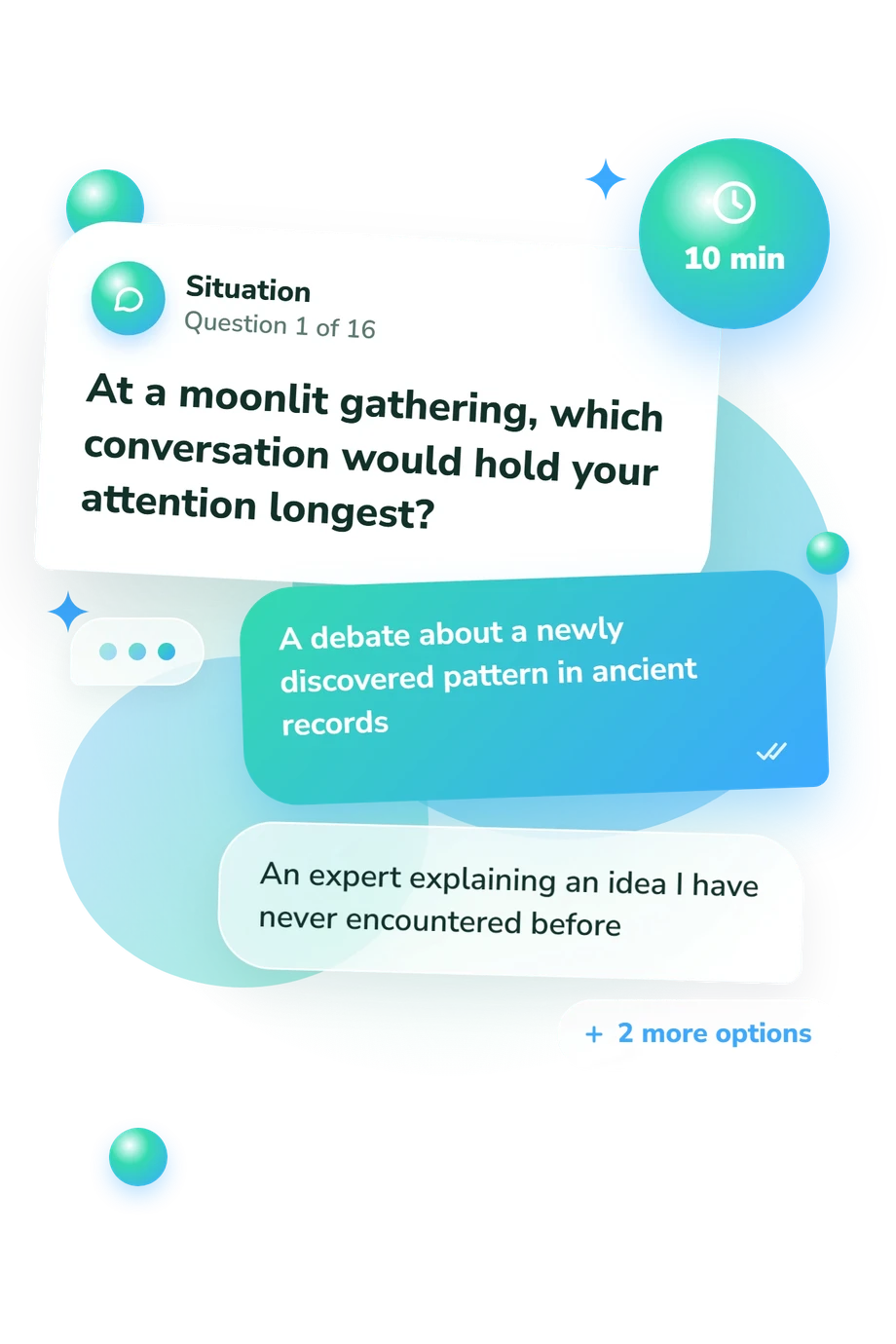
- A debate about a newly discovered pattern in ancient records
- An expert explaining an idea I have never encountered before
- An artist describing the inspiration behind a striking creation
- A traveler recounting a daring journey beyond familiar borders
- Testing landmarks, terrain, and direction to establish a safe new route
- Scouting a short distance ahead while staying connected with the group
- Helping the group pause comfortably until visibility improves
- Reviewing established route records for the most conservative retreat
- Excitement about building a life somewhere whose customs and streets are new to me
- Interest, followed by questions about what I could learn and where else I might travel
- Curiosity about visiting, though I would prefer a shorter stay
- A stronger desire to deepen the life and relationships I already have
Elf Personality Quiz - Description and methodology of the test
Curiosity about your imagined elven identity makes the Elf Personality Quiz a playful self-reflection tool for readers who enjoy fantasy themes and personality exploration. It helps fantasy-minded readers explore what kind of elf their choices suggest and reflect on the imagined role that feels most engaging. The result answers the playful question of what elf you are in quiz form, offering a profile rather than a single fixed identity.
What This Assessment Explores
These situations form a quiz about what type of elf you are, exploring imagined preferences rather than fixed abilities or real-world status. They cover creativity, hospitality, inquiry, travel, navigation, nature, and stewardship. The result shows your affinities, while close scores can form a blended identity.
These four dimensions show which elven affinity stands out:
- Hearthlight Artisan (0-12) measures making, hospitality, beauty, and community-building; Unlit Workshop (0-4), Kindled Craft (5-8), Radiant Affinity (9-12).
- Starlit Scholar (0-12) measures attraction to patterns, old stories, and inquiry; Passing Curiosity (0-4), Seeking Mind (5-8), Luminous Affinity (9-12).
- Wandering Wayfinder (0-12) measures movement, adaptable plans, and discovery; Familiar Horizon (0-4), Open Road (5-8), Far-Roaming Affinity (9-12).
- Woodland Guardian (0-12) measures connection with living landscapes, observation, and stewardship; Distant Footpath (0-4), Rooted Interest (5-8), Deep-Rooted Affinity (9-12).
Methodology and Evidence Base
Each item presents an imaginative situation with four response options. The choices call for preference judgments, and responses are grouped into the four dimensions. Separate totals show the strength of each affinity; the highest is the leading result, while close totals may create a blended profile. As an elf personality test, it turns imaginative choices into a structured reflection rather than a fixed label.
Methodologically, this is an online self-report questionnaire with descriptive result bands. The Park and Henley (2007) study offers a conceptual comparison through its link between personality preferences and fantasy-character choices. The Faber and Mayer (2009) study examines resonance with archetypal media figures. Together, these studies offer conceptual comparisons about imaginative preferences; they do not establish or validate the four displayed scales.
Read the bands as descriptive indications of affinity within this questionnaire: because the choices ask you to imagine roles, responses may reflect mood, current interests, familiarity with fantasy, and self-perception, making the profile a focused snapshot of imaginative preference rather than a complete account of everyday personality.
- Park, Anna E., and Tracy B. Henley. “Personality and Fantasy Game Character Preferences.” Imagination, Cognition and Personality, vol. 27, no. 1, 2007, pp. 37-46. 10.2190/IC.27.1.d
- Faber, Michael A., and John D. Mayer. “Resonance to archetypes in media: There’s some accounting for taste.” Journal of Research in Personality, vol. 43, 2009, pp. 307-322. 10.1016/j.jrp.2008.11.003
- Keirsey, David. Please Understand Me II: Temperament, Character, Intelligence. Prometheus Nemesis, 1998. ISBN 1885705026
Updated: