
What Human Am I Quiz
How the Scales are Structured
Who Usually Takes This Test?
See How You Compare
Below is a preview of how scores are typically distributed across each scale.
Example Questions From the Test
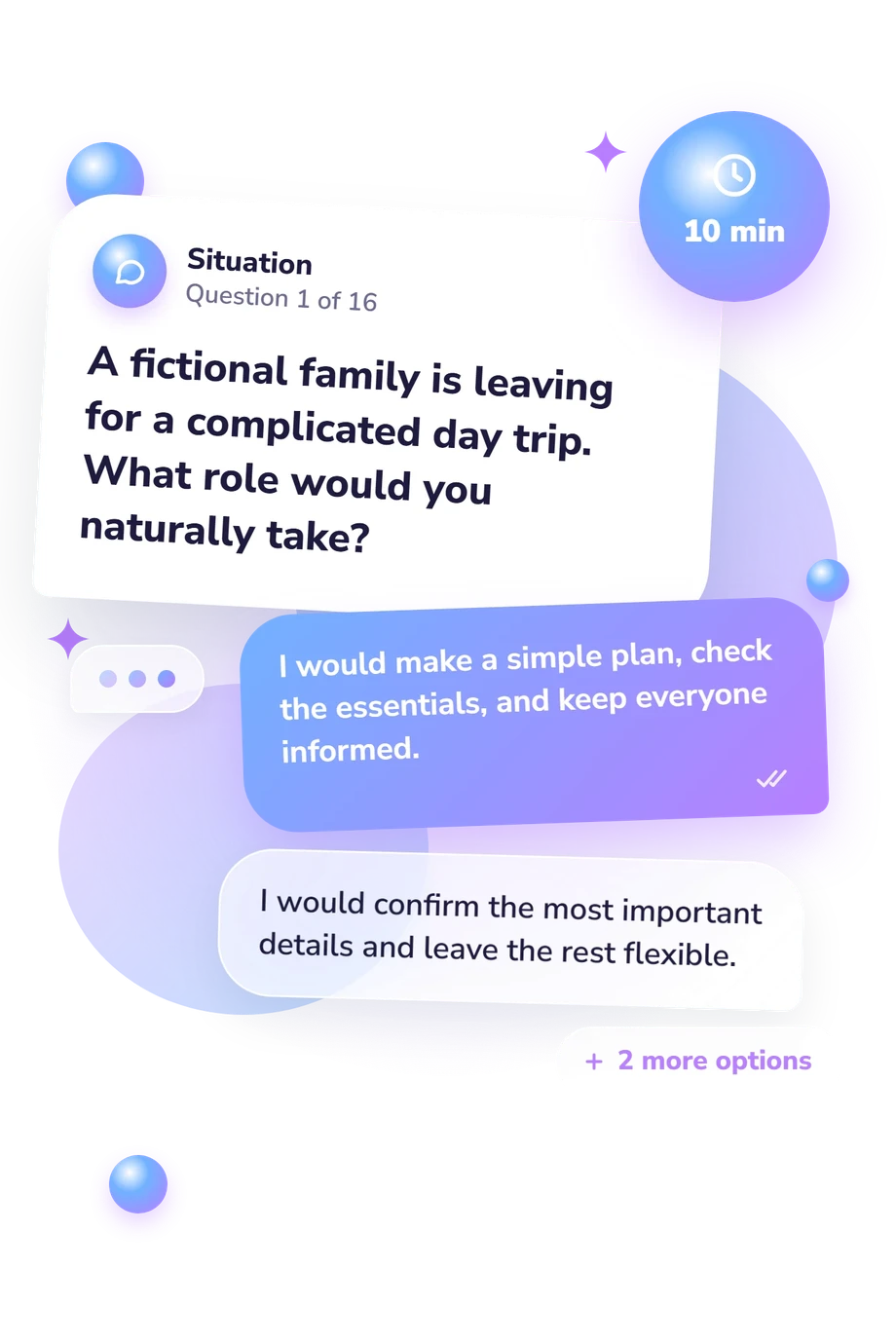
- I would make a simple plan, check the essentials, and keep everyone informed.
- I would confirm the most important details and leave the rest flexible.
- I would handle one assigned task well without coordinating the whole trip.
- I would let someone else organize and focus on adapting as the day unfolds.
- Give them room to observe and approach when they feel ready.
- Introduce myself and point out a few people or activities they might like.
- Bring them into a small, easygoing conversation before suggesting anything bigger.
- Welcome them with playful energy and invite them straight into a memorable shared activity.
- Let the quieter mood continue; not every gathering needs extra stimulation.
- Start a lively game, unusual challenge, or spontaneous group adventure.
- Suggest one light activity and see whether anyone wants to join.
- Find one person to chat with rather than changing the mood of the whole room.
What Human Am I Quiz - Description and methodology of the test
Designed for anyone curious about their place in a fictional family, the What Human Am I Quiz turns everyday choices into a character-style result. As a what kind of human are you quiz, it uses imaginative situations to show how someone supports, includes, challenges, or learns from others. The outcome highlights a leading affinity rather than a fixed identity.
What This Assessment Explores
The questionnaire explores four complementary ways of participating in a fictional family system. Scenarios involve planning, welcome, conflict, responsibility, tradition, creativity, memory, and practical care. As a what type of human are you quiz, the questionnaire explores character styles.
The four dimensions are:
- The Loyal Sibling (0-12) measures peer solidarity: Independent Companion (0-4), Responsive Ally (5-8), or Loyal Sibling Affinity (9-12).
- The Spirited Cousin (0-12) measures novelty and momentum: Grounded Participant (0-4), Occasional Spark (5-8), or Spirited Cousin Affinity (9-12).
- The Steady Guardian (0-12) measures structure and dependable care: Flexible Supporting Role (0-4), Situational Guardian (5-8), or Steady Guardian Affinity (9-12).
- The Wise Story-Keeper (0-12) measures memory and perspective: Present-Focused Role (0-4), Selective Story-Keeper (5-8), or Wise Story-Keeper Affinity (9-12).
The highest score is the strongest affinity, while scores within one point form a blended result.
Methodology and Scientific Basis
Each item presents a fictional-family situation with four response options. The choices represent ways of organizing, joining, adapting, protecting, experimenting, or reflecting, so respondents choose naturally. This format uses situational self-report rather than agreement ratings. Because situations are imagined, choices may reflect how the respondent interprets the role, current mood, or recent experiences as much as how they behave.
The displayed result compares four scale scores: the highest score indicates the strongest affinity, and scores within one point produce a blended result. Together, these scores create a relative profile of participation.
The four archetypes form its creative framework, not an adaptation of Family Climate Scales by Björnberg and Nicholson. Family Climate Scales by Björnberg and Nicholson and Moos and Moos’s Family Environment Scale offer context for support, relationships, organization, and control; Roosa and Beals stress precise constructs in family assessment.
The online questionnaire takes a human archetype quiz approach, inviting self-reflection through imagined roles and presenting affinity bands for four creative character styles. The profile is a contextual snapshot of responses to imagined situations, shaped by the respondent’s broader perspective.
- Björnberg, Åsa, and Nigel Nicholson. “The Family Climate Scales-Development of a New Measure for Use in Family Business Research.” Family Business Review, vol. 20, no. 3, 2007, pp. 229-246. 10.1111/j.1741-6248.2007.00098.x
- Moos, Rudolf H., and Bernice S. Moos. Family Environment Scale Manual: Development, Applications, Research. 4th ed., Mind Garden, 2009.
- Roosa, Mark W., and James Beals. “Measurement Issues in Family Assessment: The Case of the Family Environment Scale.” Family Process, vol. 29, no. 2, 1990, pp. 191-198. 10.1111/j.1545-5300.1990.00191.x
Updated: