
Binary Quiz
How the Scales are Structured
Who Usually Takes This Test?
See How You Compare
Below is a preview of how scores are typically distributed across each scale.
Example Questions From the Test
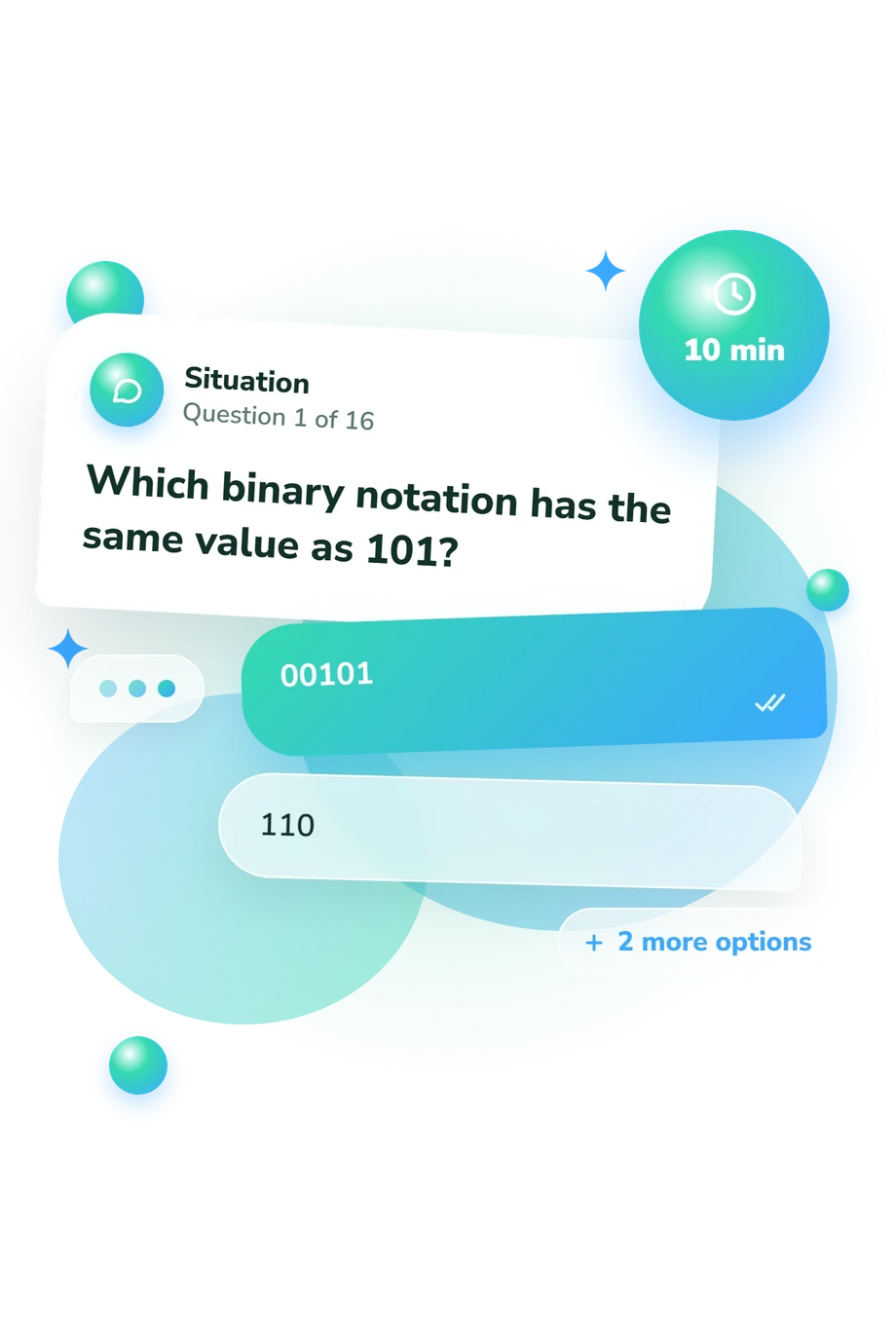
- 00101
- 110
- 1001
- 1010
- 1010, which equals 12
- 1010, which equals 10
- 10100, which equals 10
- 0101, which still equals 5
- 8
- 32
- 16
- 40
Binary Quiz - Description and methodology of the test
Designed for learners who want to check practical understanding of base-two notation, this binary quiz turns familiar operations into a focused knowledge check. It suits students, beginners in programming or digital systems, and anyone who wants a clear starting point before revisiting binary arithmetic. This binary number quiz provides an overall indication of performance, placing the respondent in a Foundations, Developing, or Strong band.
What This Assessment Explores
The questionnaire tests how unsigned binary values are read and manipulated. It links digits with powers of two, binary-decimal conversion, comparisons, simple addition, and changes caused by counting forward.
For a learner, reviewing the question types in this binary conversion quiz can support practice in place value, conversion, arithmetic, or fixed-width representation.
The questions cover four areas:
- Place values show what each position contributes.
- Conversions test recognition of equivalent binary and decimal forms.
- Operations examine addition and increases in a counter or timer.
- Representation limits show how bit patterns determine possible values.
Results appear on Binary Knowledge (0-16): Foundations (0-6) indicates concepts to review; Developing (7-12) indicates usable understanding with practice still helpful; Strong (13-16) indicates consistent command of the assessed material.
Methodology and Evidence Base
Each item presents a short problem with four answer choices. Selecting the matching representation or calculation tests recognition and application rather than extended explanation. The displayed result is a direct count of correct responses, and the bands describe performance ranges.
This questionnaire's content overlaps with topics assessed by the Digital Logic Concept Inventory, while a later psychometric study by Herman, Zilles, and Loui evaluates that published instrument rather than validating this questionnaire. The inventory and its evaluation offer context for common digital-logic misconceptions but do not validate this questionnaire itself.
As a quiz about how to count in binary, it can guide targeted practice with powers of two, conversions, addition, and carry behavior. Interpretation depends on careful reading and current familiarity, which may change with recent study. With no stated norms or independent validation, the score is best treated as a focused self-reflection result rather than a formal measure of overall mathematical or computing ability.
- David Money Harris and Sarah L. Harris, Digital Design and Computer Architecture, 2nd ed. (Morgan Kaufmann, 2012), ISBN 9780123944245.
- Geoffrey L. Herman, Michael C. Loui, and Craig Zilles, "Creating the Digital Logic Concept Inventory," in SIGCSE '10: Proceedings of the 41st ACM Technical Symposium on Computer Science Education (ACM, 2010), pp. 102-106. DOI 10.1145/1734263.1734298.
- Geoffrey L. Herman, Craig Zilles, and Michael C. Loui, "A Psychometric Evaluation of the Digital Logic Concept Inventory," Computer Science Education, 24(4), 277-303 (2014). DOI 10.1080/08993408.2014.970781.
Updated: