
Conjunctions Quiz
How the Scales are Structured
Who Usually Takes This Test?
See How You Compare
Below is a preview of how scores are typically distributed across each scale.
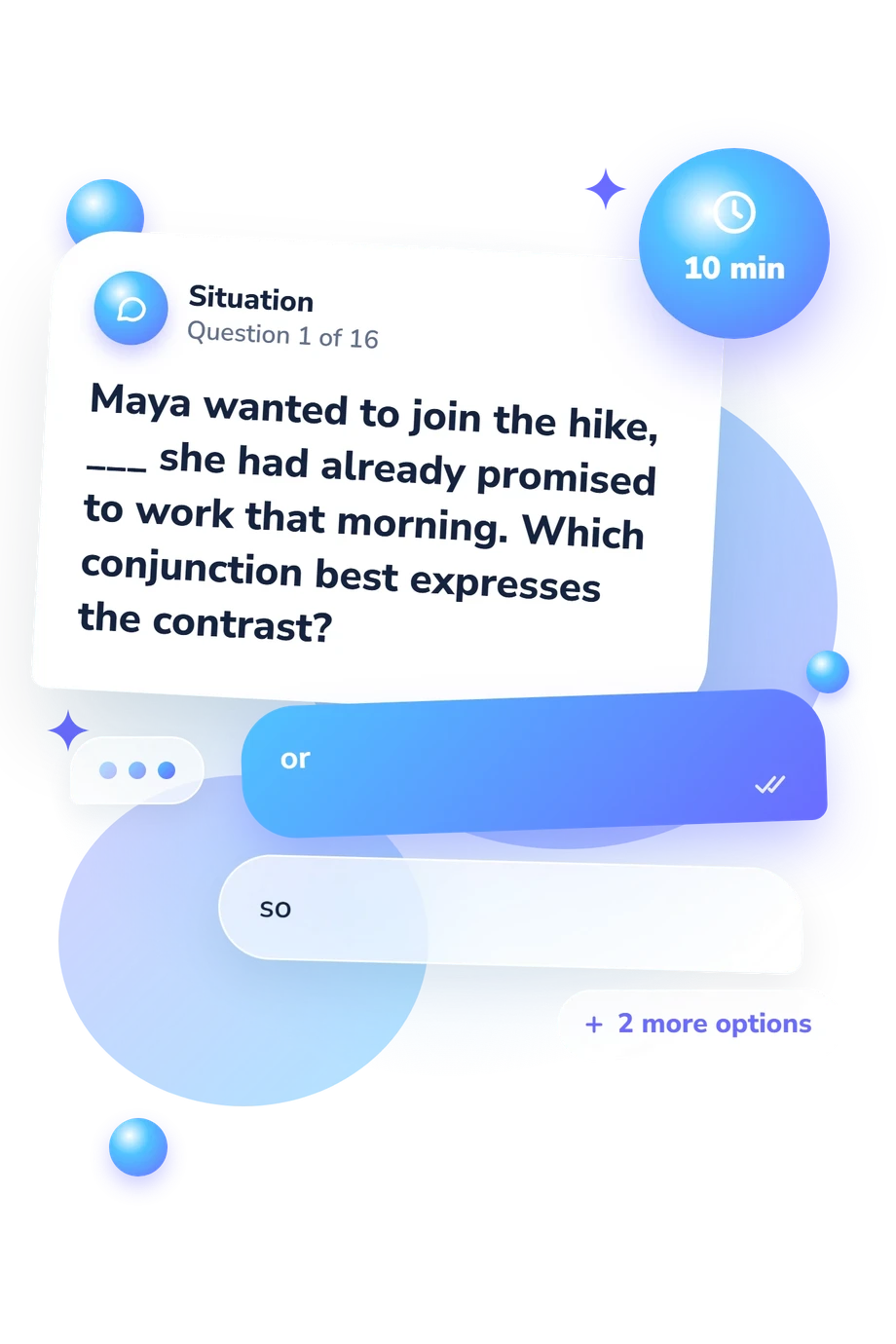
Example Questions From the Test
- or
- so
- for
- but
- Yet
- Because
- Although
- However
- The trail was steep yet manageable for the hikers.
- Although the trail was steep, yet the hikers continued.
- The steep trail challenged the hikers yet did not stop them.
- The trail was steep, yet the hikers continued.
Conjunctions Quiz - Description and methodology of the test
Readers who want to strengthen sentence construction can use this conjunctions quiz to examine how they distinguish relationships between clauses and choose connectors in context. For learners, the assessment provides a focused check of conjunction knowledge before further study and can guide grammar practice with conjunctions. The result offers a focused snapshot of current knowledge, showing where performance is stronger and where targeted review may be useful.
What This Assessment Explores
The questions focus on whether you can match conjunctions to relationships between ideas and recognize or select correctly formed sentences and clause combinations. They cover contrast, reason, condition, purpose, alternatives, clause boundaries, punctuation, subject-verb agreement, and parallel structure.
The result reflects these areas:
- Coordinating conjunctions show whether you can connect units of equal status and express relationships such as contrast or reason.
- Subordinating conjunctions show whether you can introduce dependent clauses for time, cause, condition, or concession.
- Correlative conjunctions show whether paired forms are matched and followed by parallel wording.
- Clause structure and punctuation show whether you can combine complete and dependent clauses in standard sentences.
This assessment suits learners and adults reviewing practical English grammar. It works as a conjunction practice quiz, giving that review a structured focus. Its Conjunctions Knowledge score spans 0-16: Foundations (0-6), Developing (7-12), and Strong (13-16).
Methodology and Evidence Base
Each item uses a multiple-choice format: a sentence or short grammar question is followed by alternatives, and you select the option that best fits standard English. The set combines recognition with application, including classification, clause completion, sentence completeness, punctuation, and agreement.
The result condenses these choices into a score across the displayed bands. It describes performance on the tested forms rather than a population percentile or complete writing ability. This English conjunctions test can help identify topics for review, although the outcome may also reflect familiarity with the examples and attention on the day.
Its framework is conceptually consistent with Huddleston and Pullum (2002), particularly their distinctions among coordination, subordination, and clause structure. Peters (2004) supplies usage-focused context for punctuation and conventional written English. The books provide conceptual grammatical references, while the cited sources do not establish validation, norms, or standardized administration for this questionnaire.
Interpret the result specifically: a stronger band indicates more successful decisions in this set, while a lower band highlights areas for practice. Because the items sample selected constructions, the score does not establish general proficiency, fluency, or mastery of every conjunction pattern.
- Huddleston, Rodney, and Geoffrey K. Pullum. The Cambridge Grammar of the English Language. Cambridge University Press, 2002. 10.1017/9781316423530
- Peters, Pam. The Cambridge Guide to English Usage. Cambridge University Press, 2004. 10.1017/CBO9780511487040
Updated: