
Hip Hop Quiz
How the Scales are Structured
Who Usually Takes This Test?
See How You Compare
Below is a preview of how scores are typically distributed across each scale.
Example Questions From the Test
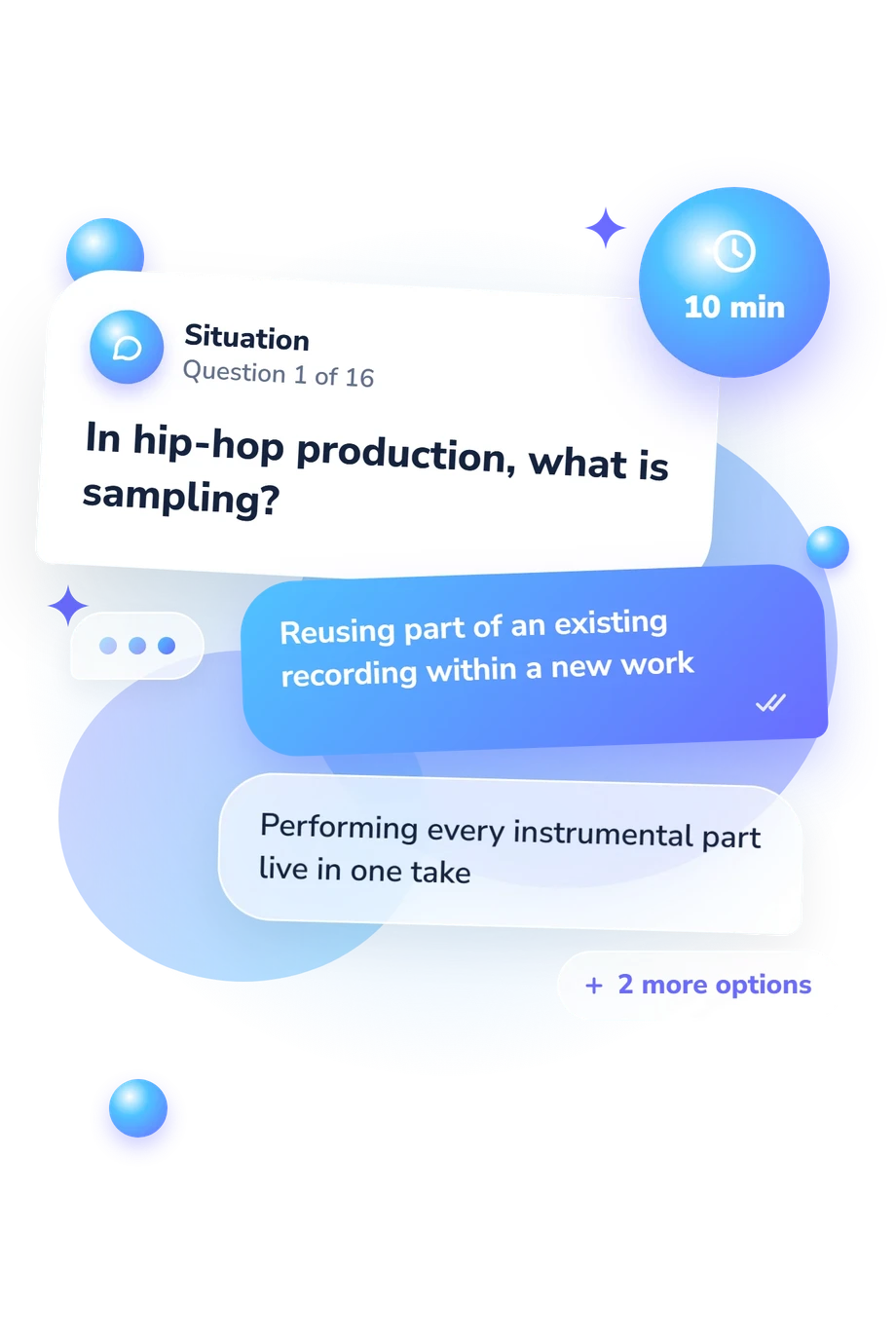
- Reusing part of an existing recording within a new work
- Performing every instrumental part live in one take
- Removing all percussion from a finished track
- Speeding up a complete song without editing it
- Staten Island
- Brooklyn
- Queens
- The Bronx
- The Rolling Stones
- Public Image Ltd
- Aerosmith
- Guns N’ Roses
Hip Hop Quiz - Description and methodology of the test
For readers who want to check their grasp of hip-hop culture, hip hop quiz questions provide a structured way to review major ideas without requiring performance experience. The assessment suits anyone using a hip hop knowledge test to connect history, techniques, artists, regional scenes, and cultural vocabulary. Its result offers a focused picture of familiarity and suggests where further listening or study may be rewarding.
What This Assessment Explores
The questions span hip-hop’s Bronx emergence, later styles, notable albums and artists, regional scenes, and social themes. They check sampling, breakbeat extension, beatmatching, scratching, beatboxing, MCing, cipher culture, graffiti, and lyrical focus. Brief scenarios test recognition of techniques and cultural references rather than musical performance.
One combined outcome is shown rather than separate scores. Hip Hop Knowledge (0-16) summarizes performance across the full quiz:
- Foundations (0-6) shows recognition of core ideas, with room to explore origins, vocabulary, and landmarks.
- Growing Knowledge (7-12) shows a useful grasp of the culture and links between terms and examples.
- Strong Knowledge (13-16) shows broad command of history, techniques, and influential moments.
Taken together, a hip hop trivia quiz result can guide curiosity: lower bands point to topics to revisit, while higher bands reflect wider familiarity.
Methodology and Evidence Base
Each item offers four answer choices and asks for the best response. Direct knowledge checks sit beside brief situations requiring a term, technique, regional association, or lyrical category. Together, the questions and answers about hip hop measure recognition and cultural knowledge, not rapping, DJing, dancing, production, or originality.
Correct responses combine into one displayed total, without separate feedback for eras, skills, or themes. The result describes performance across the questionnaire rather than a detailed profile of hip-hop knowledge.
Ewoodzie (2017) is the closest historical reference for the Bronx setting, early party practices, and breakbeat culture represented by several items. Forman and Neal (2004) and Williams (2015) add scholarly context for hip-hop’s elements, regional histories, artists, and meanings. The questionnaire is conceptually consistent with these works, but is not presented as an adaptation of them.
As an online self-report knowledge check, results may reflect prior listening, classroom exposure, guessing, and familiarity with culturally specific clues. Its bands are quiz-specific, not population norms, so the outcome is best used to guide further exploration.
- Ewoodzie, Joseph C., Jr. (2017). Break Beats in the Bronx: Rediscovering Hip-Hop's Early Years. Chapel Hill: University of North Carolina Press. 10.5149/northcarolina/9781469632759.001.0001.
- Forman, Murray, and Mark Anthony Neal, eds. (2004). That's the Joint!: The Hip-Hop Studies Reader. New York: Routledge.
- Williams, Justin A., ed. (2015). The Cambridge Companion to Hip-Hop. Cambridge: Cambridge University Press. 10.1017/CCO9781139775298.
Updated: