
Days of the Week in Spanish Quiz
How the Scales are Structured
Who Usually Takes This Test?
See How You Compare
Below is a preview of how scores are typically distributed across each scale.
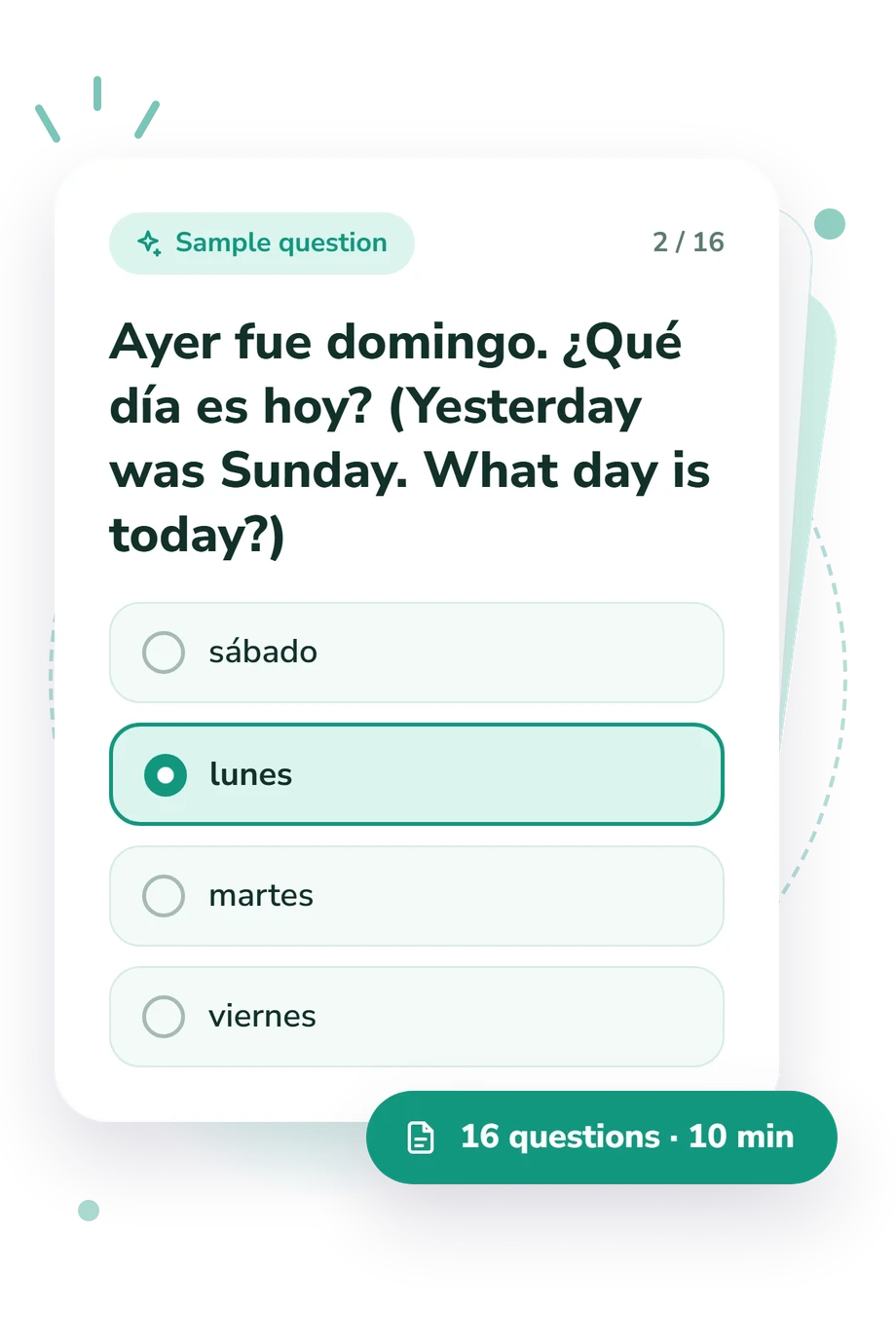
Example Questions From the Test
- lunes
- domingo
- jueves
- miércoles
- sábado
- lunes
- martes
- viernes
- miércoles
- viernes
- sábado
- martes
Days of the Week in Spanish Quiz - Description and methodology of the test
Designed for learners checking practical calendar vocabulary, this assessment shows how confidently they recognize Spanish day names and use them in short scheduling situations. The days of the week in spanish quiz suits beginners, refreshers, and anyone reviewing everyday dates and plans. Spanish weekday vocabulary practice keeps the focus on recognition, order, and expressions that support real scheduling.
What This Assessment Explores
The questions examine connected abilities rather than isolated translation. They ask you to identify day names, follow the calendar forward or backward, and solve relations such as mañana, pasado mañana, and anteayer. Other items test articles and prepositions used for one day, recurring days, or a Monday-to-Friday span. As a Spanish days of the week quiz, it links vocabulary recognition with practical scheduling choices.
The result uses one educational scale, Spanish Days of the Week Knowledge (0-16). Its bands describe the kind of review most useful after completion:
- Foundations to build (0-6) indicates that day names, order, and common translations need review.
- Developing knowledge (7-12) shows recognition of many patterns, while scheduling phrases, articles, and sequences may still require practice.
- Strong command (13-16) indicates reliable knowledge of day names in common calendar contexts.
These labels describe this focused topic, not speaking, listening, or overall Spanish proficiency.
Methodology and Evidence Base
Each item presents a prompt and four answer choices. The format combines direct word recognition with calendar problems: identifying the day before or after another, completing a sequence, or selecting expressions such as el lunes, los martes, and de lunes a viernes. It therefore checks both recall and application of familiar forms.
These conventions are consistent with Butt, Benjamin, and Moreira Rodríguez (2019), which provides a reference point for modern Spanish usage. The questionnaire is conceptually consistent with that work, not an adaptation of it. Guidance from Spanish language academies also supports the spelling, capitalization, articles, and day expressions represented in the choices.
Scoring condenses the selected responses into the single educational result described above. The score is educational rather than a standardized measure of general Spanish proficiency. Spanish days of the week practice can help target weak areas before real scheduling tasks, but recognition in four-choice items does not demonstrate spontaneous writing, speaking, or listening. Performance may also shift with recent study, wording familiarity, or momentary attention.
- Butt, John B., Carmen Benjamin, and Antonia Moreira Rodríguez. A New Reference Grammar of Modern Spanish. 6th ed. Routledge, 2019. 10.4324/9781315648446.
- Royal Spanish Academy and Association of Academies of the Spanish Language. Basic Orthography of the Spanish Language. Madrid: Espasa, 2012. ISBN 9788467005004.
- Royal Spanish Academy and Association of Academies of the Spanish Language. Basic New Grammar of the Spanish Language. Madrid: Espasa, 2011. ISBN 9788467034714.
Updated: