
Who Is Your Valentine Quiz
How the Scales are Structured
Who Usually Takes This Test?
See How You Compare
Below is a preview of how scores are typically distributed across each scale.
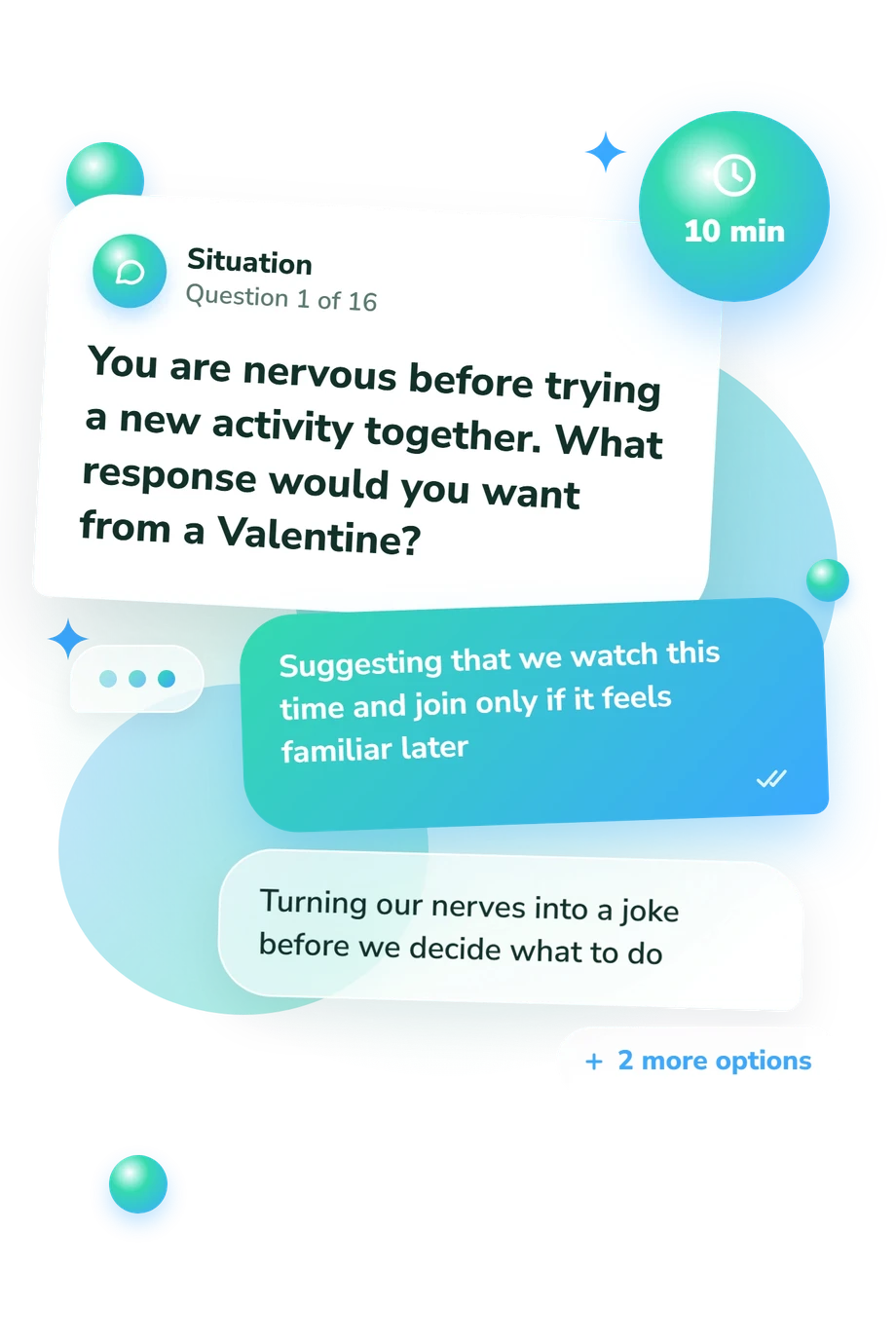
Example Questions From the Test
- Leave early for an unfamiliar town and choose stops along the way
- Stay home with favorite food and a comfortable shared routine
- Try a class or activity nearby that neither of us has done
- Settle into a café for an unhurried, meaningful conversation
- A handmade letter filled with specific shared memories
- A cozy kit for starting a new tradition at home
- A flexible day-trip plan with several possible destinations
- Two tickets for an experience neither of us has tried before
- Questions that help me uncover my values and mixed feelings
- A practical plan with clear steps I can rely on
- Humor that gives me a break from taking the choice so seriously
- An invitation to test one option through a new experience
Who Is Your Valentine Quiz - Description and methodology of the test
People who want to understand what kind of romantic connection feels appealing can use this quiz about romantic attraction to organize their preferences. The Who Is Your Valentine Quiz is designed for anyone curious about the qualities they notice in a potential partner, from novelty and humor to reliability and emotional depth. It offers a comparative result that highlights the strongest affinity or a blended pattern.
What This Assessment Explores
Rather than predicting a person, this valentine personality quiz maps the qualities that make a Valentine attractive to you. It treats compatibility as a pattern of preferences involving exploration, humor, dependable care, or emotionally attentive conversation. It compares the qualities you find appealing in a partner, showing which preferences stand out and which overlap.
The four result dimensions are:
- Adventurous Co-Pilot (0-12) shows how strongly novelty, exploration, flexible plans, and shared excitement appeal to you.
- Playful Spark (0-12) shows how strongly humor, banter, creative fun, and lively energy appeal to you.
- Steady Sweetheart (0-12) shows how strongly consistency, calm support, familiar rituals, and practical care appeal to you.
- Thoughtful Confidant (0-12) shows how strongly emotional attentiveness, meaningful conversation, vulnerability, and sentimental detail appeal to you.
Across all four profiles, the result bands are Light affinity (0-4), Compatible element (5-8), and Strong affinity (9-12).
Methodology and Evidence Base
The assessment presents everyday romantic situations such as trying an unfamiliar activity, handling disagreement, choosing a gift, or offering support to measure preferred partner qualities. Each question offers four response options, and the respondent selects the reaction or gesture that feels most appealing. The questionnaire does not state a point value for each option, so the displayed ranges should not be used to infer one.
Results are comparative: the highest profile score marks the strongest affinity, while scores within one point suggest a blend. This helps readers notice overlapping preferences rather than force themselves into one type.
The evidence base is conceptual. Driebe and colleagues’ 2024 study examines how partner ideals remain stable or change. Fletcher et al. (1999) offers a framework for studying ideals in intimate relationships, and Tartakovsky (2023) reviews motivations and mate preferences. The questionnaire is conceptually consistent with these works, not a direct adaptation or standardized administration of them.
Self-report answers can shift with mood, recent experiences, and self-awareness, so the profile is best read as a snapshot of current attraction preferences.
- Driebe, Julie C., Stern, Julia, Penke, Lars, and Gerlach, Tanja M. (2024). Stability and Change of Individual Differences in Ideal Partner Preferences Over 13 Years. Personality and Social Psychology Bulletin, 50(8), 1263-1279. 10.1177/01461672231164757
- Fletcher, Garth J. O., Simpson, Jeffry A., Thomas, Geoff, and Giles, Laura (1999). Ideals in intimate relationships. Journal of Personality and Social Psychology, 76(1), 72-89. 10.1037/0022-3514.76.1.72
- Tartakovsky, Eugene (2023). The psychology of romantic relationships: motivations and mate preferences. Frontiers in Psychology, 14, 1273607. 10.3389/fpsyg.2023.1273607
Updated: