
What Is the Best Song for Me to Sing Quiz
How the Scales are Structured
Who Usually Takes This Test?
See How You Compare
Below is a preview of how scores are typically distributed across each scale.
Example Questions From the Test
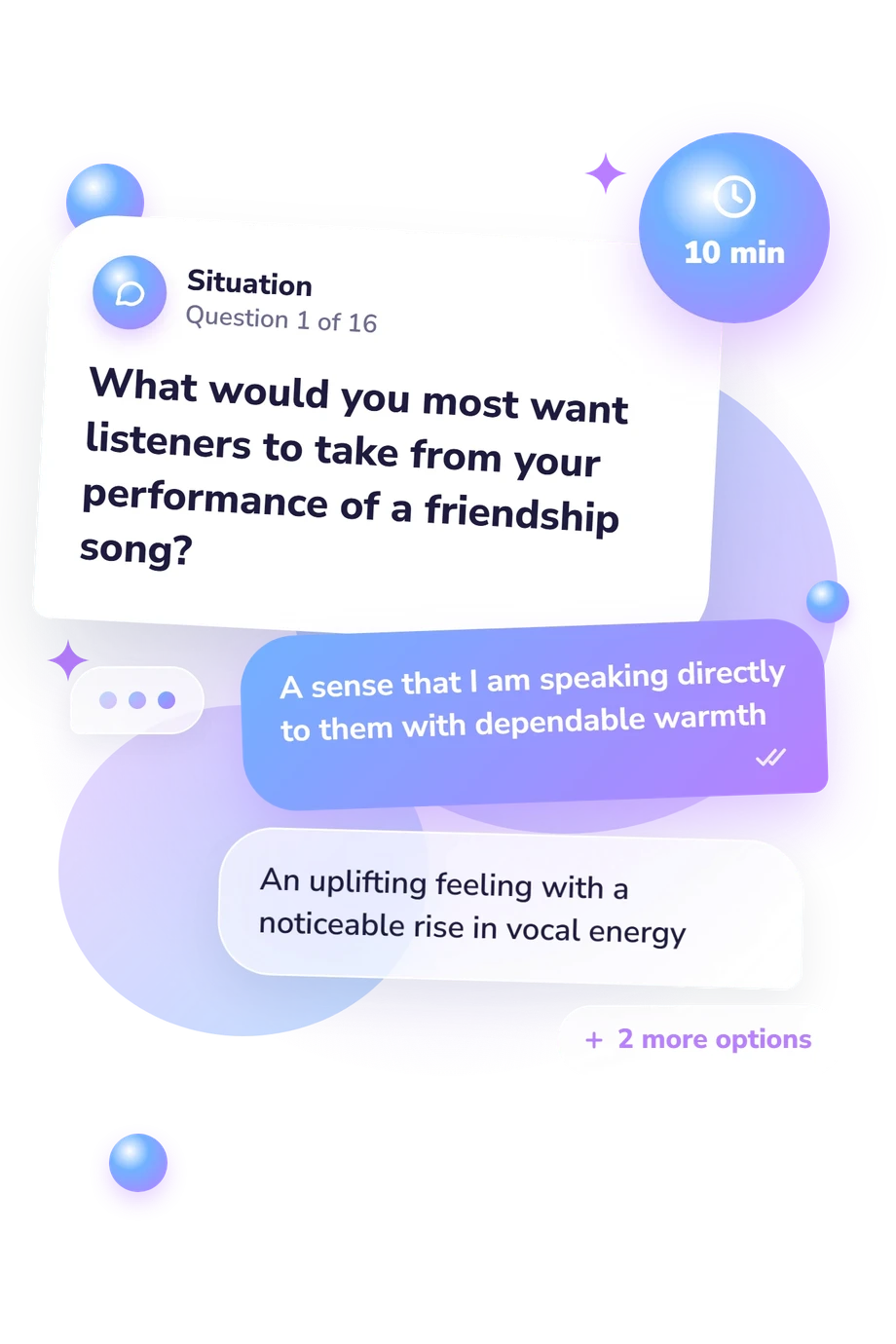
- A sense that I am speaking directly to them with dependable warmth
- An uplifting feeling with a noticeable rise in vocal energy
- A catchy, polished moment that keeps the room moving
- A more complicated or intense emotional experience than reassurance alone
- It is exactly the kind of controlled build I enjoy shaping
- It could suit me after breath-planning and adjustment to the key
- I would rather use shorter, punchier phrases over a stronger groove
- I can sustain the notes, but subtle emotional control is not my main strength
- I prefer to sing repeated lines almost identically so the melody stays central
- I might change the volume, but I rarely alter the phrasing
- I enjoy a few tasteful changes once the basic version is secure
- Small rhythmic turns and shifts in attitude are a major part of my delivery
What Is the Best Song for Me to Sing Quiz - Description and methodology of the test
Singers who want to understand their performance instincts can use this assessment to compare intimacy, confidence, emotional exposure, and rhythmic play. The What Is the Best Song for Me to Sing Quiz organizes those preferences into four song-specific affinities rather than judging vocal skill. It also turns the what song should i sing quiz question into a clearer picture of the musical situations in which your delivery may feel most natural.
What This Assessment Explores
Rather than estimating vocal range or technique, the assessment compares affinity with four specific songs or arrangements and the performance demands they represent. Questions probe warmth, emotional exposure, dynamic growth, rhythmic freedom, projection, and audience connection. It clarifies which song may be the best song to sing for your style.
The displayed scales describe these possible affinities:
- “Count on Me” - Warm Acoustic Pop: 0-12; reflects warmth and supportive storytelling; Different direction 0-4, Possible fit 5-8, Strong affinity 9-12.
- “Roar” - Bold Pop Anthem: 0-12; reflects direct confidence and rising energy; Different direction 0-4, Possible fit 5-8, Strong affinity 9-12.
- “Someone Like You” - Emotional Piano Ballad: 0-12; reflects exposed singing and controlled intensity; Different Direction 0-4, Possible Fit 5-8, Strong Affinity 9-12.
- “Valerie” - Groove-Led Retro Soul: 0-12; reflects rhythmic play and audience rapport; Different direction 0-4, Possible fit 5-8, Strong affinity 9-12.
Methodology and Evidence Base
Each item presents a performance situation and four response options. Choices cover acoustic intimacy, bold projection, emotional restraint, rhythmic play, clear phrasing, and audience engagement. As a song choice quiz, it uses structured self-report rather than testing pitch accuracy.
Responses become four affinity scores. The highest is the strongest match; any score within one point creates a blended profile. Because this is a preference comparison, key, arrangement, rehearsal, and familiarity still affect comfort.
Mustaine et al. (2018) is the closest supporting study because it examines factors in selecting music to sing. The questionnaire is conceptually consistent with that work, while Bruder et al. (2024) supports perceptual qualities in singing-voice preferences and Juslin and Laukka (2003) explain emotional communication in vocal performance. These sources do not make it a direct adaptation or revalidation of their measures.
Scores are guidance for repertoire exploration. Self-report can shift with mood, training, recent listening, and self-perception. The questionnaire provides score bands but no documented population norms for interpreting individual differences; the scores describe preference rather than singing ability.
- Mustaine, M., Ibrahim, K. M., Gupta, C., & Wang, Y. (2018). Empirically weighing the importance of decision factors when selecting music to sing. In Proceedings of the 19th International Society for Music Information Retrieval Conference (ISMIR 2018), 529-536. Paris, France.
- Bruder, C., Poeppel, D., & Larrouy-Maestri, P. (2024). Perceptual (but not acoustic) features predict singing voice preferences. Scientific Reports, 14(1), 8977. 10.1038/s41598-024-58924-9
- Juslin, P. N., & Laukka, P. (2003). Communication of emotions in vocal expression and music performance: Different channels, same code? Psychological Bulletin, 129(5), 770-814. 10.1037/0033-2909.129.5.770
Updated: