
Ordinary Quiz
How the Scales are Structured
Who Usually Takes This Test?
See How You Compare
Below is a preview of how scores are typically distributed across each scale.
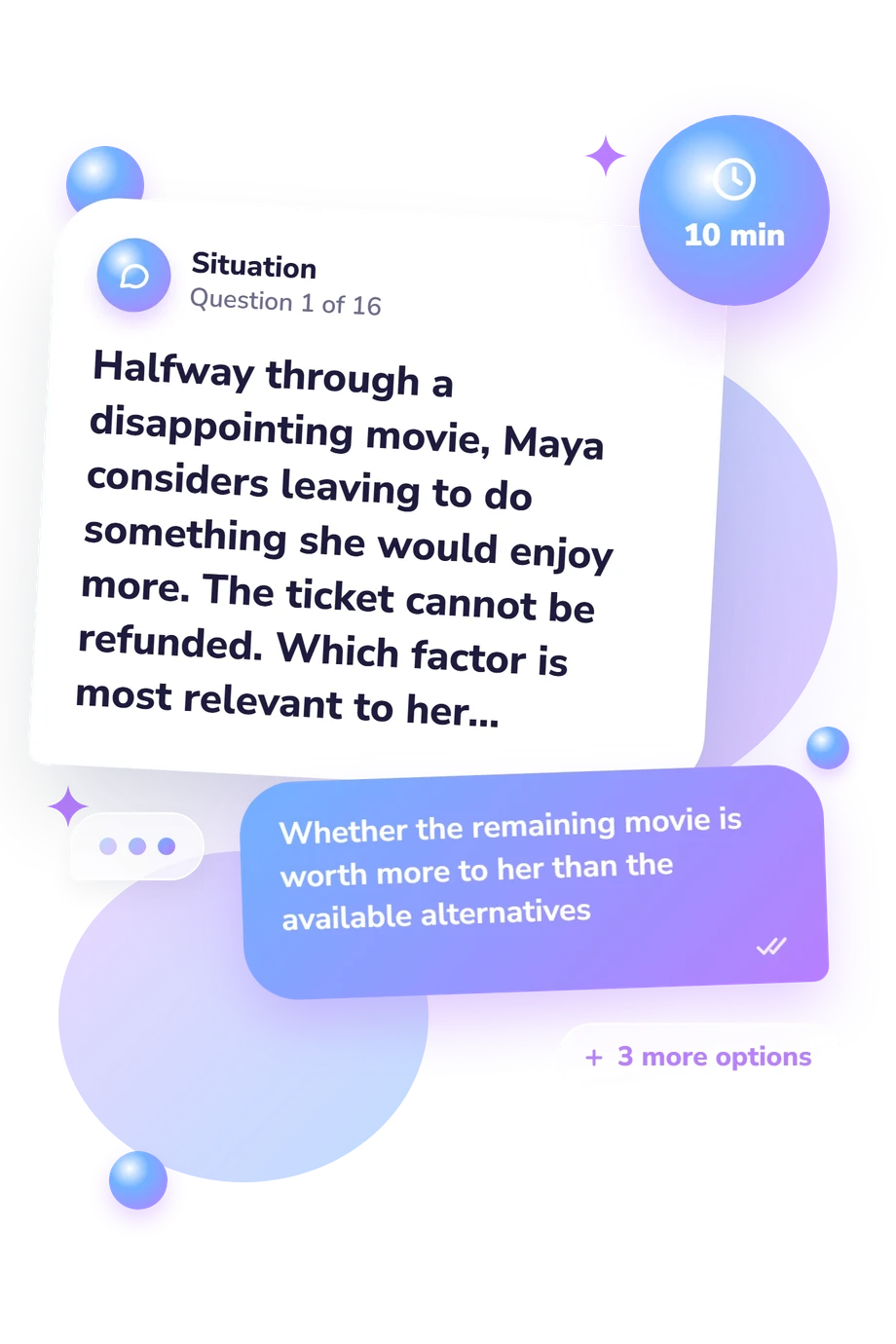
Example Questions From the Test
- A 750 g package for $6.00
- A 1 kg package for $7.50
- A 500 g package for $4.25
- A 2 kg package for $16.40
- How long the company has used its current logo
- How many people follow the company on social media
- Whether the service offers a more expensive plan
- The renewal date, future price, and cancellation method
- $62
- $68
- $66
- $72
Ordinary Quiz - Description and methodology of the test
For readers who want to make sense of routine purchases, bills, subscriptions, and online safety, this assessment offers a focused way to examine consumer decision-making. The Ordinary Quiz provides a structured review. It suits people reviewing how they weigh alternatives, check terms, compare costs, and protect personal information before acting. The result places overall performance in the stated knowledge band.
What This Assessment Explores
This questionnaire examines applied consumer knowledge. Its scenarios ask respondents to compare alternatives, calculate value, recognize borrowing costs, distinguish protections, and respond safely to fraud or misleading claims. As a consumer knowledge quiz, it suits anyone reviewing everyday decisions.
The questions cover three connected areas:
- Decision value and opportunity cost show whether the respondent considers the next-best alternative instead of money already spent.
- Prices, discounts, tax, and ownership costs show how well someone compares the full value of a purchase.
- Borrowing, contracts, security, insurance, and claims show whether key terms are checked before money or information is committed.
The Everyday Consumer Knowledge scale is 0-16: Foundations to build (0-6) marks topics to review, Developing knowledge (7-12) reflects partial command, and Strong knowledge (13-16) reflects accurate application in realistic situations. The result reflects quiz knowledge, not financial or legal advice.
Methodology and Evidence Base
Each item presents a brief consumer situation with four answer choices. Selecting the best option tests recognition and application of concepts rather than personal opinion. The set includes calculations, definitions, comparisons, and verification decisions, so the result reflects several practical skills instead of one narrow habit.
The questionnaire presents one score on the displayed scale, and its bands describe performance on the included items. That score summarizes the included tasks rather than every aspect of financial capability.
The PISA 2022 Financial Literacy Framework offers conceptual context for questions about knowledge and skills used in financial situations, including some financial literacy questions. OECD/INFE measurement guidance and Lusardi and Mitchell's 2014 review likewise provide context for connecting knowledge with decisions; these sources do not validate or establish authorship of the online questionnaire, and they do not make it a standardized adaptation of any one published instrument. Read the result as an educational self-check: performance may shift with attention, wording, prior experience, and current circumstances, and the short format covers only selected aspects of consumer and financial capability.
- OECD (2023), PISA 2022 Assessment and Analytical Framework, PISA, OECD Publishing, Paris, 10.1787/dfe0bf9c-en
- OECD (2026), OECD/INFE Toolkit for Measuring Financial Literacy, Inclusion and Well-Being 2026, OECD Publishing, Paris, 10.1787/92f2d439-en
- Lusardi, Annamaria, and Olivia S. Mitchell (2014), "The Economic Importance of Financial Literacy: Theory and Evidence," Journal of Economic Literature, 52(1), 5-44, 10.1257/jel.52.1.5
Updated: