
Tree Quiz
How the Scales are Structured
Who Usually Takes This Test?
See How You Compare
Below is a preview of how scores are typically distributed across each scale.
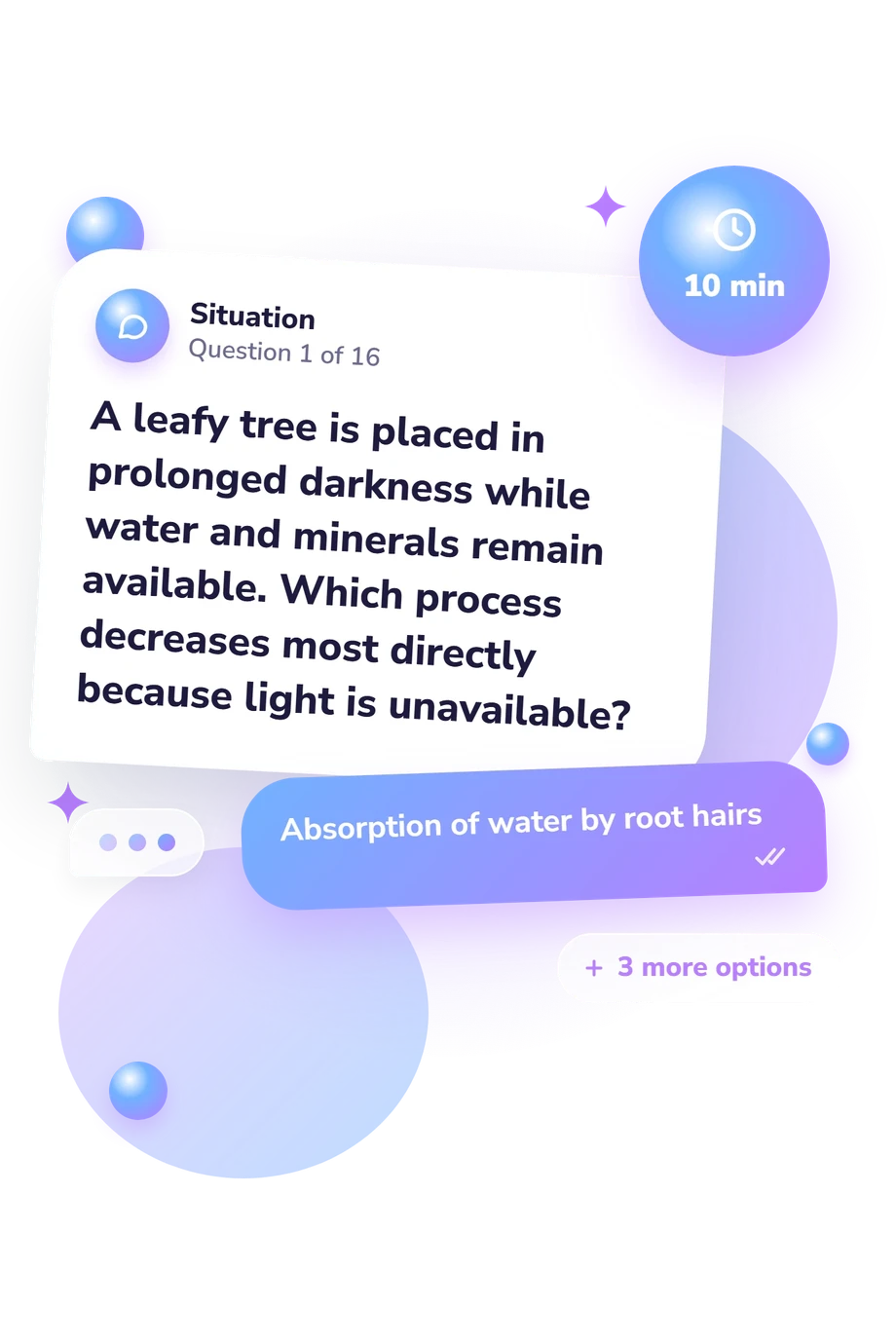
Example Questions From the Test
- Cool, humid, and still conditions
- Cool, dry, and still conditions
- Warm, dry, and breezy conditions
- Warm, humid, and still conditions
- Flowers and seeds
- Improved access to water and mineral nutrients
- A replacement for all root tissue
- Permanent protection from every pathogen
- Flush with the trunk, removing the swollen branch collar
- Just outside the branch collar without cutting into it
- Far out on the branch, leaving a long stub
- Through the trunk immediately below the branch
Tree Quiz - Description and methodology of the test
People who want a practical introduction to trees can use this assessment to connect classroom concepts with observations in gardens, parks, and streets. The tree quiz checks whether you can explain common biological processes, recognize identification clues, and identify sound care principles in described situations. Its result can guide review of botanical terms and identification concepts, with tree identification quiz items forming only one part of the broader assessment.
What This Assessment Explores
The questions suit curious learners, gardeners, students, and anyone building a foundation in trees. They connect tree function with identification clues, care decisions, seasonal responses, and relationships with other organisms. As a tree biology assessment, this questionnaire is best read as a snapshot of current knowledge, not a fixed ability.
The Tree Knowledge scale runs from 0-16. Foundations to build (0-6) reflects basic concepts that may need review; Developing knowledge (7-12) reflects understanding of many essentials with some gaps; Strong knowledge (13-16) reflects a well-rounded command of tree biology, care, identification, and ecology.
The questions group into four connected areas:
- Biology explains how tissues, water movement, and growth support tree function.
- Identification shows how leaves, buds, bark, cones, and rings provide clues.
- Care examines planting conditions, pruning, water relations, and mature size.
- Ecology considers fungi, lichens, insects, and tree-habitat relationships.
Methodology and Scientific Basis
Each item presents a tree-related situation followed by four answer choices, so the task is to select the best explanation rather than rate a personal feeling. This is a content-based multiple-choice assessment. The set combines mechanism questions, structural clues, management decisions, and ecological relationships; together, the responses produce a single combined result. No separate weighting system is stated.
Botanically and arboriculturally, the content is conceptually consistent with Hirons and Thomas (2018) and Harris et al. (2004), especially on tree function, pruning, planting conditions, and management. Brundrett and Tedersoo (2018) supplies context for mycorrhizal partnerships, while Tallamy (2004) supports the treatment of native trees and insect relationships. The questionnaire is a four-choice tree-knowledge assessment, with tree id quiz elements limited to identification-related questions; it is not presented as a direct adaptation or validation of these publications.
Interpret the score descriptively: it can show secure concepts and suggest useful study topics. The questionnaire has no stated population norms, reliability estimate, or independent validation, so performance may vary with prior learning, attention, and current context.
- Hirons, Andrew D., and Peter A. Thomas. Applied Tree Biology. John Wiley & Sons Ltd., 2018. 10.1002/9781118296387
- Harris, Richard W., James R. Clark, and Nelda P. Matheny. Arboriculture: Integrated Management of Landscape Trees, Shrubs, and Vines. 4th ed. Prentice Hall, Upper Saddle River, NJ, 2004. ISBN 0-13-088882-6
- Brundrett, Mark C., and Leho Tedersoo. Evolutionary History of Mycorrhizal Symbioses and Global Host Plant Diversity. New Phytologist, 220(4), 1108-1115, 2018. 10.1111/nph.14976
- Tallamy, Douglas W. Do Alien Plants Reduce Insect Biomass? Conservation Biology, 18(6), 1689-1692, 2004. 10.1111/j.1523-1739.2004.00512.x
Updated: