
Which Founding Father Are You Quiz
How the Scales are Structured
Who Usually Takes This Test?
See How You Compare
Below is a preview of how scores are typically distributed across each scale.
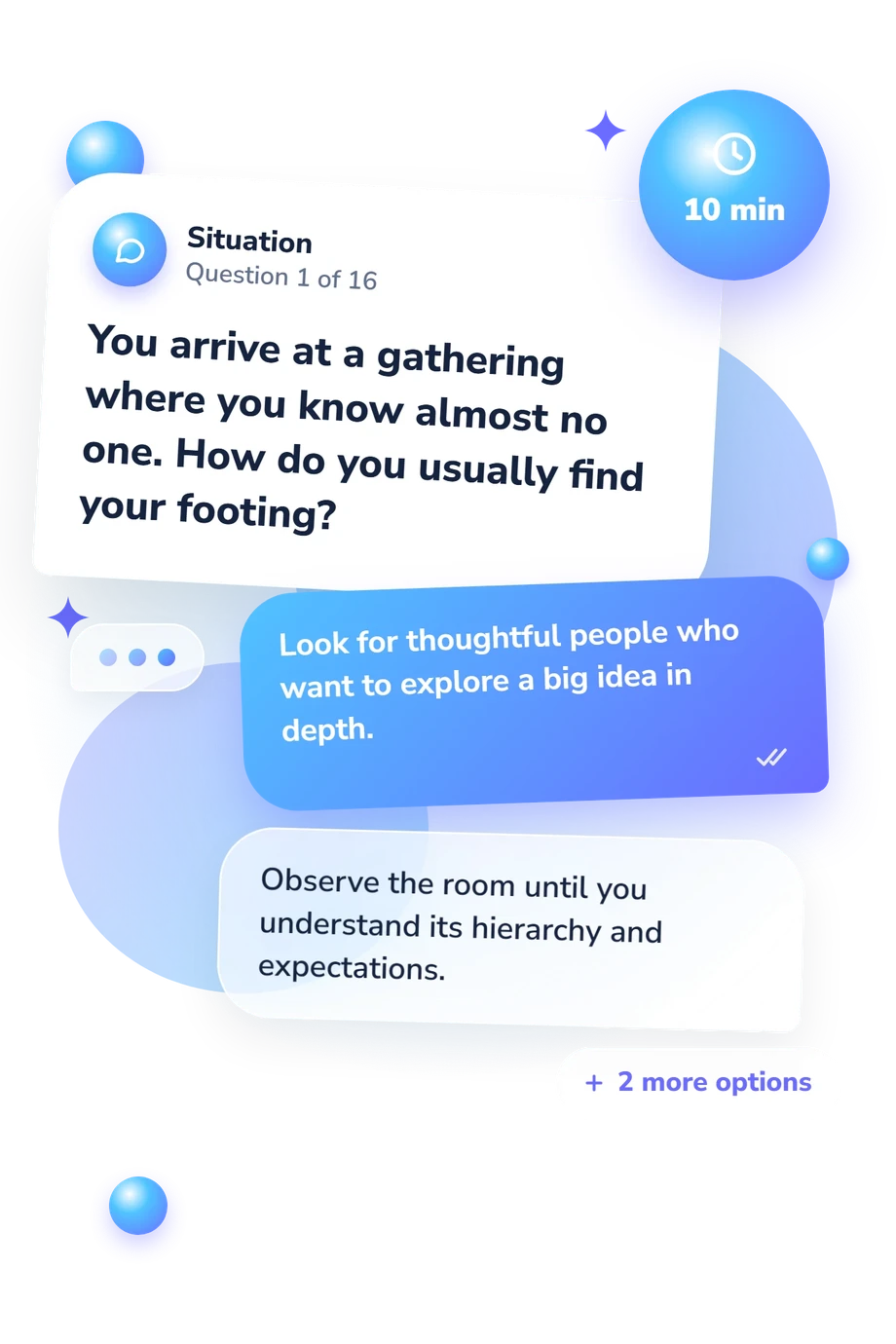
Example Questions From the Test
- Look for thoughtful people who want to explore a big idea in depth.
- Observe the room until you understand its hierarchy and expectations.
- Start light conversations, exchange useful stories, and connect people with shared interests.
- Seek out the most driven participants and discuss what they are trying to build.
- Take it on eagerly and prepare a detailed case for why the larger project matters.
- Accept only if the opportunity serves a duty others genuinely need you to fulfill.
- Explore whether a smaller experiment could achieve useful results with less conflict.
- Consider whether greater influence would compromise independence or concentrate too much power.
- Develop a durable framework that gives each side a defined role and incentive.
- Clarify the ideal at stake, even if doing so sharpens the disagreement for a while.
- Model restraint, emphasize common purpose, and prevent the coalition from breaking apart.
- Arrange informal conversations where practical cooperation can rebuild trust.
Which Founding Father Are You Quiz - Description and methodology of the test
Curious readers who want to connect early American history with personal decision-making can use the Which Founding Father Are You Quiz to explore four contrasting styles of public character. It invites reflective comparison rather than historical impersonation, while a founding father personality quiz format turns themes such as leadership, independence, experimentation, and civic duty into a personal profile.
What This Assessment Explores
Readers interested in history and personality frameworks can examine responses to influence, conflict, institutions, learning, negotiation, and leadership. Framed as a which founding father am i quiz, the result is a selective profile, not a claim that you share a figure’s complete character or conduct.
The four displayed scales are:
- Alexander Hamilton (0-12) captures ambition, persuasive advocacy, central coordination, and institution-building: Different Center (0-4), Partial Resonance (5-8), or Strong Affinity (9-12).
- Benjamin Franklin (0-12) captures experimentation, sociability, practical civic problem-solving, adaptable diplomacy, and self-directed learning: Different Center (0-4), Partial Resonance (5-8), or Strong Affinity (9-12).
- George Washington (0-12) captures steadiness, restraint, dependable leadership, unity, and responsible example: Different Center (0-4), Partial Resonance (5-8), or Strong Affinity (9-12).
- Thomas Jefferson (0-12) captures independence, ideals, local choice, reflection, and caution about concentrated authority: Different Center (0-4), Partial Resonance (5-8), or Strong Affinity (9-12).
Methodology and Evidence Base
Each item presents a social, civic, or leadership situation with four alternative responses. The options contrast organizing effort, handling disagreement, balancing authority and liberty, learning, and carrying responsibility. Selections are aggregated across the four profile scales; the result places each total within a displayed range and band, while no separate point value for each answer is stated.
The evidence base is interpretive rather than psychometric. Founding Fathers profiles (Bernstein, 2011) provides a framework for comparing selected public tendencies; Wood (2006) and Trees (2004) support viewing character as historically situated and politically expressed. Hamilton, Madison, and Jay’s constitutional arguments add context for coordination, institutional capacity, and limits on power. These are conceptual reference points, not validation studies, and no population norms or psychometric standardization are claimed.
For visitors asking what founding father am i quiz results mean, a strong band indicates repeated resonance with selected themes, while a lower band indicates a different center of preference. The profile does not endorse every action or belief associated with a figure. Self-reported answers can shift with mood, context, and self-perception, so the result is a self-reflection tool rather than a diagnostic assessment.
- Bernstein, R. B. The Founding Fathers Reconsidered. New York: Oxford University Press, 2011, 256 pp. ISBN 9780199832576. DOI 10.1093/acprof:osobl/9780199832576.001.0001.
- Wood, Gordon S. Revolutionary Characters: What Made the Founders Different. New York: Penguin Press, 2006, x + 321 pp. ISBN 9781594200939.
- Trees, Andrew S. The Founding Fathers and the Politics of Character. Princeton, NJ: Princeton University Press, 2004, xvi + 208 pp. ISBN 0691122369.
- Hamilton, Alexander, James Madison, and John Jay. The Federalist Papers. Edited by Clinton Rossiter, with an introduction and notes by Charles R. Kesler. New York: Signet Classics, 2003, 688 pp. ISBN 9780451528810.
Updated: