
Vocabulary Quiz
How the Scales are Structured
Who Usually Takes This Test?
See How You Compare
Below is a preview of how scores are typically distributed across each scale.
Example Questions From the Test
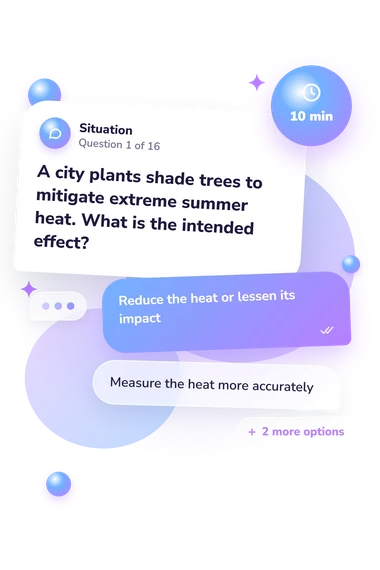
- Reduce the heat or lessen its impact
- Measure the heat more accurately
- Prevent residents from noticing the heat
- Move the heat to another location
- A focus on what would work in practice
- A preference for familiar traditions
- A refusal to compromise on any detail
- A desire to make the most impressive display
- It is based entirely on verified facts
- It is unusually difficult to understand
- It copies the plot of another story
- It seems believable even if it is invented
Vocabulary Quiz - Description and methodology of the test
For learners, writers, and curious readers deciding whether to strengthen their English vocabulary, this vocabulary quiz offers a focused way to reflect on current confidence. It can help you decide whether to spend more time building range, refining contextual precision, or simply confirming an existing comfort with unfamiliar words. In this vocab quiz, practical interpretation matters more than isolated memorization.
What This Assessment Explores
The questionnaire examines receptive vocabulary by asking you to choose a target word's meaning in a sentence. This word quiz format makes context central rather than treating definitions as isolated facts. Terms such as mitigate, pragmatic, plausible, scarce, and obsolete test contextual recognition, while complement and infer add distinctions in usage.
The items cover three aspects of word knowledge:
- Contextual recognition shows whether sentence evidence identifies the intended meaning.
- Nuance and precision show whether you distinguish close interpretations and appropriate choices.
- Inference shows whether you connect wording with an implied consequence.
Results appear under Vocabulary Knowledge (0-16): Building Foundations (0-6) reflects useful recognition needing stronger contextual understanding; Developing Range (7-12) reflects broader understanding with precision developing; Strong Command (13-16) reflects consistent recognition of nuanced meanings and appropriate choices. The resulting score describes these tasks.
Methodology and Evidence Base
Each item presents a sentence, a target word or expression, and four answer choices. You select the option that best fits the context, so the task measures applied recognition rather than free-form definition writing. This vocabulary words quiz keeps the choices tied to surrounding language and tests whether meaning can be identified through use.
The approach is conceptually consistent with Schmitt (1999), which treats vocabulary knowledge as multidimensional, and with Read (1993), who examined ways to measure vocabulary knowledge. Work by Schmitt, Schmitt, and Clapham (2001) also supports structured vocabulary-level tasks. These sources are conceptual comparators for the item style; they do not standardize or validate this online questionnaire, which is not presented as an adaptation of any one published instrument.
The total is interpreted through the displayed performance bands. Prior exposure, attention to clues, guessing, and current reading experience can influence selected answers. The result is therefore a focused snapshot of contextual word recognition, rather than a measure of vocabulary beyond sentence context.
- Schmitt, Norbert. "The relationship between TOEFL vocabulary items and meaning, association, collocation and word-class knowledge." Language Testing 16, no. 2 (1999): 189-216. 10.1177/026553229901600204
- Read, John. "The development of a new measure of L2 vocabulary knowledge." Language Testing 10, no. 3 (1993): 355-371. 10.1177/026553229301000308
- Schmitt, Norbert, Diane Schmitt, and Caroline Clapham. "Developing and exploring the behaviour of two new versions of the Vocabulary Levels Test." Language Testing 18, no. 1 (2001): 55-88. 10.1177/026553220101800103