
Types of Fractures Quiz
How the Scales are Structured
Who Usually Takes This Test?
See How You Compare
Below is a preview of how scores are typically distributed across each scale.
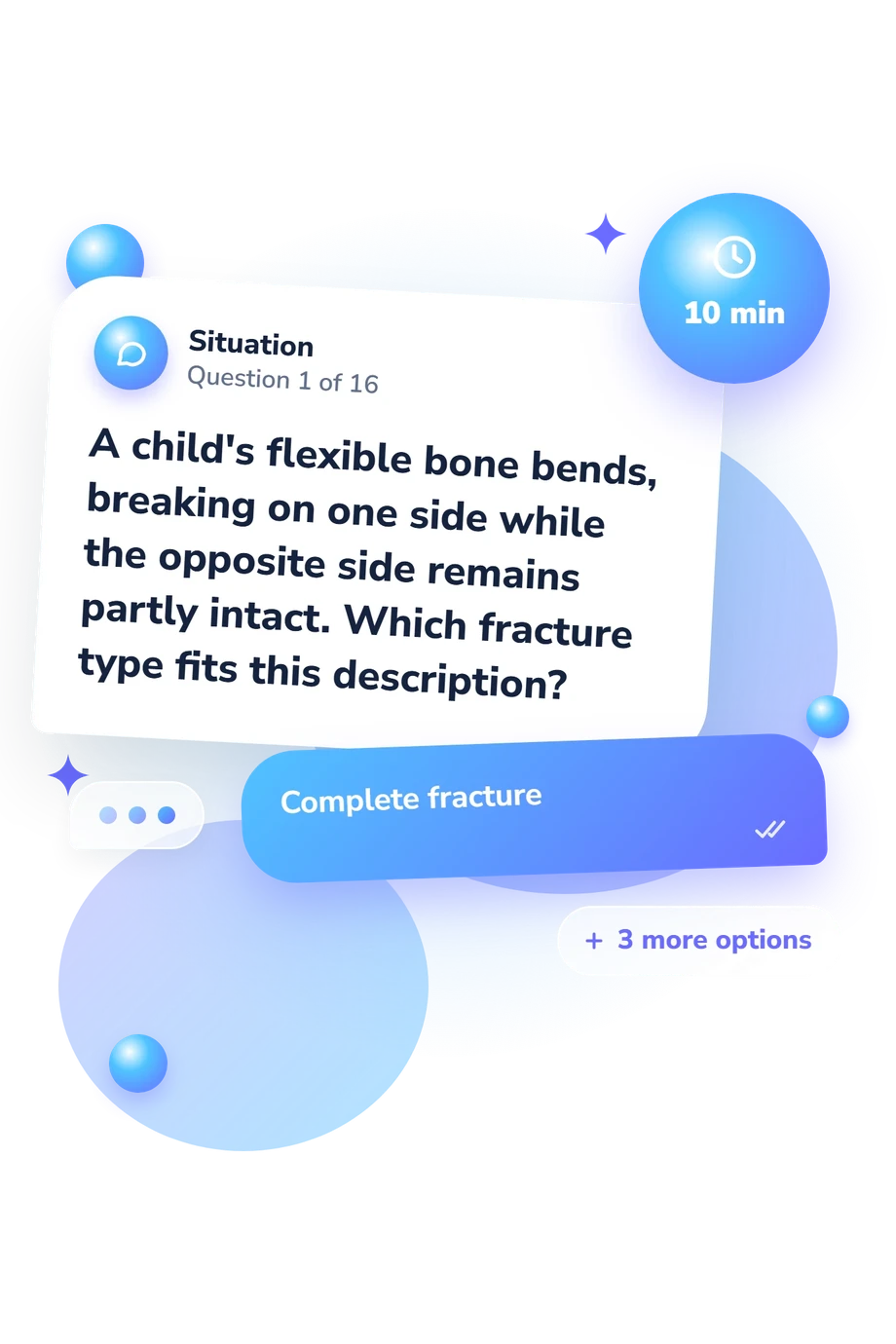
Example Questions From the Test
- Comminuted fracture
- Closed fracture
- Complete fracture
- Displaced fracture
- Displaced fracture
- Segmental fracture
- Open fracture
- Impacted fracture
- Transverse fracture
- Oblique fracture
- Spiral fracture
- Compression fracture
Types of Fractures Quiz - Description and methodology of the test
People who want to strengthen their grasp of bone injury terminology can use this types of fractures quiz as a focused self-check. Its educational focus suits learners reviewing anatomy, first-aid concepts, or introductory orthopedic material, while this bone fracture quiz helps them distinguish patterns from short clinical descriptions. The result places overall performance in an educational knowledge band, giving an indication of how securely the terminology and scenarios were recognized.
What This Assessment Explores
Fracture knowledge is tested through recognizable patterns rather than evaluation of a current injury. The content covers skin integrity, alignment, fragment number, fracture-line direction, joint involvement, and the mechanism or condition behind a break. Presented as an orthopedic fracture quiz, the task stays practical: the reader connects a short description or injury scenario with the most fitting term.
The main classification themes are:
- Skin integrity distinguishes open fractures from closed fractures.
- Alignment and fragments identify displaced, impacted, comminuted, or segmental patterns.
- Line direction separates transverse, oblique, and spiral fractures.
- Mechanism or tissue response points to avulsion, compression, stress, greenstick, buckle, or pathological patterns.
- Joint involvement indicates extension into a joint surface.
The result uses the Types of Fractures Knowledge scale (0-16): Foundations to build (0-6), Developing knowledge (7-12), or Strong knowledge (13-16). These bands describe educational terminology and scenario recognition.
Methodology and Evidence Base
Each item presents a short definition, imaging description, or mechanism followed by four answer choices. The respondent selects the term that best matches the information, so the task emphasizes classification and applied recognition rather than free-form explanation. The displayed total is interpreted through the knowledge scale and its descriptive bands, rather than a clinical cutoff.
The content is conceptually consistent with Sastry et al. (2009), which explains core fracture classifications used in surgical practice. It also aligns with Muller et al. (1990), a systematic reference for long-bone fracture terminology, while the stress-fracture examples are consistent with the framework discussed by Kaeding and Miller (2013). This online questionnaire, a fracture types quiz, is not presented as an adaptation or validation of those publications.
The displayed bands are educational descriptions rather than validated clinical cutoffs. This fracture classification quiz can support revision, but performance may vary with prior study, attention, interpretation of wording, and test-taking confidence. Its educational score cannot determine whether a current injury is fractured; suspected injuries require professional assessment, especially when severe warning signs are present.
- Sastry R, Relwani J, Purkayastha S. Principles of fracture classfication and management. In: Hospital Surgery: Foundations in Surgical Practice. Cambridge University Press; 2009:312-319. 10.1017/CBO9780511575747.056
- Muller ME, Nazarian S, Koch P, Schatzker J. The Comprehensive Classification of Fractures of Long Bones. Springer-Verlag; 1990. 10.1007/978-3-642-61261-9
- Kaeding CC, Miller T. The comprehensive description of stress fractures: a new classification system. Journal of Bone and Joint Surgery American. 2013;95(13):1214-1220. 10.2106/JBJS.L.00890
Updated: