
Trolley Problem Quiz
How the Scales are Structured
Who Usually Takes This Test?
See How You Compare
Below is a preview of how scores are typically distributed across each scale.
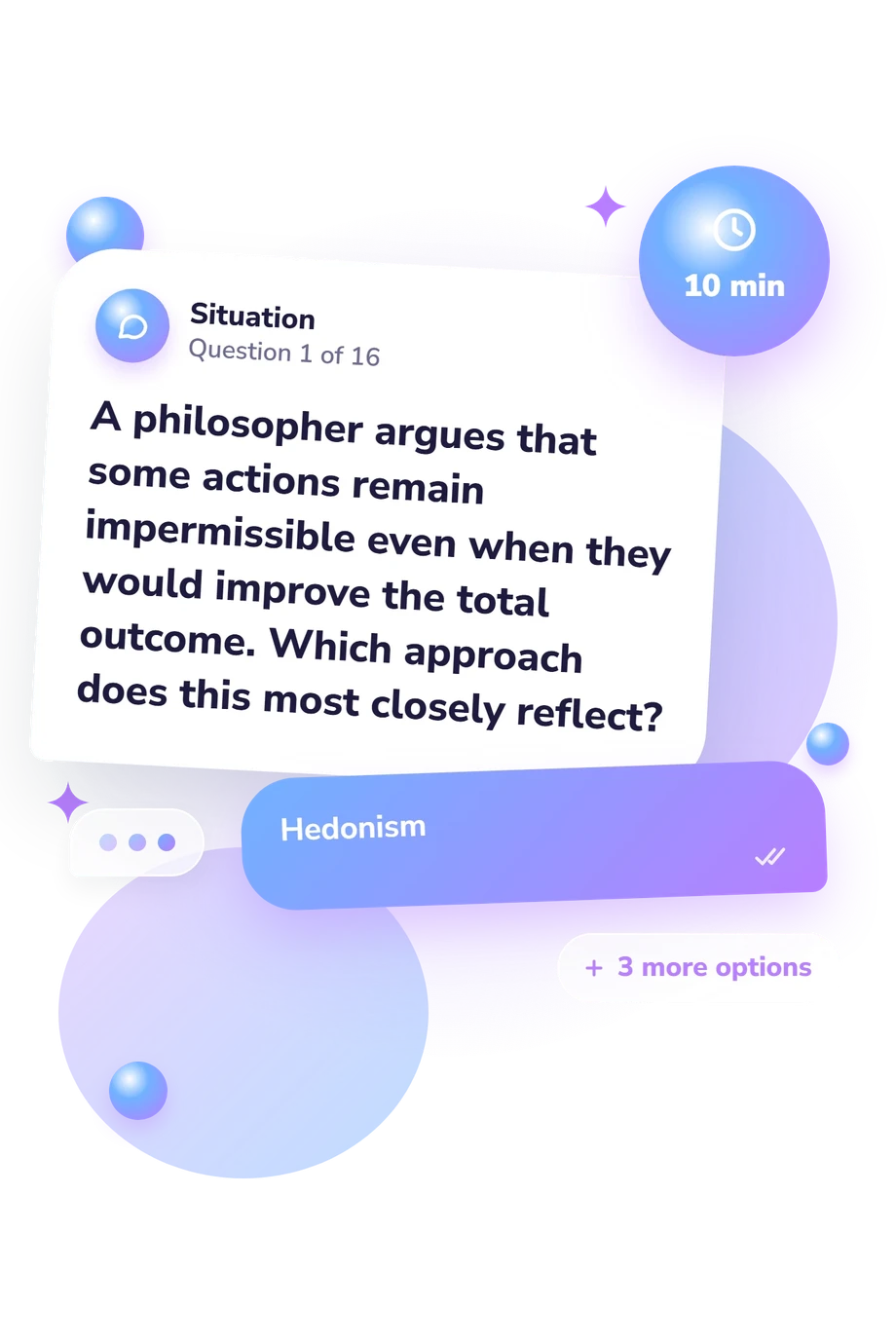
Example Questions From the Test
- Hedonism
- Descriptive relativism
- Deontological ethics
- Psychological egoism
- Uncertainty about how many people are on each track
- A choice between saving people and protecting property
- A legal duty to operate the trolley system
- The prospect of using direct personal force against a person
- Ethical egoism
- Moral particularism
- Consequentialism
- Divine command theory
Trolley Problem Quiz - Description and methodology of the test
Readers who want to examine how ethical theories handle life-and-death choices can use this assessment as a focused knowledge check. The trolley problem quiz is suited to learners, philosophy newcomers, and anyone revisiting classic thought experiments; it tests recognition of arguments and distinctions rather than personal virtue. A trolley quiz result can show which concepts you recognize and which deserve another pass.
What This Assessment Explores
Questions in this trolley ethics quiz cover switch and footbridge cases, contractualism, population ethics, moral luck, and moral status. They test framework recognition and the effects of intention, probability, and direct force.
These are the main conceptual areas reflected in the result:
- Deontological ethics shows how duties can constrain an action despite better consequences.
- Consequentialism compares options by their overall consequences.
- Double effect separates intended means from foreseen side effects.
- Moral status considers whose interests count, including future or nonhuman beings.
- Contractualist and metaethical questions examine justifiability and moral objectivity.
The result appears as Trolley Problem Knowledge, scored 0-16. Foundations to Build (0-6) signals review may help; Developing Knowledge (7-12) reflects many distinctions; Strong Knowledge (13-16) indicates a well-developed grasp of canonical variants and novel applications. It measures quiz performance, not moral character or philosophical authority.
Methodology and Evidence Base
Each item presents a case, claim, or comparison with four answer choices. The respondent selects the option that best matches the concept; the result summarizes performance on the knowledge questions. The four-choice format helps distinguish closely related ideas.
The conceptual anchor is Thomson's 1985 analysis of trolley problems, which helps explain why switch, footbridge, loop, and related variants can produce different judgments. Foot's work supplies the doctrine of double effect discussed in several items. The questionnaire is conceptually consistent with these sources, not presented as a reproduction or validated adaptation of them.
The displayed categories are learning-oriented descriptions of performance on philosophical knowledge questions. Prior exposure, wording, and familiarity with formulations can influence performance, while disputed cases may support different readings. The result therefore reflects the quiz's treatment of canonical knowledge, not a person's character, empathy, or settled moral position.
- Thomson, Judith Jarvis. “The Trolley Problem.” The Yale Law Journal 94, no. 6 (1985): 1395-1415. 10.2307/796133.
- Foot, Philippa. “The Problem of Abortion and the Doctrine of the Double Effect.” Oxford Review 5 (1967): 5-15.
- Greene, Joshua D., Brian Sommerville, Leigh Erik Nystrom, John M. Darley, and Jonathan D. Cohen. “An fMRI Investigation of Emotional Engagement in Moral Judgment.” Science 293, no. 5537 (2001): 2105-2108. 10.1126/science.1062872.
Updated: