
Buying a Car Math Quiz
How the Scales are Structured
Who Usually Takes This Test?
See How You Compare
Below is a preview of how scores are typically distributed across each scale.
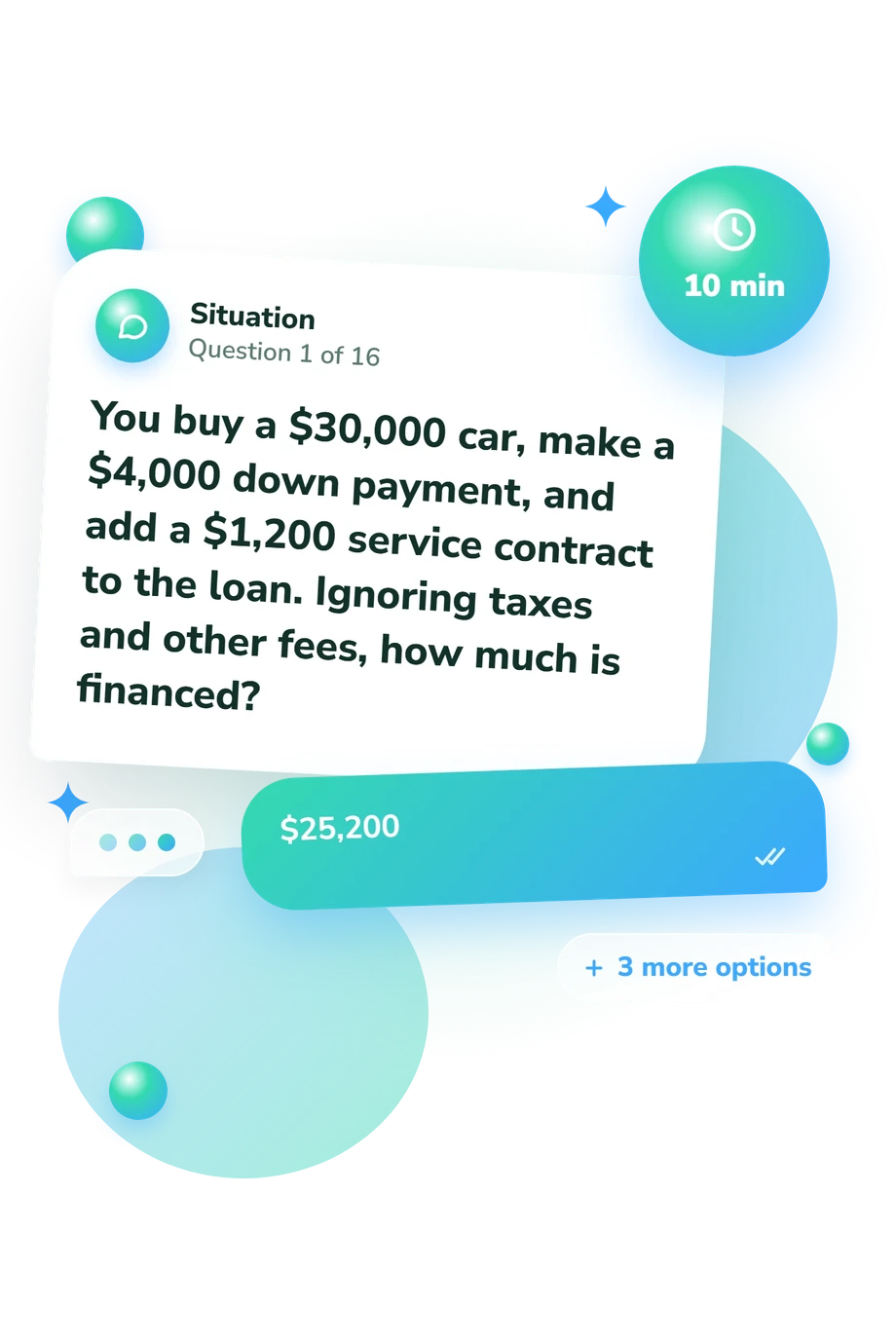
Example Questions From the Test
- A higher monthly payment and less total interest
- The same monthly payment and the same total interest
- A lower monthly payment and less total interest
- A lower monthly payment but more total interest
- $6,400
- $24,000
- $31,800
- $25,600
- The 10% discount is larger by $2,800.
- The rebate is larger by $300.
- The 10% discount is larger by $300.
- They provide equal savings.
Buying a Car Math Quiz - Description and methodology of the test
Prospective buyers and household budget planners can use the Buying a Car Math Quiz to check the calculations behind a vehicle purchase. It is also useful for readers comparing dealership offers who want a clearer view of car purchase calculations, payment limits, interest, taxes, depreciation, and ownership costs. The result shows practical knowledge rather than subjective confidence or a judgment about affordability.
What This Assessment Explores
The questionnaire tests vehicle purchase math for financing and operating a vehicle. It combines subtraction, percentages, multiplication, division, simple interest, and per-mile or monthly-cost reasoning. It shows how accurately a reader can check a budget instead of relying on a headline payment.
The Buying a Car Math Knowledge scale runs from 0 to 16 correct answers and uses three displayed bands:
- Foundational (0-6) indicates that percentages, financing terms, and total-cost calculations need review before comparing vehicles.
- Developing (7-12) indicates that everyday calculations are manageable, while multi-step costs and loan comparisons deserve careful checking.
- Strong (13-16) indicates solid command of the practical math used to compare prices, financing, and ownership expenses.
These labels describe performance on the questionnaire, not affordability in every real-world situation; actual offers may include fees, warranties, trade-in effects, or other contract terms.
Methodology and Scientific Basis
Items present short car-buying scenarios with four answer choices. They cover payment limits, financing, loan term and APR comparisons, depreciation, fuel, taxes, registration, trade-in equity, rebates, service costs, and total outlay. The score is based on correct answers, making this a knowledge check rather than a personality inventory. It emphasizes checking vehicle cost calculations instead of treating sticker price as the whole decision.
That focus is conceptually consistent with broader financial-literacy research by Ward and Lynch on responsibility for financial decisions, financial literacy, and financial outcomes. It is not that research or a validated adaptation. Research by Kim and colleagues offers an ownership-cost framework for combining operating expenses, while work by Sullivan and colleagues supports attention to add-ons, contract terms, and vehicle-purchase choices.
Because it is an online questionnaire scored by correct answers, the research does not establish norms or psychometric validation for this version; attention, arithmetic slips, and familiarity with loan language can affect performance. Results cannot establish affordability, credit eligibility, or a real contract's exact cost, so current quotes and fees require separate checking.
- Ward, Adrian F., and John G. Lynch, Jr. (2019). “On a Need-to-Know Basis: How the Distribution of Responsibility Between Couples Shapes Financial Literacy and Financial Outcomes.” Journal of Consumer Research, 45(5), 1013-1036. 10.1093/jcr/ucy037
- Kim, Daejin, Yingping Zhao, Michael O. Rodgers, and Randall Guensler (2018). “Personal Vehicle Ownership and Operating Cost Calculator.” National Center for Sustainable Transportation (UTC), Final Report.
- Sullivan, Mary W., Matthew T. Jones, and Carole L. Reynolds (2020). “The Auto Buyer Study: Lessons from In-Depth Consumer Interviews and Related Research.” Joint Staff Report of the Bureau of Economics and Bureau of Consumer Protection, Federal Trade Commission.
Updated: