
Tea Party Etiquette Quiz
How the Scales are Structured
Who Usually Takes This Test?
See How You Compare
Below is a preview of how scores are typically distributed across each scale.
Example Questions From the Test
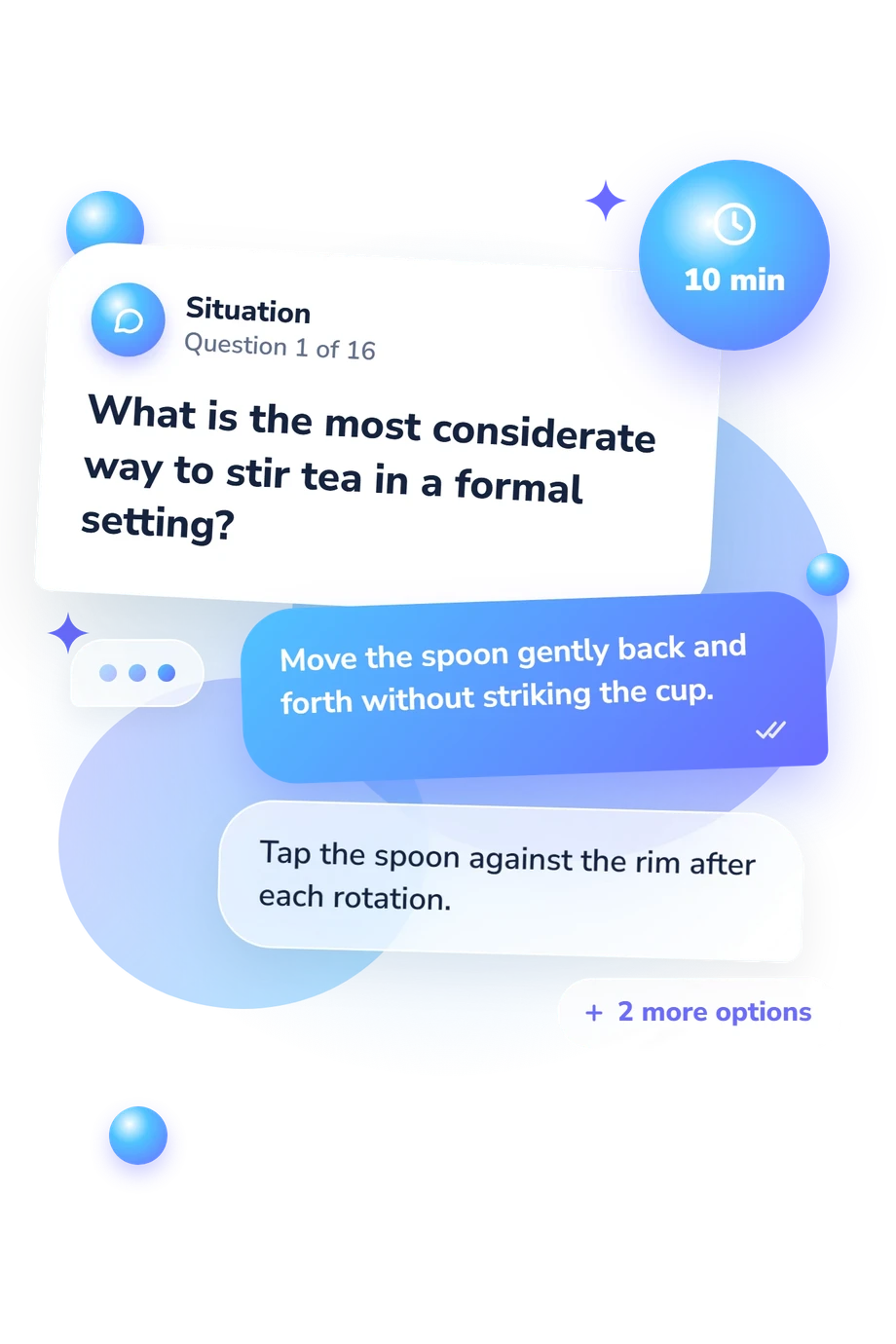
- Move the spoon gently back and forth without striking the cup.
- Tap the spoon against the rim after each rotation.
- Stir rapidly in circles so the sugar dissolves immediately.
- Swirl the cup instead of using the spoon.
- Lift the cup and saucer together for every sip.
- Hold the handle with your little finger extended for balance.
- Cradle the bowl of the cup in both hands.
- Lift the cup while leaving the saucer on the table.
- Leave it standing in the cup so it does not mark the saucer.
- Place it directly on the tablecloth beside the cup.
- Rest it across the top of the cup.
- Place it on the saucer rather than leaving it in the cup.
Tea Party Etiquette Quiz - Description and methodology of the test
Anyone preparing to host or attend a formal or garden tea can use this afternoon tea etiquette quiz to think through choices that arise before guests arrive and while the gathering is underway. The questions turn familiar social moments into practical decisions, from responding to a delay to handling an unexpected dietary need. For a reader deciding whether to take it, the tea party etiquette quiz offers a focused way to rehearse courteous responses without treating one tradition as universal.
What This Assessment Explores
The questionnaire measures practical knowledge of situations before, during, and after a formal or garden tea. The questionnaire's tea party etiquette questions ask readers to recognize considerate conduct in specific tea settings while allowing for differences between tradition and personal preference. It suits readers who want to understand British-style customs, including the distinction between afternoon tea and high tea.
The questions cover three areas:
- Table service shows whether you can stir, pour, flavor, and handle shared food appropriately.
- Guest conduct shows how you manage lateness, dress, conversation, phones, napkins, and departures.
- Hosting awareness shows whether you accommodate dietary needs and preferences without assumptions.
The Tea Party Etiquette Knowledge scale runs from 0-16: Tea-Time Beginner (0-6) reflects basic recognition with some confusion; Developing Tea Guest (7-12) reflects broad understanding with details to refine; Etiquette-Savvy (13-16) reflects strong command of traditional guest and host practices.
Methodology and Evidence Base
Each item uses four-option multiple choice, presenting different responses to a tea-related situation. The preferred answer represents the tested convention, and the result is reported as one total on the displayed range. The point assignment is not specified, so it should not be inferred from the range alone.
The four-option format tests recognition of practical norms rather than personality or status. Its situations present British afternoon tea manners through table actions such as stirring and scone service, then extend to timing, hospitality, inclusion, and conversation.
Peters discusses the manners covered; Johnson and Richardson address social tea settings; Skinner and Fine clarify afternoon tea and its distinction from high tea. The questionnaire is conceptually consistent with these works, while its displayed result remains specific to the conventions in its own items.
The displayed score is a descriptive knowledge band tied to the conventions covered, not broad social competence. Interpretation varies with differences among hosts, cultures, settings, and personal preferences. It also depends on reading each situation accurately and answering from your own knowledge.
- Peters, Beryl. The Etiquette of an English Tea. Copper Beech, 1995. ISBN 1898617066.
- Johnson, Dorothea, and Bruce Richardson. Tea & Etiquette: Taking Tea for Business and Pleasure. Benjamin Press, 2009. ISBN 9780979343162.
- Skinner, Julia. Afternoon Tea: A History. Rowman & Littlefield, 2019. ISBN 9781442271012.
- Fine, Julia. “Afternoon tea: a history.” Food, Culture & Society 23, no. 5 (2020): 631-638. 10.1080/15528014.2020.1727712
Updated: