
Drug and Alcohol Quiz
How the Scales are Structured
Who Usually Takes This Test?
See How You Compare
Below is a preview of how scores are typically distributed across each scale.
Example Questions From the Test
- Cannabis can impair reaction time, attention, coordination, and judgment even if the person feels calm.
- Cannabis affects driving only when mixed with alcohol.
- Driving is unaffected if the person uses cannabis regularly.
- Feeling calm reliably predicts that driving ability is unaffected.
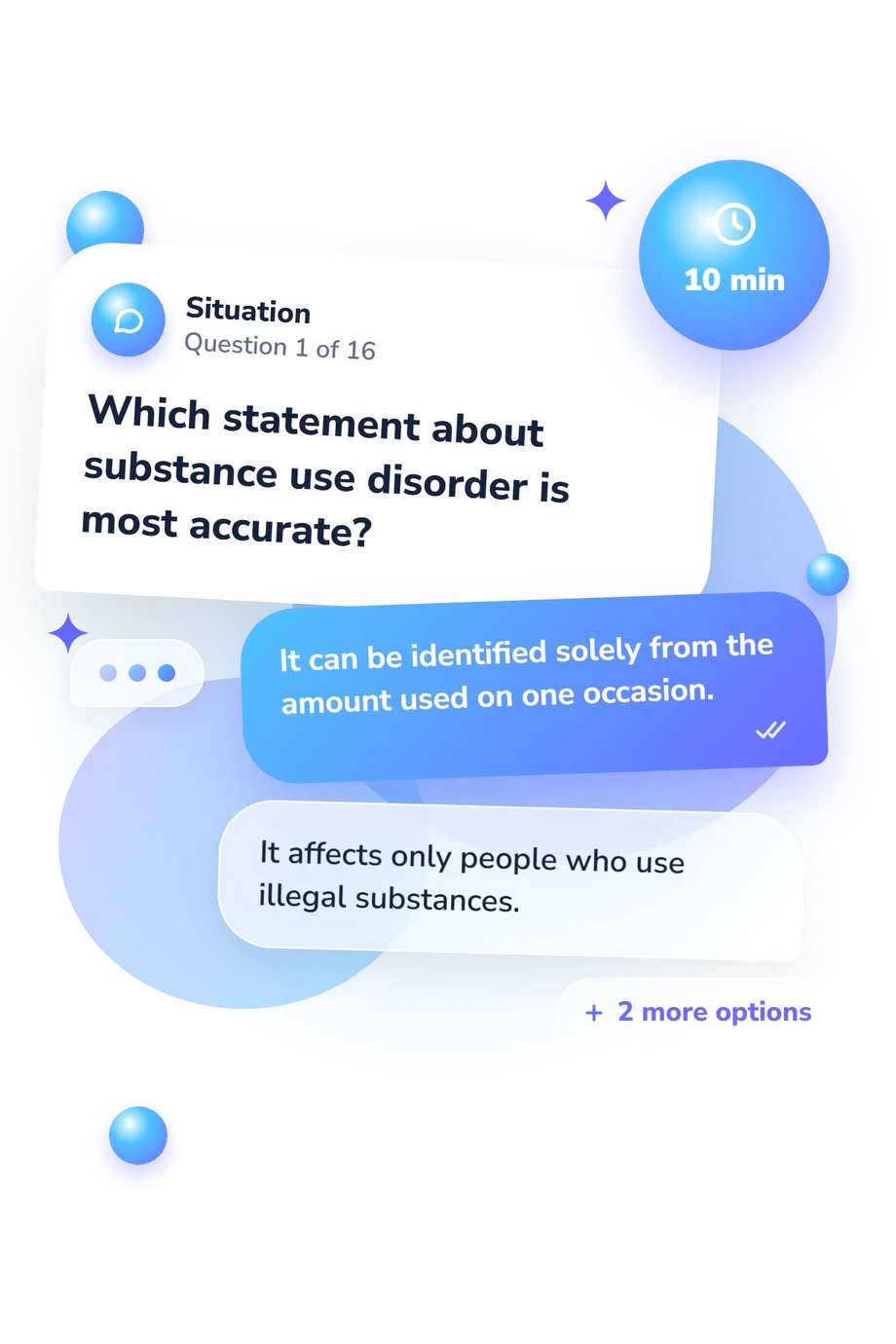
- It can be identified solely from the amount used on one occasion.
- It affects only people who use illegal substances.
- Withdrawal must be present before problematic use can matter.
- It involves a problematic pattern of use and consequences, and proper assessment requires more than a brief knowledge quiz.
- A substance use disorder is defined only by experiencing withdrawal.
- Physical dependence and a substance use disorder are always identical.
- Physical dependence can occur with regular prescribed use, while a substance use disorder involves a broader problematic pattern and impaired control.
- Neither can occur when medication is prescribed by a clinician.
Drug and Alcohol Quiz - Description and methodology of the test
People who want to check their understanding of substance-related risks can use this drug and alcohol quiz as a focused educational exercise. It is intended for general readers considering how impairment, dependence, medication interactions, and emergencies are recognized. As a drug and alcohol awareness quiz, it indicates which core concepts appear familiar and where targeted review may strengthen practical safety knowledge.
What This Assessment Measures
Instead of asking about personal history, the questionnaire checks factual understanding and safer responses. It covers impairment, dependence, interactions, medication safety, contamination, and overdose situations. This substance use knowledge quiz checks factual knowledge and safer responses.
These content areas shape the result:
- Impairment and interactions: shows whether calmness or alertness is separated from restored judgment.
- Dependence and use disorder: shows recognition of tolerance, withdrawal, adaptation, and impaired control.
- Medication and contamination: shows awareness of unknown pills, shared equipment, and risky combinations.
- Overdose response: shows recognition of slow breathing, unresponsiveness, naloxone, and emergency action.
The Drug and Alcohol Knowledge scale runs 0-16: Foundation (0-6) means concepts or warning signs need review; Developing (7-12) reflects many essentials with possible gaps; Strong (13-16) reflects broad practical knowledge. This unvalidated educational score is not a diagnosis, impairment test, or clinical cutoff.
Methodology and Evidence Base
Each item uses a scenario or question with several answer choices. Respondents select the option matching the safety principle tested across impairment, tolerance, dependence, medication combinations, unknown substances, standard drinks, infection risks, and overdose response. This drug and alcohol knowledge test emphasizes recognition and action, not disclosure or symptom scoring.
The bands describe performance on these questions rather than real-world impairment or disorder status.
Evidence is conceptual. The content is consistent with the SUD Knowledge Scale, Vargas and colleagues' alcohol-knowledge questionnaire, and Heckman and colleagues' health-education findings, but this online version is not presented as an adaptation or validation of those instruments. SAMHSA's Overdose Prevention and Response Toolkit supports the emergency focus on naloxone and contacting services.
Answers may reflect attention, wording, and prior learning rather than behavior. A strong result cannot establish safe driving, safe combinations, or emergency competence; immediate warning signs matter regardless of the score.
- Earnshaw, Valerie A., Mohammad Mousavi, Braeden Kelly, Kayla Zawislak, Annie B. Fox, and Jessica Hulsey. "Development and psychometric evaluation of two substance use disorder knowledge scales." Drug and Alcohol Dependence, vol. 282, 2026, article 113095. 10.1016/j.drugalcdep.2026.113095
- Vargas, Divane de, Dionasson Altivo Marques, Rosa Jacinto Volpato, Erika Gisseth Leon Ramirez, and Maria do Perpetuo Socorro de Sousa Nobrega. "Internal validity evidence of a knowledge questionnaire on alcohol use, abuse and dependence and associated questions." Revista Brasileira de Enfermagem, vol. 76, no. 1, 2023, article e20210377. 10.1590/0034-7167-2021-0377
- Heckman, Carolyn J., Jennifer L. Dykstra, and Bradley N. Collins. "Substance-Related Knowledge, Attitude, and Behavior among College Students: Opportunities for Health Education." Health Education Journal, vol. 70, no. 4, 2011, pp. 383-399. 10.1177/0017896910379694
- Substance Abuse and Mental Health Services Administration. Overdose Prevention and Response Toolkit. Publication No. PEP23-03-00-001, 2025.
Updated: