
Hockey Slang Quiz
How the Scales are Structured
Who Usually Takes This Test?
See How You Compare
Below is a preview of how scores are typically distributed across each scale.
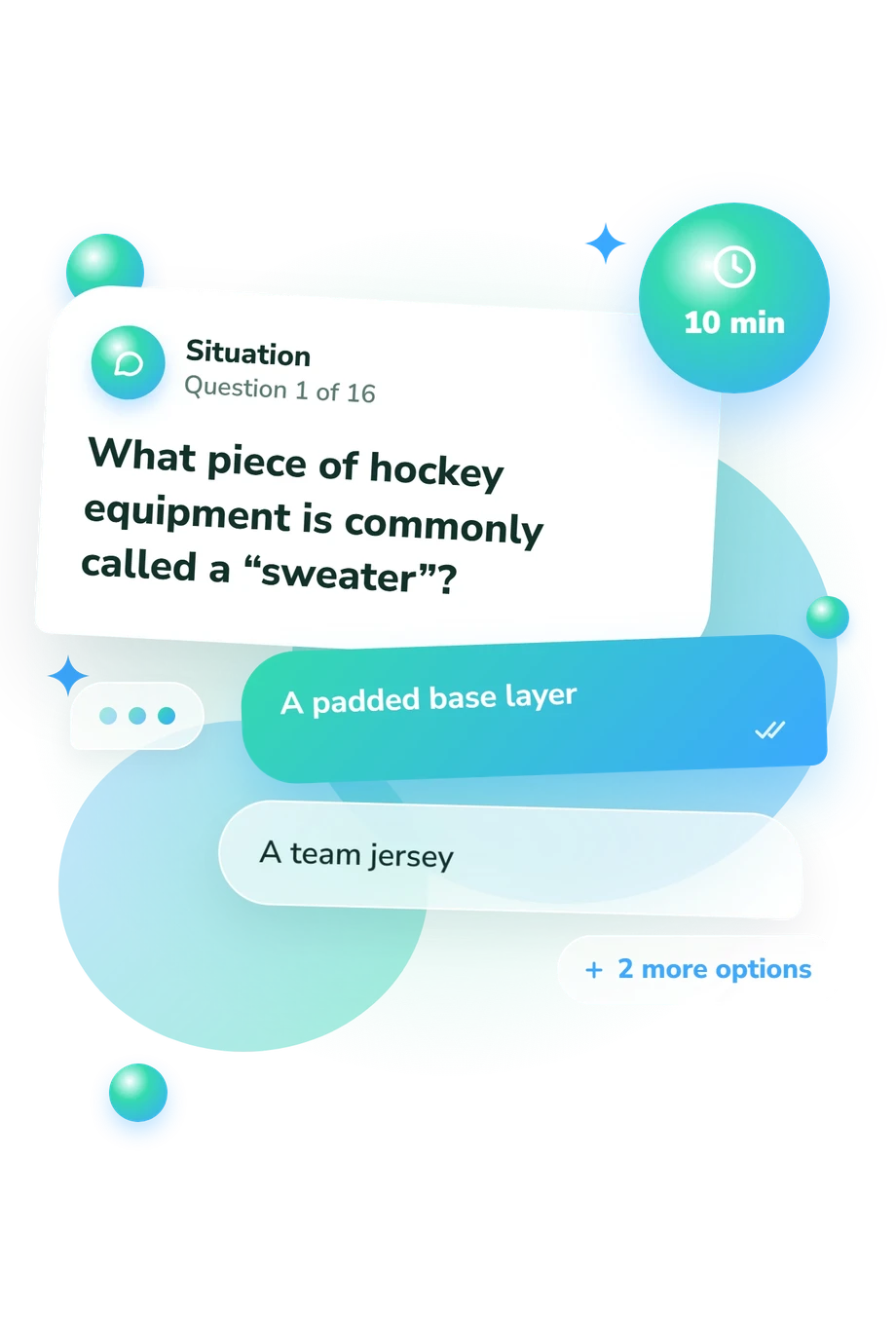
Example Questions From the Test
- A padded base layer
- A team jersey
- A warm-up jacket
- A neck guard
- Recorded a goal, an assist, and a fight
- Recorded three assists
- Scored three goals
- Scored the team's first, middle, and final goals
- The puck
- The net
- A scoring rebound
- The goalie's catching glove
Hockey Slang Quiz - Description and methodology of the test
Readers who follow hockey, hear rink talk, or want to decode commentary can use the hockey slang quiz to check how well familiar expressions connect with their meanings. It focuses on practical language rather than skating technique or rules, making the result useful for fans, newer viewers, and anyone building confidence with hockey conversation. For newer viewers, this hockey lingo quiz can turn unfamiliar commentary into usable vocabulary.
What This Assessment Explores
The questionnaire measures recognition of hockey slang in context. It covers equipment, scoring, shot locations and areas of the net, penalties, player actions, appearance, and exchanges between teammates or opponents. In this hockey slang test, the items test recognition through definitions and game situations.
The single scale is Hockey Slang Knowledge (0-16). It describes how accurately the respondent recognizes expressions across definitions and game situations. Results are New to the lingo (0-6), Developing fluency (7-12), or Slang savvy (13-16). The bands summarize this quiz, while usage can vary across regions, leagues, generations, and hockey communities.
The questions group into three practical language areas:
- Equipment and rink terms link informal names to objects or locations.
- Scoring and action language identifies goals, shots, celebrations, and puckhandling.
- Identity and interaction terms capture hair, lineup status, collisions, and verbal exchanges.
Methodology and Scientific Basis
Each item presents a hockey situation or phrase with four answer choices. The respondent selects the meaning that best fits, so the format tests recognition and contextual interpretation rather than free-form recall. The result is a single total performance scale, not a profile of personality, skating ability, or playing skill.
Conceptual context for the questionnaire includes Bray’s 2025 lexicon work, Bray’s 2015 analysis of hockey community language, Podnieks’ 2007 dictionary, and Kennedy and Zamuner’s 2006 discussion of sports lexicon. No standardized norms are provided for this questionnaire; these works offer conceptual context for reading hockey language as community-shaped, contextual, and sometimes identity-marking.
For self-checking, this hockey vocabulary quiz can show which terms need more exposure. Its bands are descriptive rather than universal proficiency standards because slang varies by region, era, league, and local culture. Memory, broadcast exposure, and context can affect answers, so the score is a snapshot of performance on these items rather than a complete measure of hockey knowledge.
- Bray, Andrew R. (2025). The Bender-Sieve Dictionary: Identifying and Defining Hockey's Unique Lexicon. Presentation at the Twelfth International Hockey Conference, Winnipeg, Canada, June 17, 2025. 10.13140/RG.2.2.35431.97446
- Bray, Andrew R. (2015). More Than Just Long Hair and Chipped Teeth: Constructing Identity in the Hockey Community of Practice. Unpublished master's thesis, Wayne State University.
- Podnieks, Andrew. (2007). The Complete Hockey Dictionary. Fenn.
- Kennedy, Robert, and Tania Zamuner. (2006). Nicknames and the Lexicon of Sports. American Speech, 81(4), 387-422. 10.1215/00031283-2006-026
Updated: