
Fairy Name Quiz
How the Scales are Structured
Who Usually Takes This Test?
See How You Compare
Below is a preview of how scores are typically distributed across each scale.
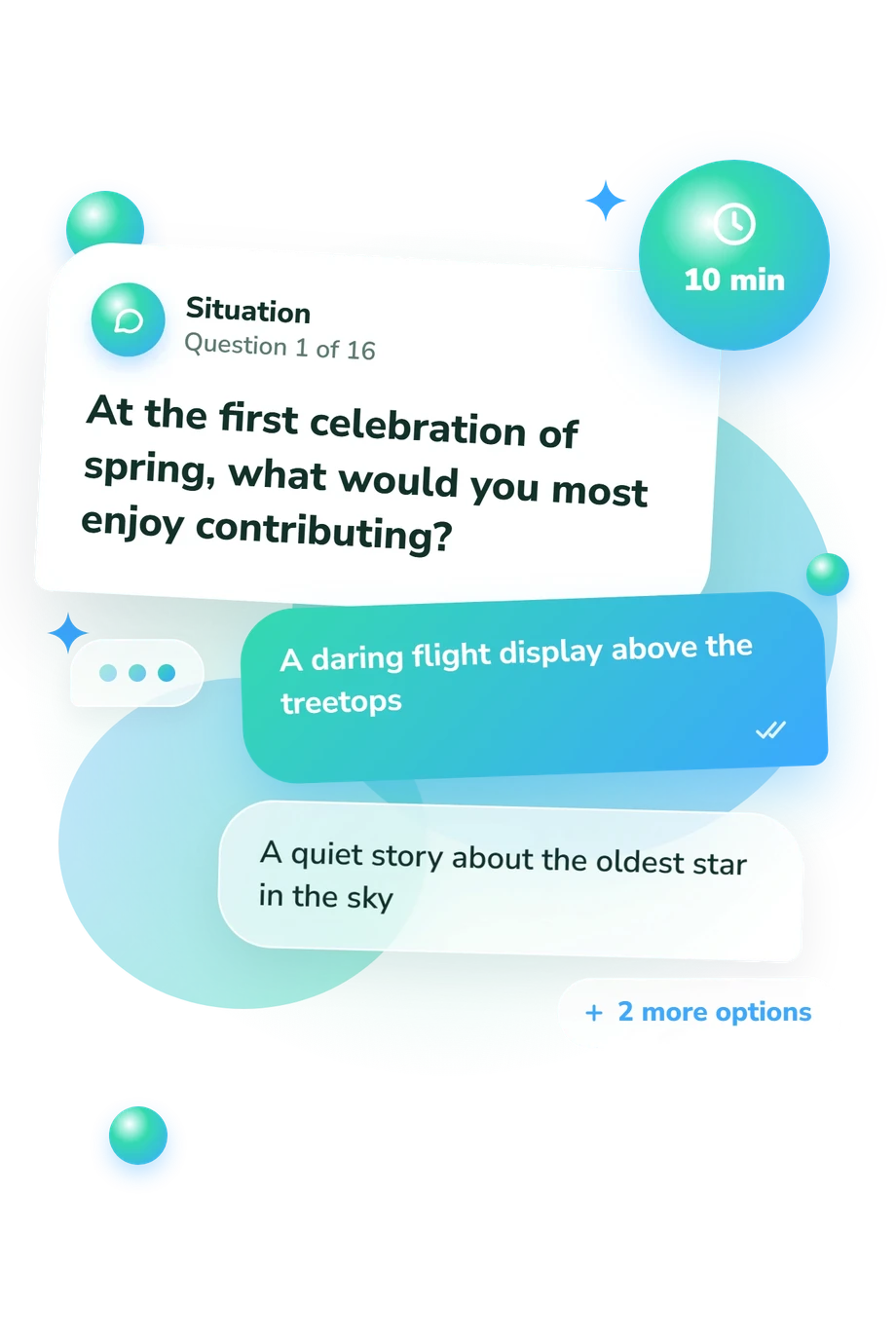
Example Questions From the Test
- A daring flight display above the treetops
- A quiet story about the oldest star in the sky
- A circle of living flowers grown into seats and archways
- Handmade wreaths designed around each guest’s favorite color
- It is waiting for a spell that can only appear in a dream
- It could be used to sketch a practical map of the library
- A hidden message may emerge after a careful experiment
- Someone removed the original writing and left a clue elsewhere
- Whether the hill would make a good gathering place
- The pattern of the notes and what message they might conceal
- The quickest way to reach the source before the ringing stops
- Which flowers and creatures become active nearby
Fairy Name Quiz - Description and methodology of the test
For visitors seeking a playful self-reflection exercise, the fairy name quiz offers a way to consider how they approach connection, adventure, imagination, and care. The result presents a concise profile across four dimensions, showing which qualities feel most prominent in everyday choices. The imaginative fairy name generator quiz format still produces a result organized around recognizable patterns of preference.
What This Assessment Explores
Each prompt places the respondent in an imaginative situation and offers four possible reactions. The choices cover social warmth, daring action, symbolic curiosity, and patient care, helping this assessment present a four-part profile rather than one fixed label. Anyone seeking a creative self-reflection profile can use this fairy name personality quiz to see which qualities are most prominent.
The four result dimensions are:
- Dewspark (0-12) shows playful creativity, social warmth, and shared delight: Quiet Glimmer (0-4), Bright Ripple (5-8), or Dewspark Glow (9-12).
- Emberwing (0-12) reflects courage, momentum, and limit-testing: Banked Spark (0-4), Rising Flame (5-8), or Emberwing Spirit (9-12).
- Moonwhisper (0-12) captures inward imagination, symbolic thinking, and quiet mysteries: Clear Daydream (0-4), Twilight Listener (5-8), or Moonwhisper Soul (9-12).
- Willowgleam (0-12) represents patient care, grounded magic, and growing things: Wandering Seed (0-4), Woodland Kin (5-8), or Willowgleam Heart (9-12).
Methodology and Evidence Base
Methodologically, this is a structured self-report: the respondent chooses the reaction that feels most natural, and the result is reported across four displayed scales. There are no right answers; interpretation is profile-based rather than one overall personality score.
Weibel and colleagues' Fantasy Questionnaire is the closest conceptual reference for the imaginative and creative material. The CEQ is a related self-report measure of fantasy proneness, while Zuckerman's sensation-seeking research supports the focus on novelty, risk, and testing personal limits. Mayer and Frantz's Connectedness to Nature Scale provides a comparison for the nature-oriented care theme. The questionnaire is conceptually consistent with these works, not an adaptation of them.
Used as a fairy name test, its bands are descriptive prompts: results are grouped into the named bands for each displayed scale, helping readers notice preferences that may otherwise stay implicit.
Those studies do not establish norms, reliability, or validity for this exact online questionnaire. Self-report can also shift with current mood, self-image, and the appeal of a chosen answer, so the result is a reflective profile rather than a clinical conclusion.
- Weibel, D., Martarelli, C. S., Häberli, D., & Mast, F. W. (2018). The Fantasy Questionnaire: A Measure to Assess Creative and Imaginative Fantasy. Journal of Personality Assessment, 100(4), 431-443. 10.1080/00223891.2017.1331913
- Merckelbach, H. L. G. J., Horselenberg, R., & Muris, P. E. H. M. (2001). The Creative Experiences Questionnaire (CEQ): A Brief Self-Report Measure of Fantasy Proneness. Personality and Individual Differences, 31(6), 987-995. 10.1016/S0191-8869(00)00201-4
- Zuckerman, M., Eysenck, S. B. G., & Eysenck, H. J. (1978). Sensation Seeking in England and America: Cross-Cultural, Age, and Sex Comparisons. Journal of Consulting and Clinical Psychology, 46(1), 139-149. 10.1037/0022-006X.46.1.139
- Mayer, F. S., & Frantz, C. M. (2004). The Connectedness to Nature Scale: A Measure of Individuals’ Feeling in Community with Nature. Journal of Environmental Psychology, 24(4), 503-515. 10.1016/j.jenvp.2004.10.001
Updated: