
Does He Like Me Back High School Quiz
How the Scales are Structured
Who Usually Takes This Test?
See How You Compare
Below is a preview of how scores are typically distributed across each scale.
Example Questions From the Test
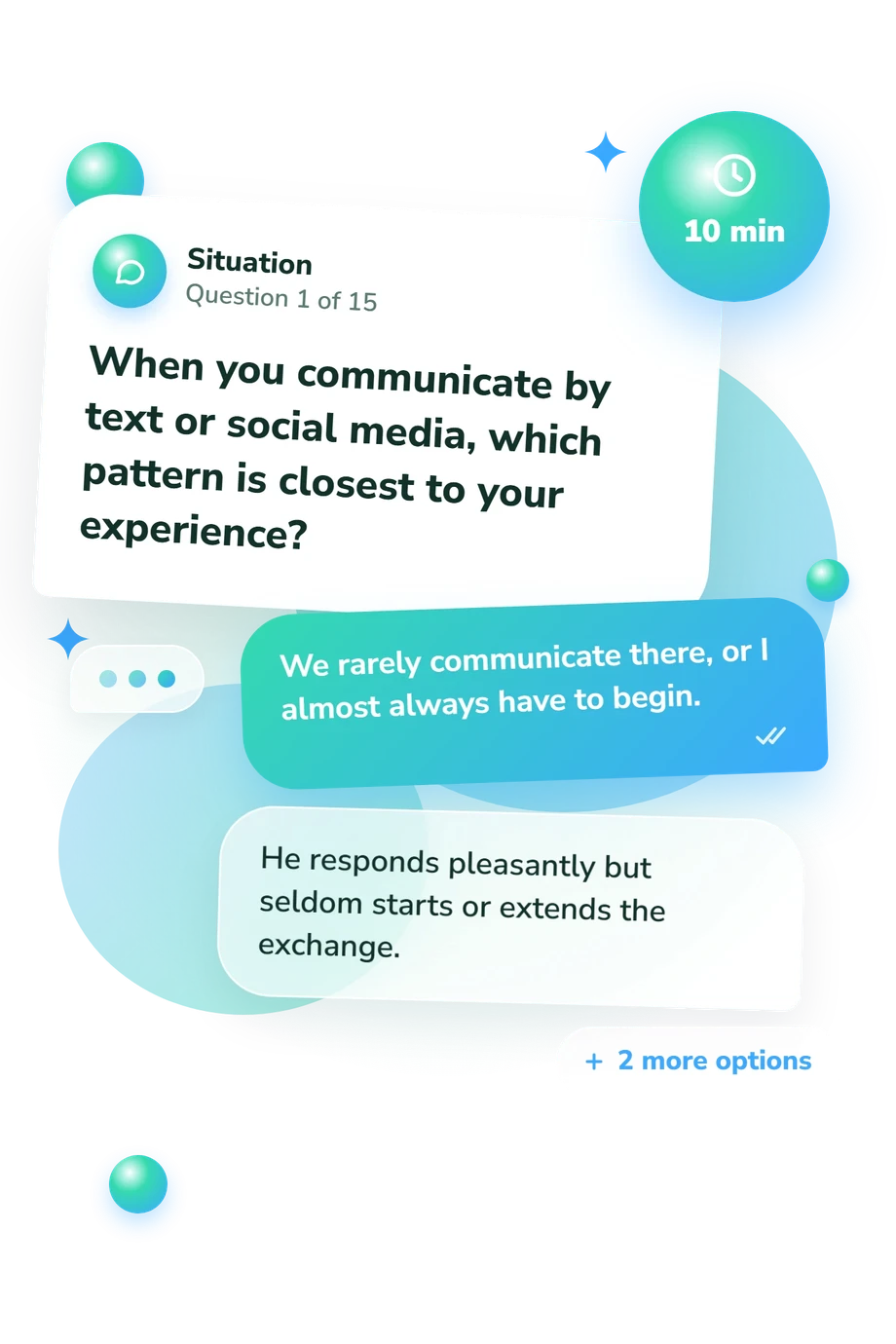
- We rarely communicate there, or I almost always have to begin.
- He responds pleasantly but seldom starts or extends the exchange.
- He sometimes starts conversations or sends something chosen for me.
- He regularly initiates and develops conversations rather than only reacting.
- The interruption normally ends our interaction.
- He returns to the conversation if I bring it back up.
- He often returns to what I was saying once the interruption passes.
- He makes a noticeable effort to reconnect and hear the rest, even later.
- His attention seems evenly spread, with no clear focus on my reaction.
- He occasionally notices my reaction when I am already involved.
- He often looks toward me after saying something or includes me directly.
- He repeatedly seeks my reaction and keeps drawing me into the exchange.
Does He Like Me Back High School Quiz - Description and methodology of the test
For students trying to understand whether a classmate’s behavior means something more, the Does He Like Me Back Quiz High School organizes recurring social signals into a clearer profile. It can help when you are weighing mixed interactions rather than one memorable moment. Any conclusion from this high school quiz about whether he likes you depends on repeated, well-observed interactions, so the assessment focuses on everyday school behavior over time.
What This Assessment Explores
The questionnaire is for students who want to examine a school connection through repeated behaviors rather than isolated eye contact or hearsay. It focuses on whether another student creates contact, adds personal depth, follows conversations, remembers details, and seeks your response. A high school crush quiz like this organizes uncertainty, but the result describes interaction patterns rather than proving romantic intent.
The three result dimensions are:
- Connection Initiative (0-15) shows how actively he starts, extends, and follows through on contact: Mostly situational (0-5), Some investment (6-10), or Consistent initiative (11-15).
- Personal Warmth and Curiosity (0-15) reflects whether conversation feels individualized and genuinely curious: General friendliness (0-5), Growing connection (6-10), or Distinct personal interest (11-15).
- Reciprocal Attention (0-15) captures how consistently he notices, remembers, and responds to you: Limited evidence (0-5), Mixed signals (6-10), or Stronger pattern (11-15).
Methodology and Scientific Basis
Each item presents a school situation with four ordered response options, moving from little or situational evidence toward more active, personal, and sustained behavior. The questionnaire reports patterns across three displayed dimensions, but its item-to-score weighting or calculation method is not specified. Each displayed range is divided into three descriptive bands that organize the observed pattern.
Conceptually, the questionnaire is closest to Murphy and Schneider (1994), whose work examined social transactions peers use when inferring liking. The 2016 study adds context about romantic interest expressed on a social stage, while the 1988 study supports attention to interpersonal competence in peer relationships. This questionnaire is conceptually consistent with these sources, not an adaptation of their measures.
Because the questionnaire relies on self-report, answers in this school-crush assessment can be shaped by hopes, anxiety, memory, mood, and limited contact. It has no stated normative standardization or clinical validation, and its scores describe observed interaction patterns rather than confirming attraction. Broader context remains important when interpreting the pattern.
- Murphy, Kevin, and Barry Schneider. (1994). Development of a Peer-Report Measure of Social Transactions Used by Early Adolescents to Infer Liking. The Journal of Early Adolescence, 14(1), 66-82. 10.1177/0272431694014001005
- Christopher, F. Scott, Sarah J. McKenney, and Franklin O. Poulsen. (2016). Early adolescents' "crushing": Pursuing romantic interest on a social stage. Journal of Social and Personal Relationships, 33(4), 515-533. 10.1177/0265407515583169
- Buhrmester, Duane, Wyndol Furman, Mitchell T. Wittenberg, and Harry T. Reis. (1988). Five Domains of Interpersonal Competence in Peer Relationships. Journal of Personality and Social Psychology, 55(6), 991-1008. 10.1037/0022-3514.55.6.991
Updated: