
Comfort Character Quiz
How the Scales are Structured
Who Usually Takes This Test?
See How You Compare
Below is a preview of how scores are typically distributed across each scale.
Example Questions From the Test
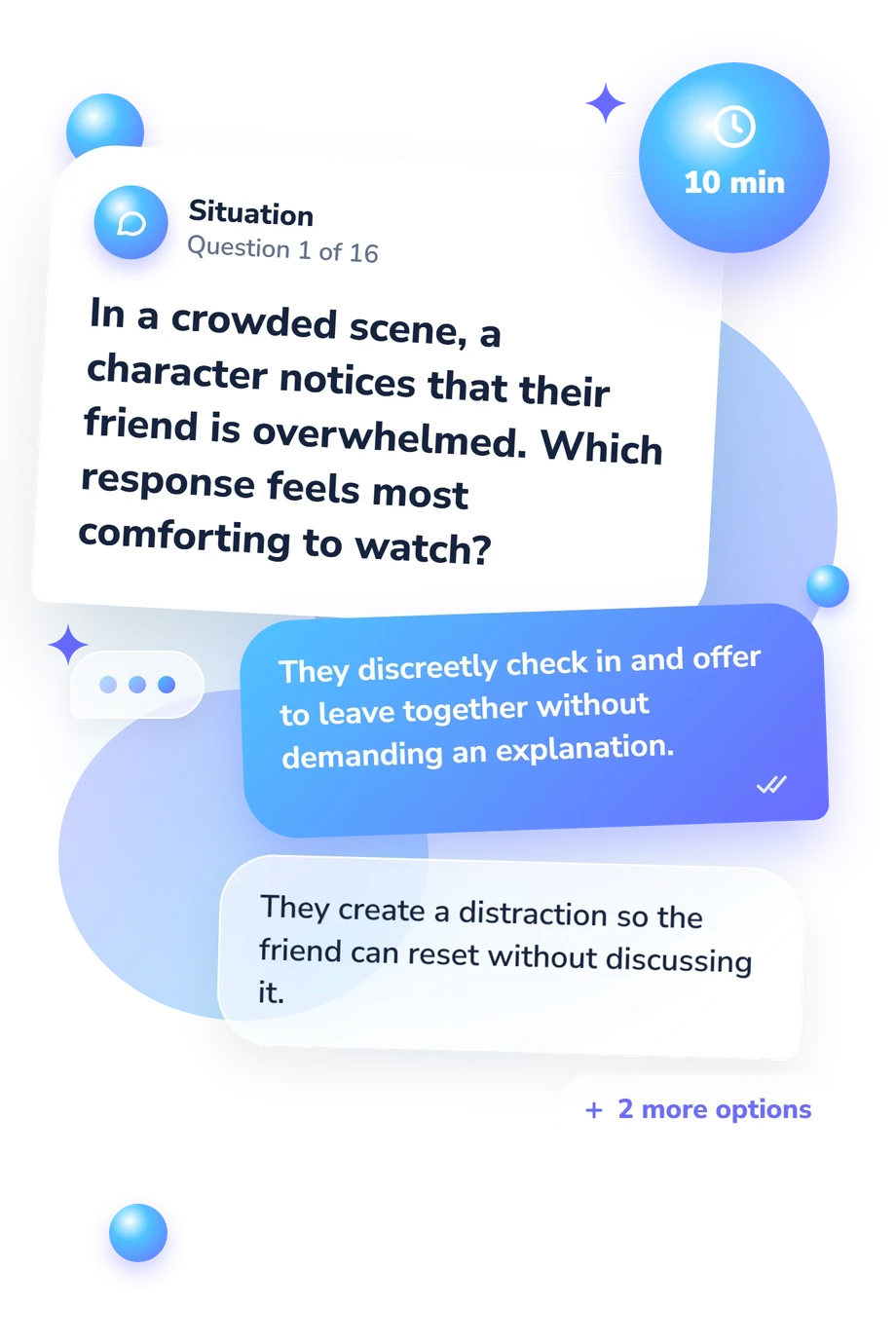
- They discreetly check in and offer to leave together without demanding an explanation.
- They create a distraction so the friend can reset without discussing it.
- They stay close and wait to see whether the friend asks for help.
- They trust the friend to find their own rhythm in the crowd.
- They gain recognition by proving they can succeed on conventional terms.
- They build a stable life while keeping a few distinctive habits.
- They find companions who understand their differences and join them in imagining what comes next.
- They choose an independent path that finally feels authentic.
- “There may be something interesting on the other side of this.”
- “Take it one step at a time; you know more than you think.”
- “Whatever happens, I have your back.”
- “Pause when you need to, and notice what the moment brings.”
Comfort Character Quiz - Description and methodology of the test
People who want to understand why fictional figures feel safe, familiar, or restorative can use this comfort character quiz as a guided reflection. Rather than assigning one fictional name, it clarifies which qualities, emotional functions, and scenes make a fictional comfort character meaningful. It is intended for readers curious about their relationship with fiction and the character presence they revisit for reassurance, energy, understanding, or steadiness.
What This Assessment Explores
This comfort character questionnaire groups support, difference, humor, responsibility, and connection into four dimensions.
The four scales and their bands are:
- The Gentle Healer (0-12) measures affinity for attentive, validating, warm characters; Light Tenderness (0-4) indicates a lighter match, Warm Connection (5-8) an important one, and Restorative Bond (9-12) a strong one.
- The Kindred Dreamer (0-12) measures affinity for imaginative, sensitive, unconventional characters who make differences feel understood; Distant Echo (0-4) is lighter, Kindred Thread (5-8) meaningful, and Deep Recognition (9-12) strong.
- The Playful Spark (0-12) measures affinity for witty, energetic characters who bring relief and lightness; Occasional Lift (0-4) is lighter, Bright Companion (5-8) valued, and Joyful Reset (9-12) strong.
- The Steady Guardian (0-12) measures affinity for characters offering practical help, consistency, and protection; Passing Reassurance (0-4) is lighter, Reliable Presence (5-8) stabilizing, and Home-Base Energy (9-12) strong.
Methodology and Scientific Basis
Self-reported prompts present fictional scenes or situations with four alternative responses representing different kinds of comfort. As an online comfort character test, the questionnaire displays four thematic scales and their bands; it does not state how choices contribute to scores or how results are combined.
Rain and Mar (2021) is the closest conceptual study for this subject. It connects attachment tendencies with engagement with fictional characters; this questionnaire is conceptually consistent with that perspective while focusing on comforting character qualities, not attachment assessment.
Horton and Wohl (1956) provide broader context on mediated or parasocial intimacy with media figures. Their framework concerns social presence at a distance, whereas this questionnaire focuses on comfort-character preferences.
Lotun et al. (2024) adds evidence that parasocial relationships may meet emotional needs, supporting a reading of these results as preferred emotional functions in fiction rather than proof of an attachment style.
Because answers depend on self-awareness, current mood, personal associations, and honest choice, results may shift with context. Treat the outcome as a self-reflection profile rather than a diagnostic measure.
- Rain, Marina, and Raymond A. Mar. "Adult attachment and engagement with fictional characters." Journal of Social and Personal Relationships, 38(9), 2792-2813 (2021). 10.1177/02654075211018513
- Lotun, Shaaba, Veronica M. Lamarche, Ana Matran-Fernandez, and Gillian M. Sandstrom. "People perceive parasocial relationships to be effective at fulfilling emotional needs." Scientific Reports, 14, 8185 (2024). 10.1038/s41598-024-58069-9
- Horton, Donald, and R. Richard Wohl. "Mass communication and para-social interaction: Observations on intimacy at a distance." Psychiatry, 19(3), 215-229 (1956). 10.1080/00332747.1956.11023049
Updated: