
Do I Have Bed Bugs Quiz
How the Scales are Structured
Who Usually Takes This Test?
See How You Compare
Below is a preview of how scores are typically distributed across each scale.
Example Questions From the Test
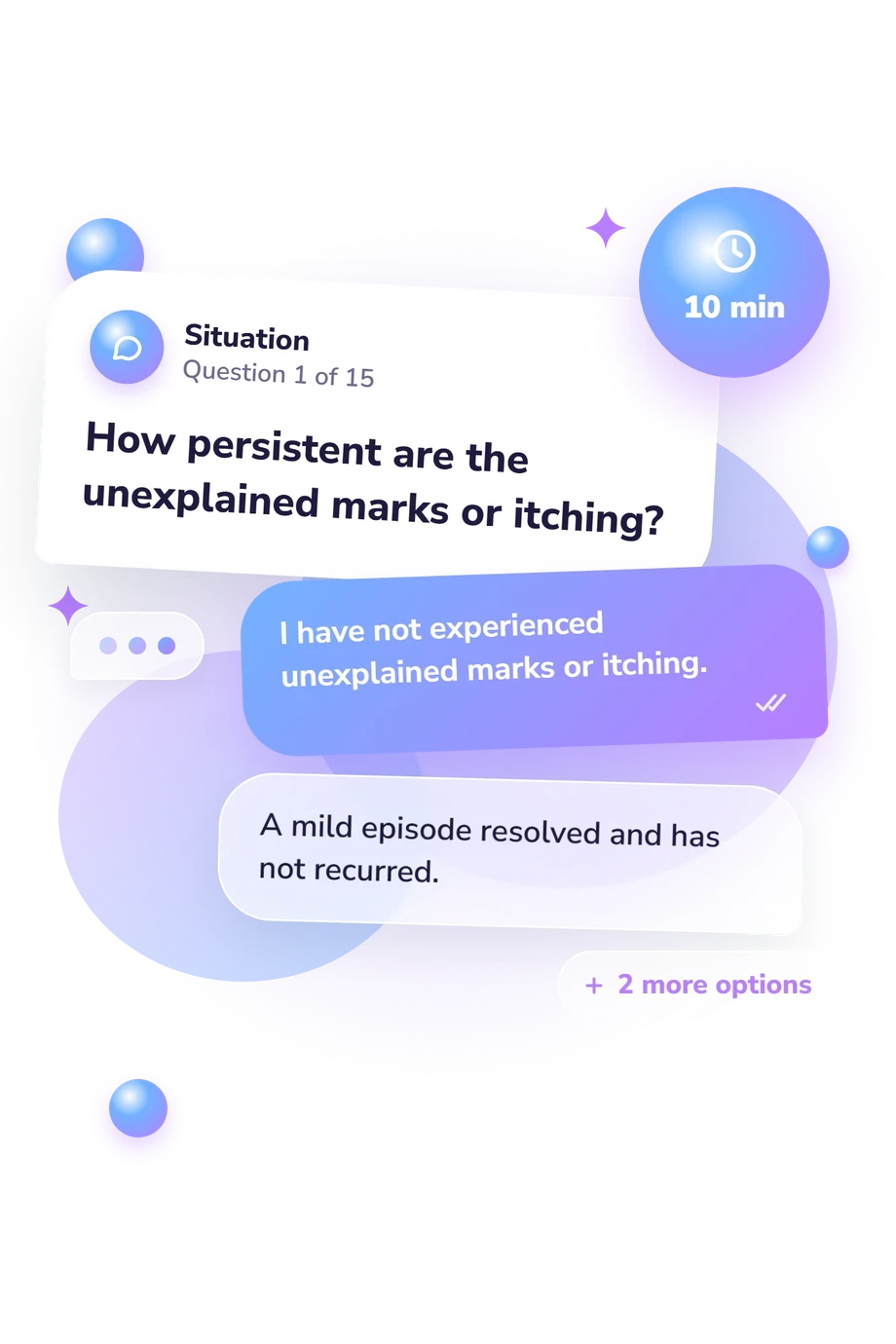
- I have not experienced unexplained marks or itching.
- A mild episode resolved and has not recurred.
- Symptoms have recurred or remained bothersome despite basic skin care.
- Symptoms are worsening, disrupting sleep, or showing signs such as spreading redness, warmth, drainage, or increasing pain.
- A used item entered the room after a basic visual check, with no signs noticed.
- No used or recently moved upholstered furniture or mattress has entered the area.
- A used bed, mattress, sofa, or upholstered item entered without a thorough crevice inspection.
- An introduced item came from a location with reported bed bugs or had suspicious insects, spotting, or shed material.
- There has been an unconfirmed pest concern somewhere in the building.
- A directly adjacent unit or connected room has reported or identified bed bugs.
- A nonadjacent unit has a confirmed report, or management has announced an inspection.
- I know of no nearby report, or my home does not share walls with other units.
Do I Have Bed Bugs Quiz - Description and methodology of the test
People wondering whether unexplained marks or insects could relate to bed bugs can use the Do I Have Bed Bugs Quiz to consider environmental clues alongside skin experiences. It is designed for self-reflection around possible exposure, physical signs, and reactions, not for making a medical or pest-control determination. This bed bug quiz helps frame what you have noticed in context.
What This Assessment Explores
Questions connect marks, itching, spotting, shed material, and possible insects with travel, shared housing, moved furniture, and changes tied to one sleeping location. They examine bed bug symptoms without treating skin reactions as proof of an infestation.
These are the three displayed dimensions and the meaning attached to each result:
- Exposure and Recurrence Patterns (0-15) shows whether reported context and repeated location-linked experiences form a pattern worth investigating; bands are No listed exposure pattern (0), Possible context (1-2), and Pattern worth investigating (3-15).
- Physical Signs (0-15) reflects insects, spotting, shed material, possible eggs, or signs near seams; bands are No listed indicators (0), Limited or uncertain evidence (1-2), and Action-worthy evidence (3-15).
- Skin Experiences (0-15) captures persistence, distribution, and intensity of marks or reactions; bands are No listed skin experience (0), Limited or nonspecific symptoms (1-2), and Symptoms needing attention (3-15).
Methodology and Evidence Base
Each item in this online self-report questionnaire offers four options ranging from absent or uncertain situations to recurring or more concerning ones. Choosing the closest description keeps the response qualitative, even though the result is numerical.
Responses are organized into thematic totals, but the questionnaire does not document equal point values, item weighting, validated cutoffs, or an infestation-severity scale. Totals can guide inspection and documentation, not estimate probability.
The low-cost inspection protocol described by Wang and colleagues offers the closest practical support for structured inspection; clinical reviews by Doggett and Leung discuss environmental clues and variable skin reactions. These sources provide conceptual context, but they do not validate or standardize this questionnaire.
Memory, surroundings, self-awareness, and skin response can shape self-report. Here, bed bug signs are more useful when documented with a photograph or preserved specimen. A single red-flag response should be acted on regardless of the total. Persistent or infected marks warrant routine clinical attention, while trouble breathing, facial or throat swelling, faintness, or a severe whole-body reaction requires urgent medical help; displayed bands remain unvalidated reflective summaries.
- Wang, Changlu, Narinderpal Singh, Chen Zha, and Richard Cooper. "Bed Bugs: Prevalence in Low-Income Communities, Resident’s Reactions, and Implementation of a Low-Cost Inspection Protocol." Journal of Medical Entomology 53, no. 3 (2016): 639-646. 10.1093/jme/tjw018
- Doggett, Stephen L., Dominic E. Dwyer, Pablo F. Peñas, and Richard C. Russell. "Bed Bugs: Clinical Relevance and Control Options." Clinical Microbiology Reviews 25, no. 1 (2012): 164-192. 10.1128/CMR.05015-11
- Leung, Alexander K. C., Joseph M. Lam, Benjamin Barankin, Kin Fon Leong, and Kam Lun Hon. "Bed Bug Infestation: An Updated Review." Current Pediatric Reviews 20, no. 2 (2024): 137-149. 10.2174/1573396320666230406084801
Updated: