
Do I Seek Male Validation Quiz
How the Scales are Structured
Who Usually Takes This Test?
See How You Compare
Below is a preview of how scores are typically distributed across each scale.
Example Questions From the Test
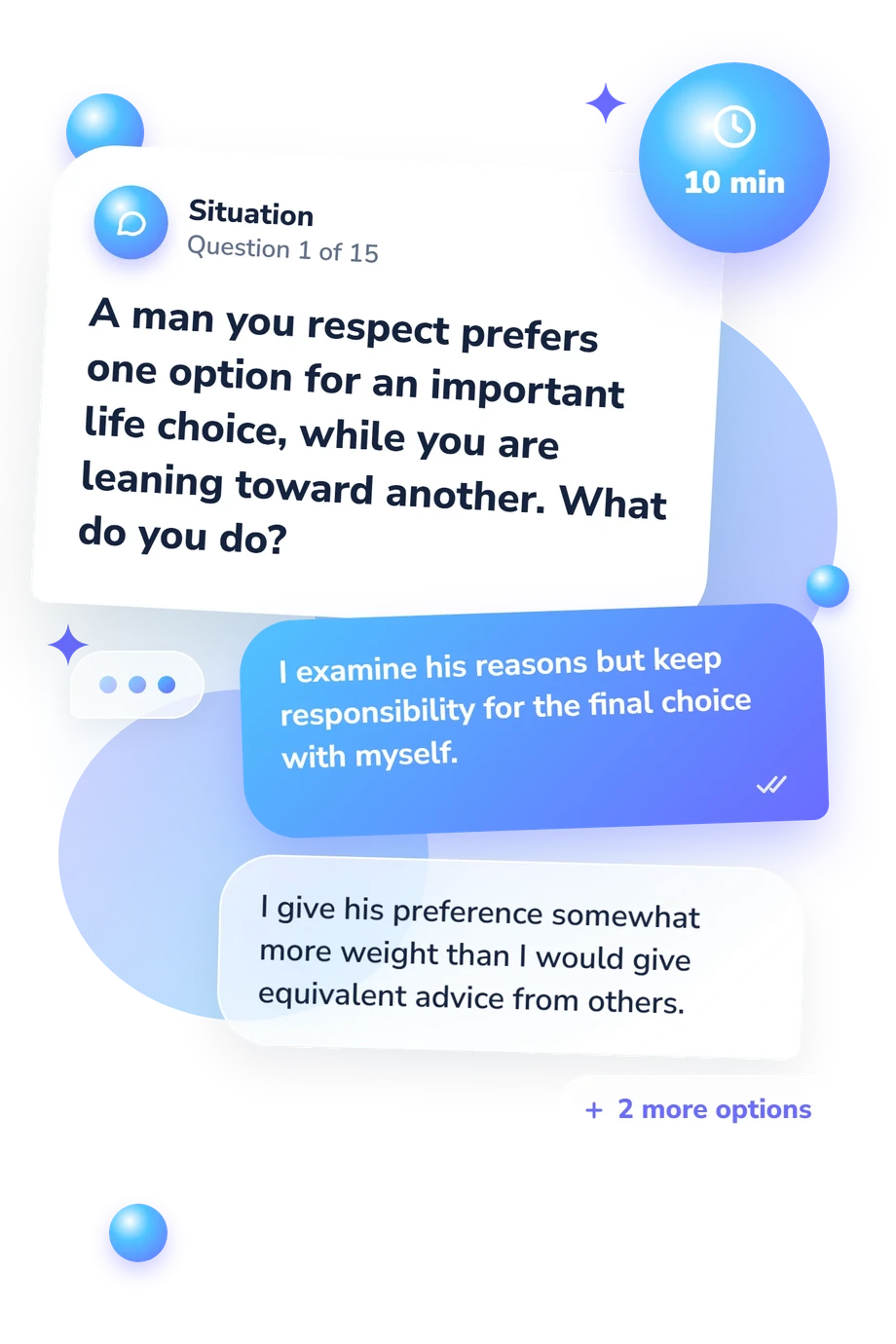
- I examine his reasons but keep responsibility for the final choice with myself.
- I give his preference somewhat more weight than I would give equivalent advice from others.
- I lean toward his option because disappointing him would be hard to tolerate.
- I follow his preference even though it conflicts with what I believe is right for me.
- Soften or partially change my position to keep his approval.
- Ask more about his view while remaining honest about where I differ.
- Avoid revealing what I really think and align myself with his position.
- Present my opinion more cautiously because his impression matters to me.
- I drop the boundary because keeping his interest feels more important.
- I reconsider whether I could be more flexible, though I remain uneasy.
- I explain the boundary and consider his perspective without abandoning what I need.
- I briefly question myself but ultimately maintain the boundary.
Do I Seek Male Validation Quiz - Description and methodology of the test
People who wonder whether approval from men quietly shapes confidence, choices, boundaries, or self-presentation can use the Do I Seek Male Validation Quiz as a structured self-reflection exercise. A male validation assessment like this is intended for people reflecting on recurring reactions in dating, social, appearance, or online situations. The result highlights patterns to consider rather than assigning an identity or a fixed explanation.
What This Assessment Explores
This questionnaire separates male influence into attention affecting reassurance, mood, and self-evaluation; approval affecting decisions, priorities, and boundaries; and anticipated approval shaping appearance, opinions, interests, and public presentation. It suits people reflecting on recurring reactions in dating, social, appearance, or online situations. The profile shows where influence feels incidental or influential.
The three displayed dimensions are:
- Attention and Reassurance (0-15) reflects how male attention affects reassurance, mood, or self-evaluation: Internally anchored (0-5), Noticeable pull (6-10), Strong reassurance loop (11-15).
- Decision and Boundary Influence (0-15) reflects how male approval affects choices, priorities, and limits: Independent footing (0-5), Approval-sensitive choices (6-10), Approval over autonomy (11-15).
- Self-Presentation for Approval (0-15) reflects how anticipated male reactions shape appearance, opinions, interests, or public image: Self-directed expression (0-5), Selective adaptation (6-10), Approval-led presentation (11-15).
Together, the profile highlights where you may seek male validation.
Methodology and Scientific Basis
Each item presents a familiar situation with four response options. The scenarios cover disagreement, boundaries, invitations, appearance, hobbies, social media, attention, and rejection. Choose the response closest to your usual pattern, rather than the answer that sounds most independent or admirable.
Responses are organized into three displayed profiles, so the outcome is multidimensional rather than a single verdict. The online questionnaire uses reflective, non-clinical bands; the displayed categories describe patterns rather than diagnostic thresholds, and point values should not be inferred beyond the scoring shown.
Conceptually, the questionnaire is consistent with Rowe’s 2006 male-preference instrument, which examines perceived male influence on self-image. It also relates to Crocker and colleagues’ (2003) contingencies-of-self-worth framework and Knee and colleagues’ (2008) work on relationship-contingent self-esteem. It is not presented as an adaptation or re-standardization of those published works.
As an online self-report, results may vary with current relationships, mood, memory, and candor. Male approval patterns are best read alongside the situations that prompted each answer; one profile cannot explain the cause of a response or establish a diagnosis.
- Rowe, V. (2006). Cross-gender influence: The effect of perceived male preference on female body image and self-esteem in a young adult group. The Educational and Developmental Psychologist, 23(2), 46-64. 10.1017/S0816512200028984
- Crocker, J., Luhtanen, R. K., Cooper, M. L., & Bouvrette, A. (2003). Contingencies of self-worth in college students: Theory and measurement. Journal of Personality and Social Psychology, 85(5), 894-908. 10.1037/0022-3514.85.5.894
- Knee, C. R., Canevello, A., Bush, A. L., & Cook, A. (2008). Relationship-contingent self-esteem and the ups and downs of romantic relationships. Journal of Personality and Social Psychology, 95(3), 608-627. 10.1037/0022-3514.95.3.608
Updated: