
Inflation Quiz
How the Scales are Structured
Who Usually Takes This Test?
See How You Compare
Below is a preview of how scores are typically distributed across each scale.
Example Questions From the Test
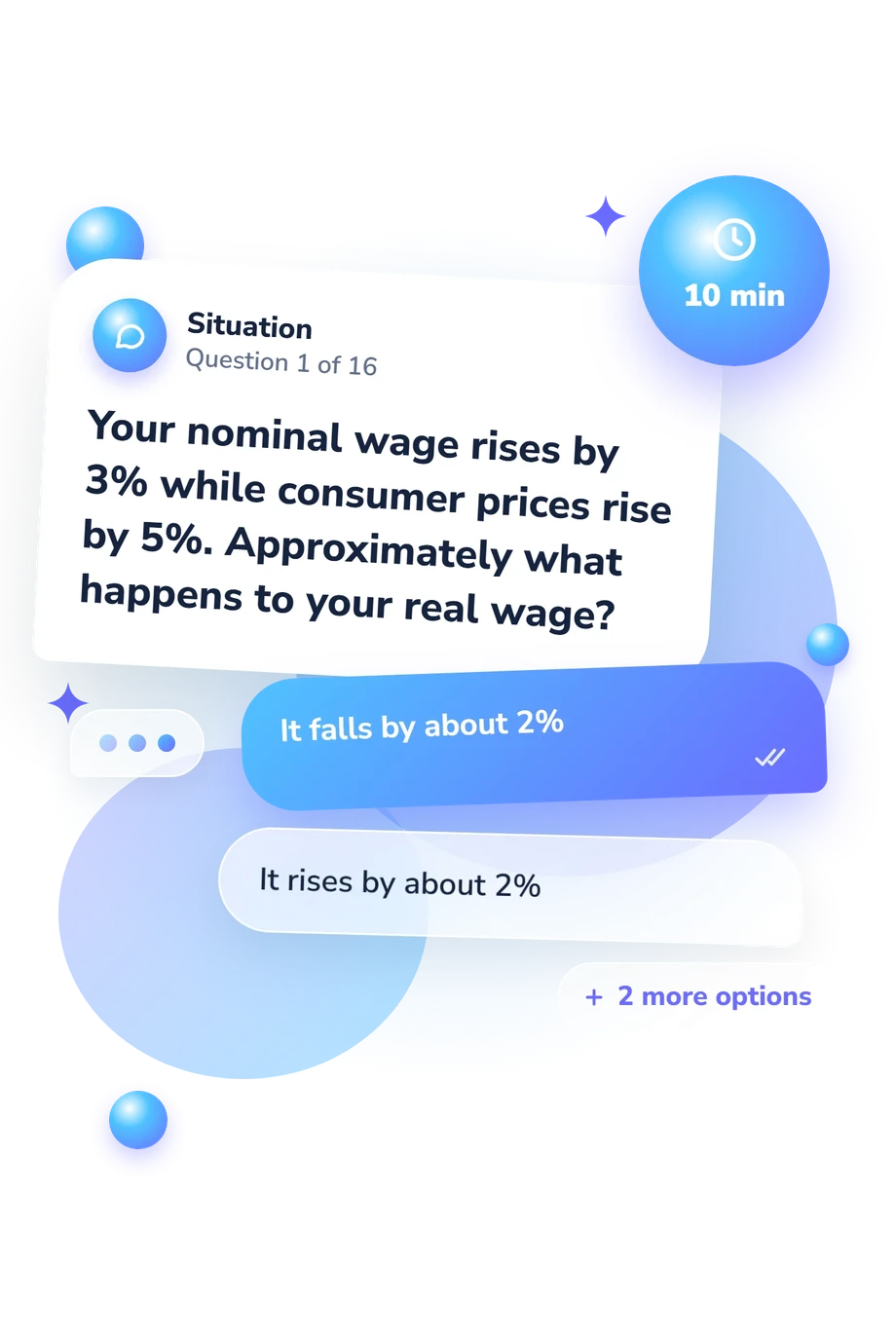
- It falls by about 2%
- It rises by about 2%
- It rises by about 8%
- It remains unchanged because the wage still increased
- 2%
- 20%
- 10%
- 5%
- By guaranteeing that every retail price immediately falls
- By directly increasing the productive capacity of factories
- By raising all wages at the same rate as prices
- By making borrowing less attractive and moderating overall demand
Inflation Quiz - Description and methodology of the test
People who want to check their grasp of everyday economics can use this inflation quiz as a focused self-assessment rather than a lesson or forecast. It suits learners, students, and curious adults who want to distinguish changes in individual prices from movements in the general price level. Questions about measuring inflation rates and interpreting price changes point to ideas that may deserve further review.
What This Assessment Explores
Inflation is a sustained increase in the general price level, while the questions examine its implications for purchasing power. They distinguish broad price movements from relative-price shifts, such as one commodity becoming more expensive. Tested inflation concepts include real and nominal values, price indexes, interest, debt, pensions, relative-price changes, and economy-wide effects on output, employment, capacity, and policy.
The main areas are:
- Price measurement tests whether you can read baskets, indexes, and annual changes.
- Purchasing power shows how prices affect wages, savings, loans, and pensions.
- This area distinguishes demand-pull, cost-push, wage-price, and supply-shock pressures.
- This area links interest rates, capacity, output, and employment to price pressure.
The displayed result is Inflation Knowledge (0-16). Foundational (0-6) indicates ideas needing review; Developing (7-12) reflects understanding of core principles; Strong (13-16) reflects solid command and practical application. It serves as a general review prompt.
Methodology and Evidence Base
Each item presents a short economic situation or definition with four answer choices. The format requires recognition, comparison, and simple calculation, such as relating an index change to an inflation rate, estimating a real interest rate, or identifying disinflation while prices still rise. The scoring is explicit: every correct answer adds one point, and the total determines the displayed result band.
The online multiple-choice questionnaire produces an aggregate knowledge score for understanding inflation from the total correct answers. Its content is conceptually consistent with Rumler and Valderrama (2020), whose work links inflation literacy with inflation expectations, and with Leiser and Drori (2005), who examined common nontechnical understandings of inflation. The Test of Economic Literacy manual by Walstad, Rebeck, and Butters supplies a relevant framework for economic concepts and multiple-choice testing.
Interpret the outcome as performance on these concepts at the time of answering. Prior coursework, vocabulary familiarity, attention, and guessing can affect the result. The quiz can guide targeted review, but it is not a diagnosis or a complete measure of financial judgment.
- Rumler, Fabio, and María Teresa Valderrama. "Inflation literacy and inflation expectations: Evidence from Austrian household survey data." Economic Modelling 87 (2020): 8-23. 10.1016/j.econmod.2019.06.016
- Leiser, David, and Shelly Drori. "Naïve understanding of inflation." Journal of Socio-Economics 34, no. 2 (2005): 179-198. 10.1016/j.socec.2004.09.006
- Walstad, William B., Ken Rebeck, and Roger B. Butters. Test of Economic Literacy Examiner's Manual (4th Edition). New York: Council for Economic Education, 2013.
Updated: