
Halloween History Quiz
How the Scales are Structured
Who Usually Takes This Test?
See How You Compare
Below is a preview of how scores are typically distributed across each scale.
Example Questions From the Test
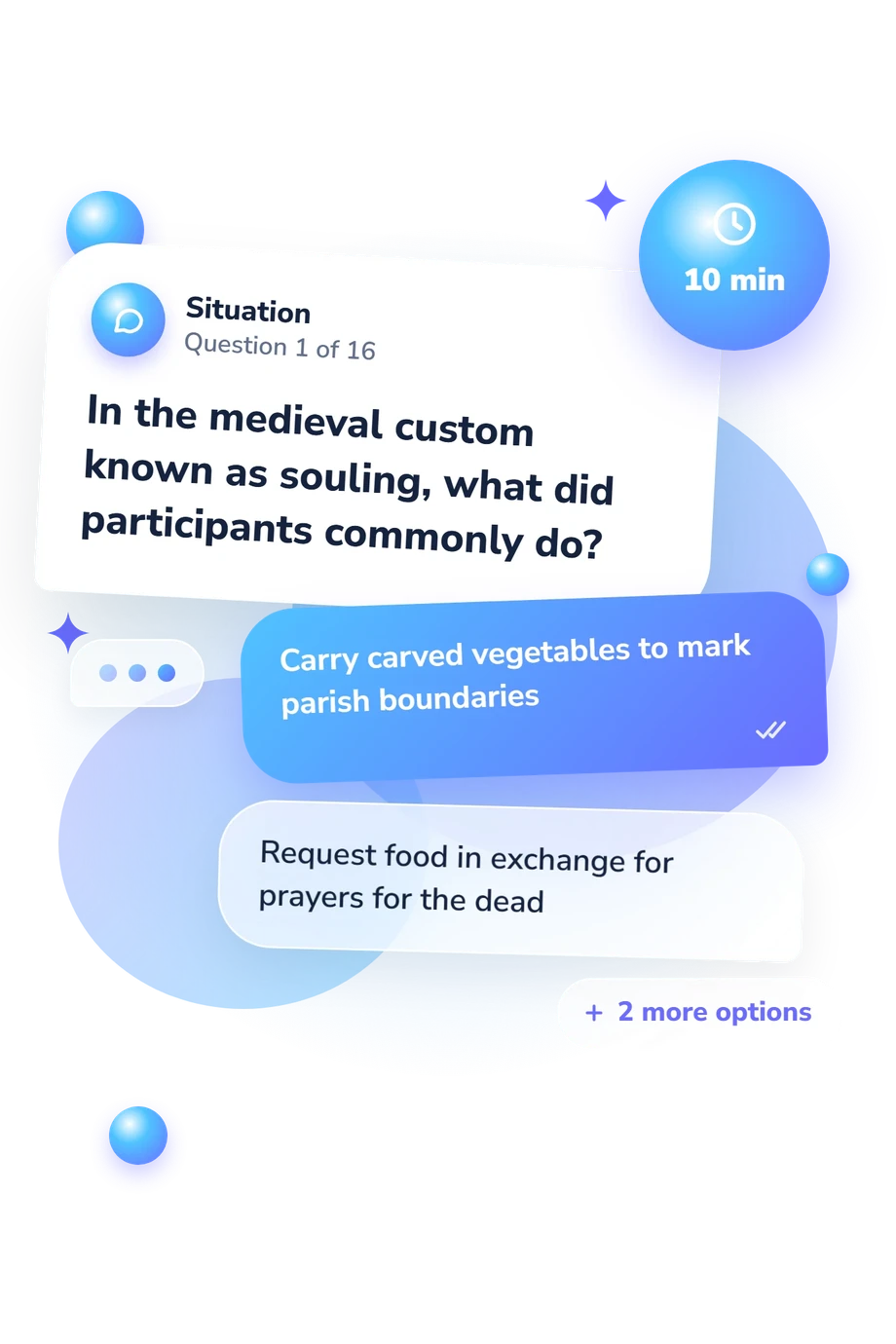
- Carry carved vegetables to mark parish boundaries
- Request food in exchange for prayers for the dead
- Trade masks for candles at an autumn market
- Perform harvest plays in exchange for seed grain
- All Harvest Evening
- Harvest Hallow Night
- Hallowed Autumn
- All Hallows’ Eve
- The 1770s and 1780s
- The 1860s and 1870s
- The 1920s and 1930s
- The 1960s and 1970s
Halloween History Quiz - Description and methodology of the test
For readers curious about how Halloween developed, this Halloween history assessment connects familiar customs with the religious, social, and commercial changes that shaped them. The halloween history quiz suits learners who want to check historical understanding rather than recall isolated trivia. Its four-choice format produces an overall knowledge result.
What This Assessment Explores
The questions present Halloween as a layered tradition, moving from Gaelic seasonal observance and Christian feast-day calendars to migration, North American adaptation, commercialization, wartime conditions, and organized community celebrations. Some also distinguish related observances, including the Day of the Dead, without treating them as interchangeable.
As a history of Halloween quiz, this assessment asks readers to connect chronology, cause and effect, and cultural change. The result is reported through the Halloween History Knowledge scale, using these bands:
- Historical Starter (0-6) indicates familiarity with some traditions while leaving origins or chronology uncertain.
- Developing Historian (7-12) shows understanding of major influences and several historical settings.
- Halloween History Expert (13-16) reflects strong command of the holiday’s layered development and historical clues.
Methodology and Evidence Base
Each item presents a short historical question, scenario, or comparison with four answer choices. The method is structured multiple-choice knowledge testing: readers identify the strongest explanation, sequence events, or distinguish related traditions. The result is displayed on the 0-16 scale and placed into the named bands, which function as descriptive categories for performance on this questionnaire.
Rogers (2002) supplies the closest historical framework, placing Halloween within overlapping Gaelic, Christian, migratory, and commercial histories. Foley and O'Donnell similarly describe it as a changing cultural practice in a globalising setting. Brandes (1998) supports separating Halloween from the Day of the Dead, while Vittachi (1986) provides context for the UNICEF fundraising item. These works provide historical context for the historical questions and comparisons here. The questionnaire is conceptually consistent with their account of Halloween’s development, not an adaptation of any one instrument or study.
This Halloween history test is an educational knowledge assessment covering historical recognition, chronology, interpretation, and cultural change across Halloween’s development. Performance can reflect prior schooling, cultural exposure, language, and familiarity with particular historical details. The result is most useful for identifying areas to explore further, not for making a complete judgment about someone's historical expertise.
- Rogers, Nicholas. Halloween: From Pagan Ritual to Party Night. Oxford University Press, 2002. 10.1093/oso/9780195146912.001.0001.
- Brandes, Stanley. "The Day of the Dead, Halloween, and the Quest for Mexican National Identity." Journal of American Folklore 111, no. 442 (1998): 359-380. 10.2307/541045.
- Foley, Malcolm, and Hugh O'Donnell. "Introducing Halloween." In Treat or Trick? Halloween in a Globalising World, 2-8. Cambridge Scholars Publishing, 2009.
- Vittachi, V. Tarzie. UNICEF at 40. UNICEF News, 1986.
Updated: