
Harry Potter Parents Quiz
How the Scales are Structured
Who Usually Takes This Test?
See How You Compare
Below is a preview of how scores are typically distributed across each scale.
Example Questions From the Test
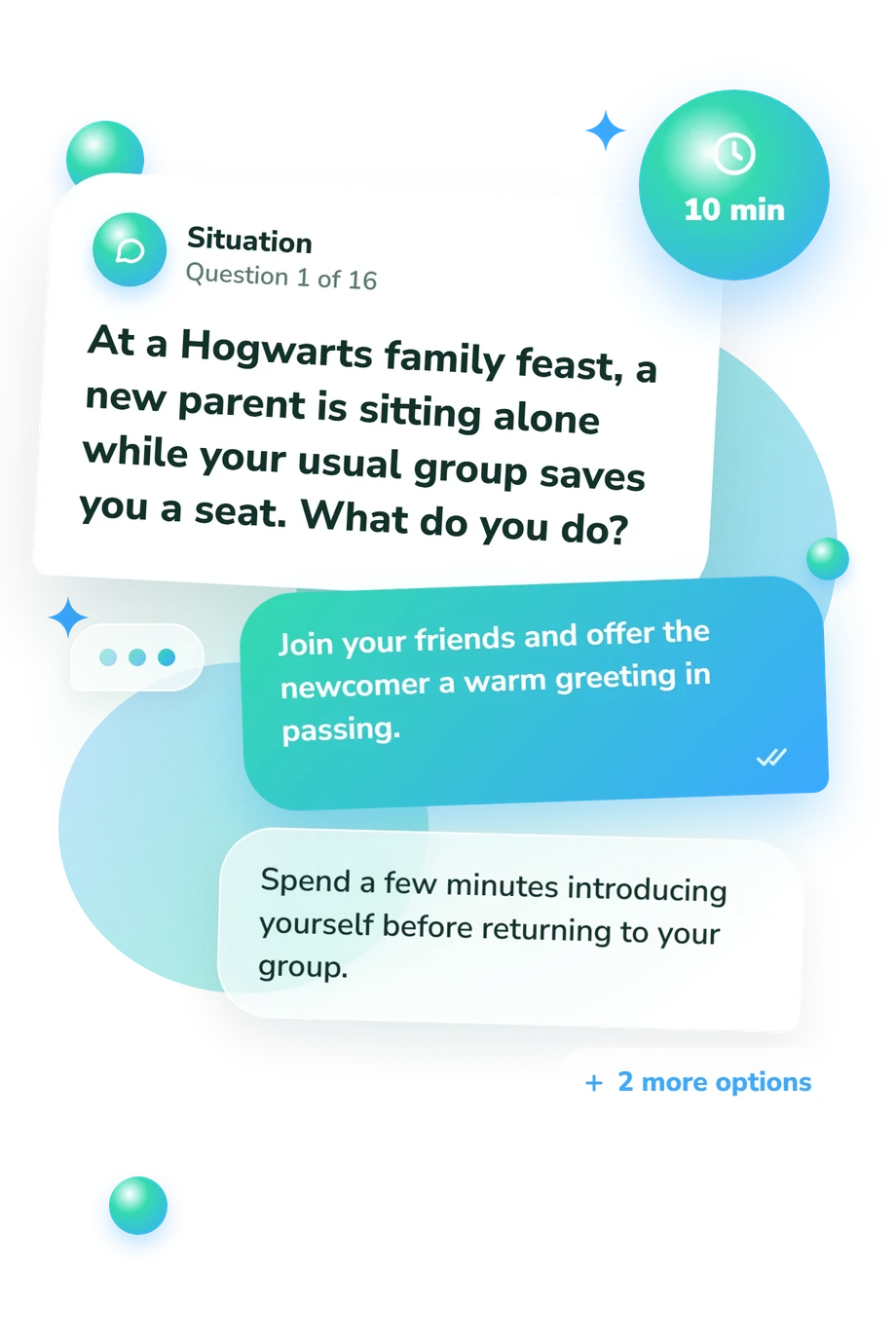
- Join your friends and offer the newcomer a warm greeting in passing.
- Spend a few minutes introducing yourself before returning to your group.
- Invite the newcomer to join the group if they would like company.
- Sit with them and make introductions, staying long enough for them to feel genuinely included.
- Complete their own section efficiently and let the professor manage the partnership.
- Agree on separate tasks so each student can work at a comfortable pace.
- Check in regularly and adjust the workload if one person is struggling.
- Treat the project as a shared responsibility, making sure both partners understand and contribute to the final result.
- Help them contribute backstage first, where they can learn the production without being in the spotlight.
- Suggest they audition only after practicing until the performance feels predictable.
- Encourage a small speaking part so they can stretch themselves without carrying the show.
- Urge them to audition for the role they truly want and praise the courage it takes to be seen trying.
Harry Potter Parents Quiz - Description and methodology of the test
Parents, guardians, and other caregivers who enjoy using fiction as a mirror can use this profile to examine how they guide, protect, encourage, and advocate for a child. The Harry Potter Parents Quiz connects everyday choices with four Hogwarts-style caregiving patterns. Wondering who are my Harry Potter parents becomes a playful reflection on caregiving style, with the focus kept on your own responses.
What This Assessment Explores
The scenarios examine how a caregiver handles inclusion, cooperation, challenge, fairness, planning, persistence, learning, and advocacy. Read as a Harry Potter parenting quiz, the profile identifies the house qualities most visible in your choices rather than assigning a fixed personality label.
These are the four dimensions shown in the result:
- Gryffindor (0-12) reflects courage and principled action: Quiet Resolve (0-4), Courage in Context (5-8), or Daring Protector (9-12).
- Hufflepuff (0-12) reflects patience, fairness, dependability, and community: Independent Supporter (0-4), Steady Teammate (5-8), or Loyal Community Builder (9-12).
- Ravenclaw (0-12) reflects curiosity and independent learning: Practical Guide (0-4), Curious Mentor (5-8), or Wonder Cultivator (9-12).
- Slytherin (0-12) reflects ambition, resourcefulness, and strategic advocacy: Open-Path Encourager (0-4), Thoughtful Strategist (5-8), or Ambitious Advocate (9-12).
The highest score marks your strongest affinity; scores within one point suggest a blended result.
Methodology and Evidence Base
Each item presents a Hogwarts situation with four response options. Across the scenarios, choices contrast practical, cooperative, courageous, investigative, and strategic approaches; respondents select the response closest to their natural approach. The format is a comparative self-report with no right or wrong answer.
Scoring is profile-based: responses produce one 0-12 result for each house. The highest result indicates strongest affinity, while scores within one point are blended. The online version does not publish a point-by-point weighting rule, so individual answers cannot be meaningfully reverse-engineered into a separate measure.
Its conceptual reference point is the Pottermore Sorting Hat Quiz (Crysel et al., 2015), whose four-house framework links personality-related tendencies; this questionnaire is not that published instrument. Jakob et al. (2019) similarly treated Sorting Hat placement as an exploratory relation to personality and human values. Robinson et al. (1995) offers a relevant parenting-practice framework, but this questionnaire is not the Parenting Styles and Dimensions Questionnaire.
That design makes this Hogwarts parenting style quiz an interpretive profile rather than a normed measure. This version has no published standardization, and self-reports can shift with family circumstances, ideals, self-awareness, and familiarity with the fictional setting.
- Crysel, Laura C., Corey L. Cook, Tatiana Orozco Schember, and Gregory D. Webster. 2015. Harry Potter and the measures of personality: Extraverted Gryffindors, agreeable Hufflepuffs, clever Ravenclaws, and manipulative Slytherins. Personality and Individual Differences 83:174-179. 10.1016/j.paid.2015.04.016
- Robinson, Clyde C., Barbara Mandleco, Susanne Frost Olsen, and Craig H. Hart. 1995. Authoritative, Authoritarian, and Permissive Parenting Practices: Development of a New Measure. Psychological Reports 77(3):819-830. 10.2466/pr0.1995.77.3.819
- Jakob, Lea, Eduardo Garcia-Garzon, Hannes Jarke, and Fabian Dablander. 2019. The Science Behind the Magic? The Relation of the Harry Potter “Sorting Hat Quiz” to Personality and Human Values. Collabra: Psychology 5(1):31. 10.1525/collabra.240
Updated: