
Indie Music Quiz
How the Scales are Structured
Who Usually Takes This Test?
See How You Compare
Below is a preview of how scores are typically distributed across each scale.
Example Questions From the Test
- Reptilia
- A-Punk
- Maps
- Do You Want To
- Neon Bible
- The Suburbs
- Funeral
- Reflektor
- Motion Sickness
- Garden Song
- Savior Complex
- Kyoto
Indie Music Quiz - Description and methodology of the test
Listeners who enjoy alternative and independent artists can use this assessment to test how broadly they recognize music from the indie tradition. The indie music quiz focuses on recall rather than taste, connecting names with albums, songs, vocalists, and lyrical narratives. It suits anyone wanting to test the breadth of their knowledge. The indie quiz uses recognition-based prompts to link artists, recordings, and described vocal or lyrical clues.
What This Assessment Explores
Recognition spans artists, recordings, and song narratives. Listeners connect tracks with performers, identify albums and vocalists, and use lyrical clues. The focus is factual recall, not taste, emotion, listening frequency, or authenticity. The four-choice question format makes these indie artist questions concrete while sampling recognition types.
The questionnaire covers these content areas; one score combines performance across them:
- Artist recognition shows whether names, songs, and described vocal characteristics are associated with the correct performer.
- Album and song knowledge links titles, records, and artists accurately.
- Lyrical context shows how narrative clues identify a track.
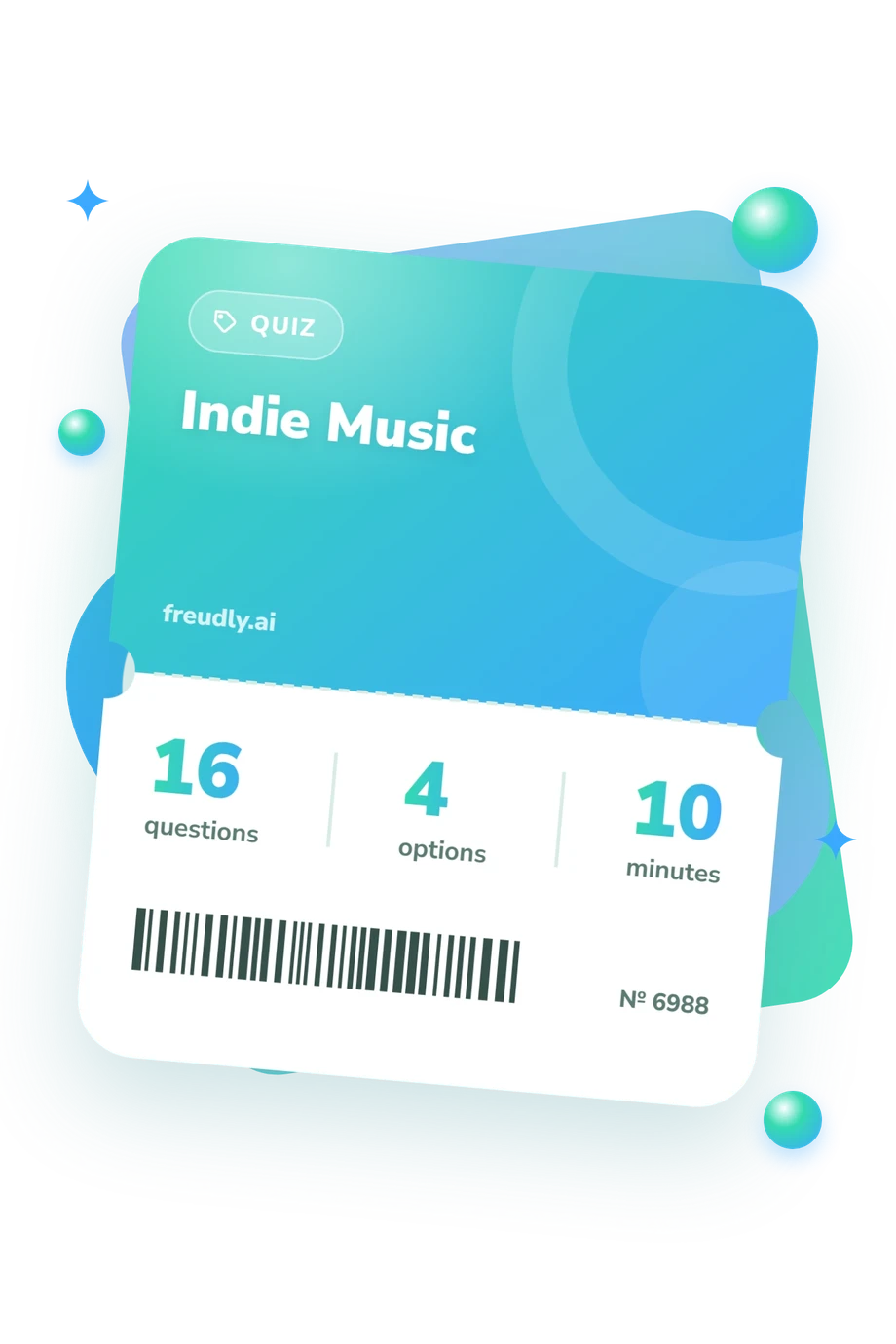
- Indie Music Knowledge is the single score, ranging from 0-16: Foundation Builder (0-6) marks emerging familiarity; Scene Savvy (7-12) marks solid coverage with gaps; Indie Expert (13-16) marks strong command of the tested material.
A higher band reflects recall; lower results highlight areas for exploration.
Methodology and Evidence Base
Each item presents a music-identification prompt with four answer choices. Clues ask for a band, singer, album, or song, sometimes using lyrics, vocal descriptions, metadata, or narrative. The respondent selects the best match, so the format tests recognition rather than performance or opinion.
Results are summarized as one knowledge score with descriptive bands rather than clinical thresholds. The displayed bands describe performance on this item set; they do not establish general musical ability or population-level norms.
This questionnaire is conceptually consistent with the Musical Knowledge Test’s multiple-choice knowledge format but is not an adaptation of it. Work by Öztürk and Kalyoncu on music-knowledge test construction is relevant to the four-choice format but does not supply norms for this assessment.
Recent listening and cultural exposure can affect recall, so performance on indie music recognition questions may vary with familiarity. Honest self-report and attention also matter, so the bands are best read as a focused check of performance on these questions.
- Smith, Kerry L. (2008). Encyclopedia of Indie Rock. Westport, CT: Greenwood Press.
- Öztürk, Özlem, and Nesrin Kalyoncu. (2020). Development of a ‘Musical Knowledge Test’ for the Sixth Grade Music Lesson of Turkish Primary Education. Journal of Theoretical Educational Sciences, 13(3), 609-629.
- Müllensiefen, Daniel, Bruno Gingras, Jan Musil, and Lauren Stewart. (2014). The Musicality of Non-Musicians: An Index for Assessing Musical Sophistication in the General Population. PLOS ONE, 9(2), e89642. 10.1371/journal.pone.0089642.
- Baker, David John, Juan Ventura, Matthew Calamia, Daniel Shanahan, and Emily M. Elliott. (2020). Examining musical sophistication: A replication and theoretical commentary on the Goldsmiths Musical Sophistication Index. Musicae Scientiae, 24(4), 411-429. 10.1177/1029864918811879
Updated: