
Emophilia Quiz
How the Scales are Structured
Who Usually Takes This Test?
See How You Compare
Below is a preview of how scores are typically distributed across each scale.
Example Questions From the Test
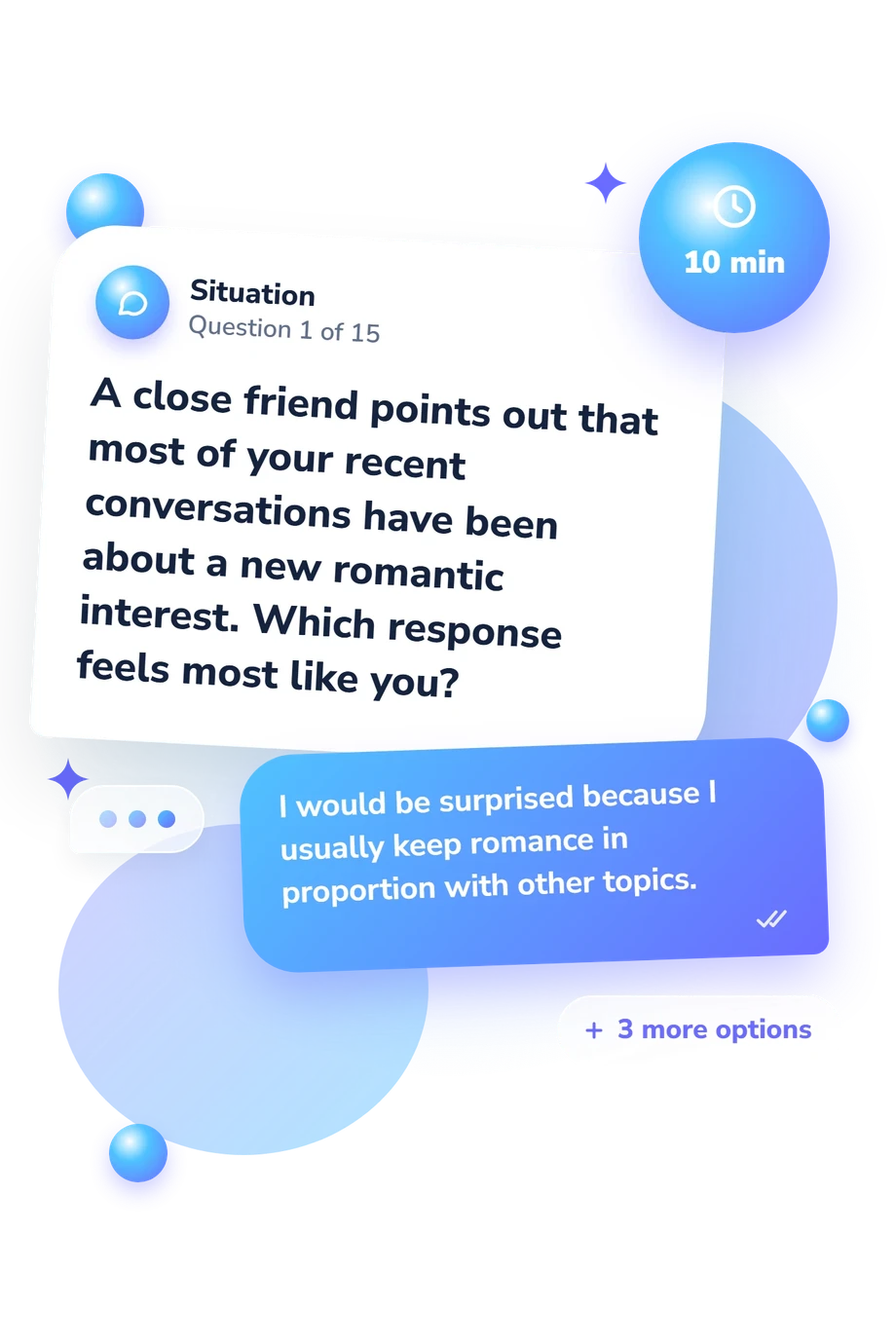
- I would be surprised because I usually keep romance in proportion with other topics.
- I would recognize some extra enthusiasm but still feel connected to the rest of my life.
- I would agree that the person has taken up a large share of my attention.
- I would understand because nearly everything currently seems connected to the romance.
- Quite early; strong chemistry can feel like love almost immediately.
- After some consistency, even if we have known each other only briefly.
- Only after I have seen who the person is across different situations.
- Once trust is starting to form, but before we know each other deeply.
- I enjoy it, reply when practical, and stay focused on my day.
- It lifts my mood and crosses my mind a few more times.
- I find it hard to concentrate because I keep thinking about them.
- The message becomes the emotional center of my day.
Emophilia Quiz - Description and methodology of the test
People who notice that a new connection becomes emotionally central quickly may use the Emophilia Quiz to organize those experiences. This emophilia assessment is intended for readers reflecting on attraction, attachment, romantic focus, and comfort with single life. Its profile highlights tendencies that may help someone compare feelings with priorities, pacing, and observable relationship behavior.
What This Assessment Explores
Emophilia describes attraction becoming emotionally significant quickly. Items address early chemistry, imagined commitment, delayed replies, dating pauses, mismatched goals, and reactions to being single.
As a romantic attachment test, it shows whether investment outruns familiarity or romance crowds out other priorities. The result has three reflective dimensions:
- Attachment Speed (0-15) shows how quickly attraction becomes attachment: Gradual Bond Builder (0-5), Quickening Attachment (6-10), or Fast-Falling Tendency (11-15).
- Romantic Absorption (0-15) shows how much new romance captures thought, mood, and priorities: Steady Focus (0-5), Romance-Engaged (6-10), or Romance-Absorbed (11-15).
- Single-Life Contentment (0-15) shows comfort and fulfillment without a relationship: Partnership-Oriented (0-5), Situationally Flexible (6-10), or Independently Content (11-15).
Together, they show how attachment, romantic focus, and single-life comfort interact in a personal pattern rather than a verdict.
Methodology and Scientific Basis
Each item presents a situation with four choices representing different degrees of attachment, romantic absorption, or single-life contentment. The prompts ask about typical patterns, not only passing moods.
This emophilia questionnaire uses a dimension-based profile rather than one overall label. The displayed bands organize each tendency, while separate results keep rapid attachment, romantic focus, and partnership needs distinct.
The closest published reference is the Emotional Promiscuity Scale, the instrument associated with emophilia. This online questionnaire is conceptually consistent with that construct, but it is not a validated reproduction or adaptation of the published scale. Jones's 2019 study links emophilia with relationship dispositions and life outcomes, while Røed and colleagues' 2024 study reports psychometric findings for the scale in a Scandinavian sample.
As a relationship self-assessment, the profile is best read alongside current context and behavior. Self-report can be shaped by infatuation, mood, memory, social expectations, and self-awareness. The displayed bands are reflective rather than clinical; they do not determine relationship quality or compatibility.
- Røed, S. E., Nærland, R. K., Strat, M., Pallesen, S., & Erevik, E. K. (2024). Emophilia: Psychometric properties of the emotional promiscuity scale and its association with personality traits, unfaithfulness, and romantic relationships in a Scandinavian sample. Frontiers in Psychology, 15, 1265247. 10.3389/fpsyg.2024.1265247
- Jones, D. N. (2019). Defining Emophilia Through the Emotional Promiscuity Scale. In R. R. Milhausen, J. K. Sakaluk, T. D. Fisher, C. M. Davis, & W. L. Yarber (Eds.), Handbook of Sexuality-Related Measures (4th ed., pp. 436-438). Routledge. 10.4324/9781315183169
- Jones, D. N. (2015). Life outcomes and relationship dispositions: The unique role of Emophilia. Personality and Individual Differences, 82, 153-157. 10.1016/j.paid.2015.03.024
Updated: