
How Intelligent Are You Quiz
How the Scales are Structured
Who Usually Takes This Test?
See How You Compare
Below is a preview of how scores are typically distributed across each scale.
Example Questions From the Test
- 12 minutes
- 15 minutes
- 16 minutes
- 18 minutes
- Copper objects conduct only some of the time.
- The object contains no metal at all.
- Every nonconductive object is made of plastic.
- The object is not made entirely of copper.
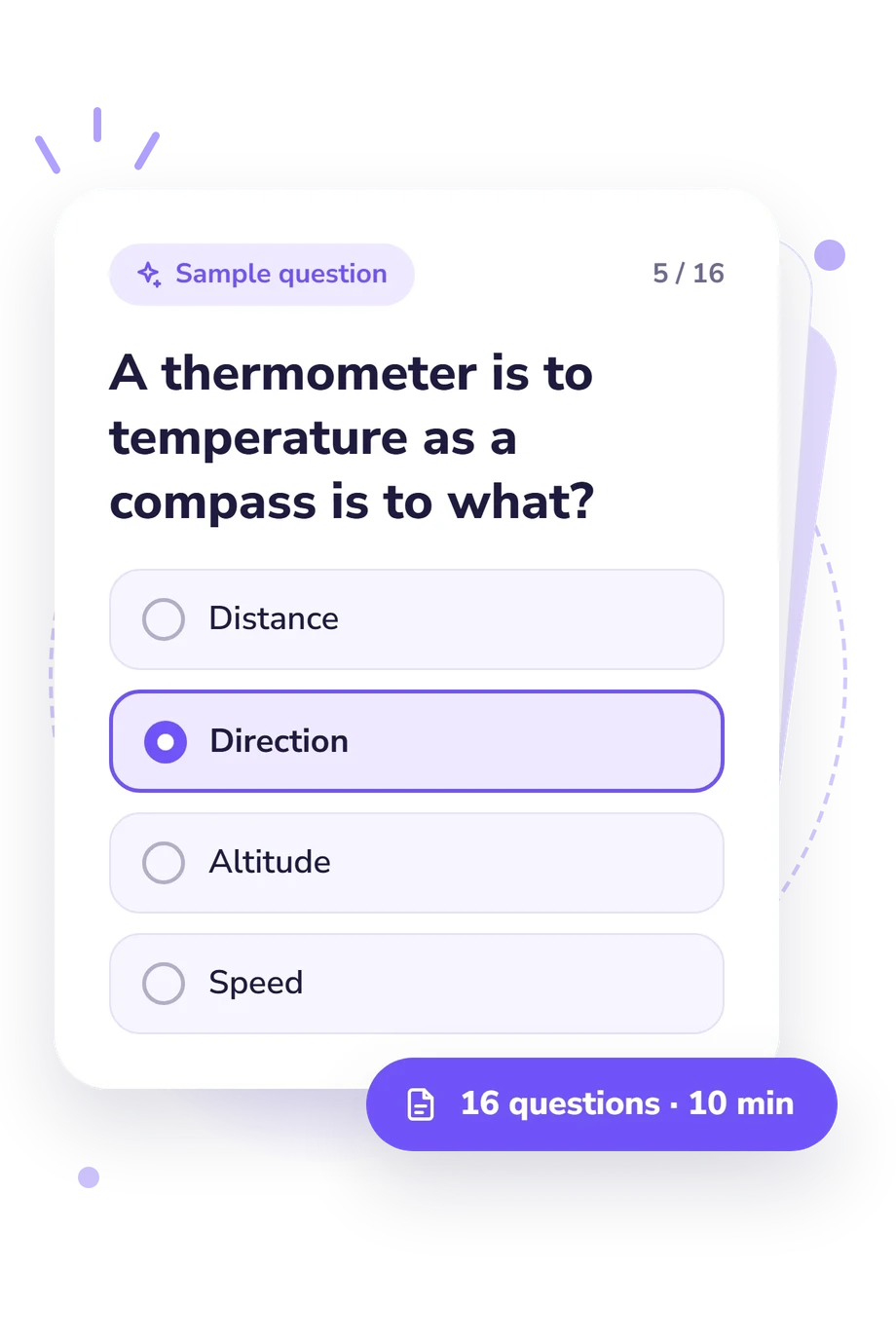
- Distance
- Direction
- Altitude
- Speed
How Intelligent Are You Quiz - Description and methodology of the test
People who want a quick, structured look at how they handle common reasoning problems can use the How Intelligent Are You Quiz to decide whether this kind of assessment matches their interests. It is suited to curious visitors who want to examine problem-solving and decide what they want to explore further. This psychology intelligence quiz offers a structured look at reasoning and intelligence, giving readers a result to consider alongside their goals.
What This Assessment Explores
The questions sample several kinds of mental work rather than one narrow ability. They cover probabilities, averages, rates, patterns, analogies, conditional rules, evidence, and the difference between a necessary conclusion and a tempting assumption. The resulting intelligence assessment summarizes performance on this quiz only: it shows how accurately the respondent handled this aggregate set of reasoning tasks, rather than measuring each area separately.
The score and task themes are:
- Reasoning Knowledge: 0-16 counts correct answers. Emerging foundation (0-6) means the items were challenging; Developing range (7-12) means many were solved correctly but checking assumptions may help; Strong performance (13-16) means most varied tasks were handled accurately.
- Quantitative reasoning shows work with percentages, averages, rates, probability, and sequences.
- Verbal and formal logic shows handling of categories, analogies, conditions, and necessary conclusions.
- Evidence-based judgment shows recognition of sampling flaws and overextended claims.
Methodology and Scientific Basis
Each item presents a problem with four answer choices and asks for one best response. The displayed scoring assigns one point for each correct answer and sums those points into a total. The format tests selected skills, with the total reflecting the number of correct responses rather than separate domain scores.
Methodologically, the mix of varied and applied problem-solving tasks and learned information is conceptually consistent with SAFRAN. Cattell’s account of fluid and acquired abilities and Carroll’s factor-analytic model provide relevant theoretical context. These sources support the kinds of abilities sampled here, but this online questionnaire is not an adaptation of SAFRAN.
Interpret the result as performance on these particular tasks under the test’s conditions. The bands are descriptive summaries of performance on this quiz only, not validated IQ or intelligence classifications. The 2014 testing standards stress that interpretations need evidence suited to their intended use; here, concentration, language, familiarity with similar problems, and current context can affect performance. Results from this reasoning ability quiz are most useful as a prompt to review the reasoning habits reflected in the items.
- Mussel, P., Schäpers, P., Schulte, N., Hewig, J., & Krumm, S. (2025). The Short And Free Reasoning Ability assessmeNt (SAFRAN): Multidimensional, publicly available and only 15 minutes testing time. Intelligence, 112, 101947. DOI 10.1016/j.intell.2025.101947
- Cattell, R. B. (1943). The measurement of adult intelligence. Psychological Bulletin, 40(3), 153-193. DOI 10.1037/h0059973
- Carroll, J. B. (1993). Human cognitive abilities: A survey of factor-analytic studies. Cambridge University Press.
- American Educational Research Association, American Psychological Association, & National Council on Measurement in Education. (2014). Standards for educational and psychological testing. American Educational Research Association.
Updated: