
Gustar Practice Quiz
How the Scales are Structured
Who Usually Takes This Test?
See How You Compare
Below is a preview of how scores are typically distributed across each scale.
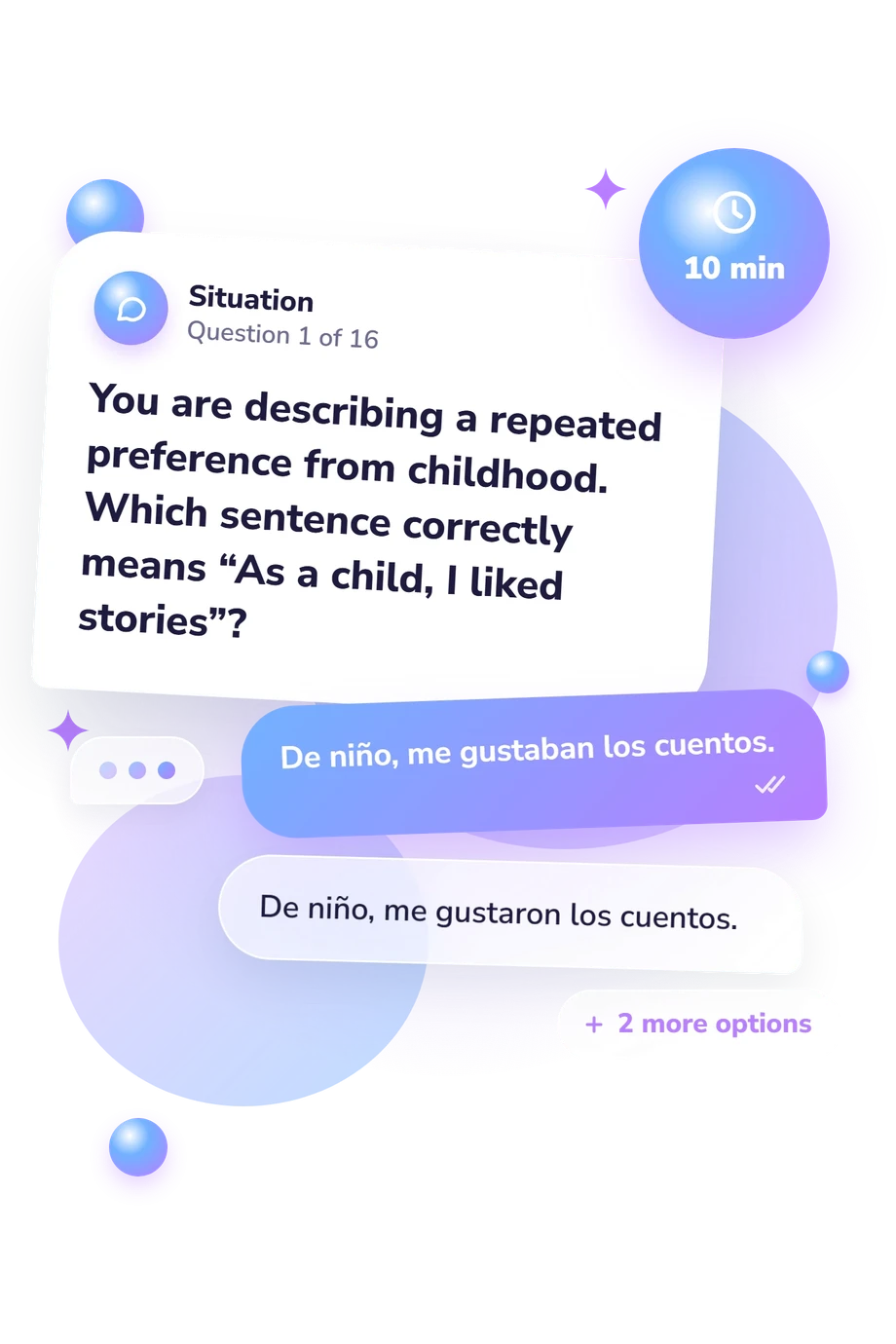
Example Questions From the Test
- De niño, me gustaban los cuentos.
- De niño, me gustaron los cuentos.
- De niño, yo gustaba los cuentos.
- De niño, me gustaba los cuentos.
- ¿Te gustan las películas?
- ¿Te gusta las películas?
- ¿Tú gustas las películas?
- ¿Le gustan las películas?
- A mis amigos le gusta la música.
- A mis amigos les gustan la música.
- Mis amigos gustan la música.
- A mis amigos les gusta la música.
Gustar Practice Quiz - Description and methodology of the test
Students checking their command of Spanish gustar patterns can use this gustar practice quiz to identify correct pronouns, agreement, negation, emphasis, and tense or mood forms. It is suited to learners working with indirect object pronouns, subject-verb agreement, negation, emphasis, and changes in meaning across present, past, and conditional contexts. Results from this Spanish gustar quiz identify which parts of the construction deserve more attention.
What This Assessment Explores
The questions focus on gustar-type verbs, where the liked thing controls agreement and the interested person appears through an indirect object pronoun. They test explicit clarifiers such as A Carlos, singular-versus-plural forms, negation, emphasis, familiar address, and changes in tense or mood.
The result describes accuracy with the patterns sampled here, not vocabulary, speaking fluency, or overall Spanish ability. It is reported as:
- Gustar Knowledge (0-16) shows control of the tested structures: Foundations to Review (0-6) marks core patterns to revisit; Developing Command (7-12) reflects a workable structure with context or form distinctions to practise; Strong Command (13-16) reflects accurate use across the quiz.
This makes the result a focused guide for Spanish gustar practice.
Methodology and Evidence Base
Each item presents a short Spanish sentence or situation with four answer choices. You select the form that best matches meaning and grammar, including pronoun choice, agreement, emphasis, informal or plural address, and tense or mood. Some items ask for a correction, so the task involves grammatical reasoning as well as translation.
The displayed result places performance in the catalogue’s instructional bands and reflects these quiz items rather than overall Spanish proficiency. It does not describe proficiency beyond the tested constructions. Higher bands indicate firmer control of the sampled grammatical forms.
Research by Kanwit and Quesada examines learner and native-speaker judgments involving gustar-type psychological verbs. Work by Zhang offers an acquisition perspective, while the Spanish grammar reference supplies a framework for pronouns, agreement, and verb use. These sources clarify the content focus; they do not identify this questionnaire as an adaptation.
Because this is a gustar grammar test, results depend on attention to each short context and interpretation of its wording. Reviewing missed patterns alongside broader language practice gives the score its most useful meaning.
- Kanwit, Matthew, and Margaret Lubbers Quesada. (2018). Learner and native-speaker differences in the acceptability of gustar-type psychological verbs in Spanish. International Review of Applied Linguistics in Language Teaching, 56(3), 279-313. 10.1515/iral-2015-0102
- Zhang, Shu. (2021). The acquisition of Spanish as L3 by Chinese students: constructions with gustar. Círculo de Lingüística Aplicada a la Comunicación, 88, 255-268. 10.5209/clac.78314
- Real Academia Española and Asociación de Academias de la Lengua Española. (2009). Nueva gramática de la lengua española. Madrid: Espasa.
Updated: