
Controversial Quiz
How the Scales are Structured
Who Usually Takes This Test?
See How You Compare
Below is a preview of how scores are typically distributed across each scale.
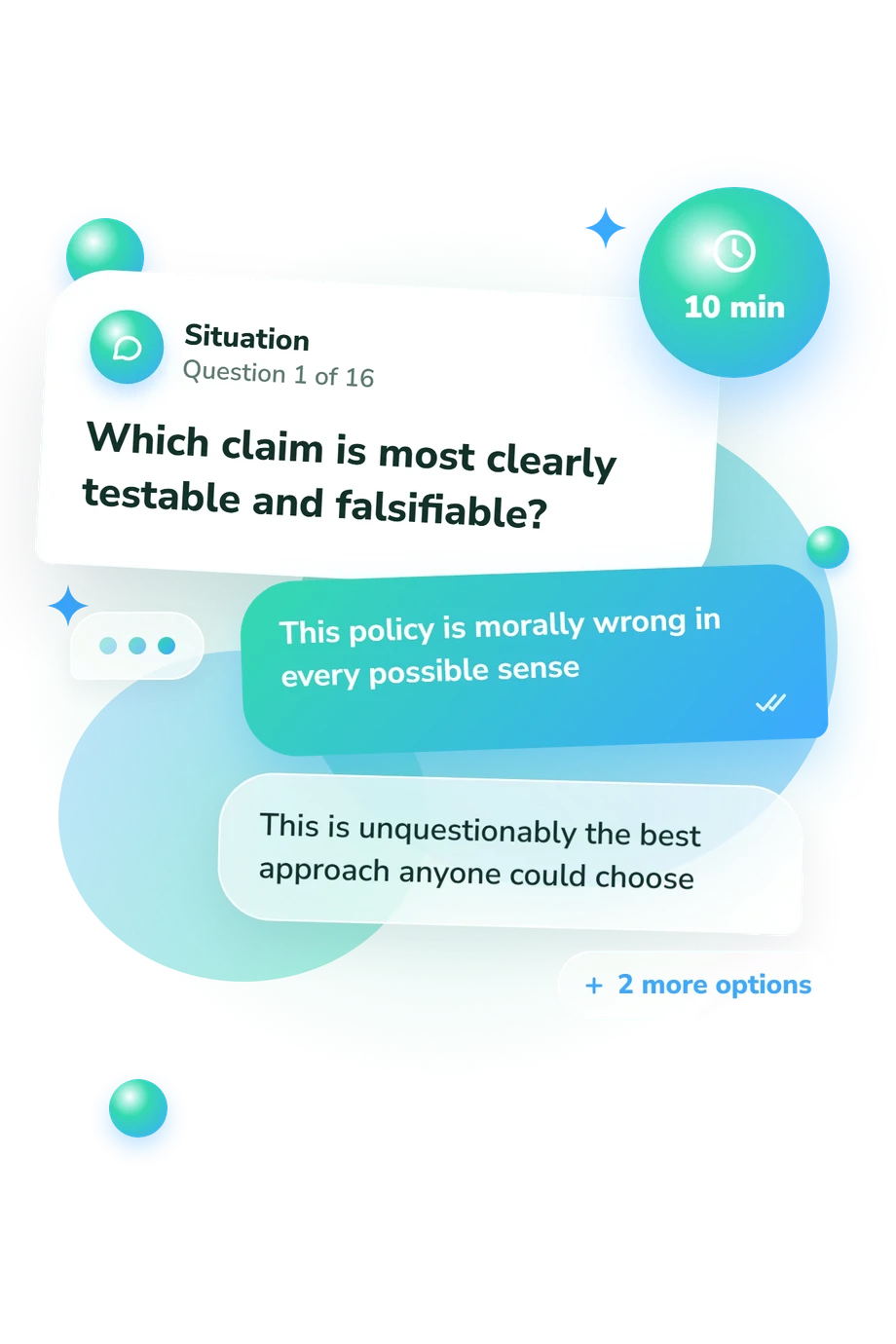
Example Questions From the Test
- This policy is morally wrong in every possible sense
- This is unquestionably the best approach anyone could choose
- Within one year of implementation, average reported wait times will fall by at least 10%
- Anyone who understands the issue already knows the answer
- Assume the clip is complete because the speaker is visible
- Locate the longer recording or transcript and check the surrounding context
- Read the most-liked reaction posted beneath the clip
- Judge it by whether the remark fits the speaker's reputation
- Repeat it using more emotionally forceful language
- List every possible objection before they can respond
- Present its strongest reasonable form before evaluating it
- Treat the argument as correct to avoid disagreement
Controversial Quiz - Description and methodology of the test
People who want to see which parts of responsible public reasoning they understand, and which merit further study, can use this controversial quiz as a focused self-check. It suits readers who encounter contentious claims in news, civic discussion, education, or everyday conversation. The result offers an educational snapshot of strengths and gaps in evaluating controversial claims through evidence, reasoning, and context.
What This Assessment Explores
The questionnaire examines knowledge of methods for evaluating disputed claims and discussing them responsibly, rather than measuring which opinions you hold. It covers testability, context, source verification, evidence quality, causal reasoning, fallacies, expert consensus, steel-manning, and active listening. It suits anyone seeking critical evaluation of controversial topics rather than ideological agreement.
The question themes fall into these groups:
- Testability and evidence checks show whether claims can be examined and whether evidence supports them.
- Source evaluation shows whether you verify context, provenance, and independent reporting.
- Reasoning quality shows whether you spot false dilemmas, straw men, cherry-picking, and ad hominem attacks.
- Discussion skills show whether you steelman positions, listen actively, and treat anecdotes appropriately.
The result uses one educational scale: Controversial Topics Knowledge (0-16), with Emerging Foundation (0-6), Developing Knowledge (7-12), and Strong Knowledge (13-16).
Methodology and Evidence Base
Each item presents a short scenario or claim with four answer choices, and the respondent selects the strongest response. The result is a single educational score interpreted through the displayed bands; because no item weights or normative conversion are stated, no more detailed scoring formula should be inferred. As a critical thinking quiz, it can indicate topics worth reviewing without assigning a permanent label.
Its closest conceptual anchor is the Halpern Critical Thinking Assessment, which links critical-thinking skills with real-world outcomes. This questionnaire is conceptually consistent with that work, not an adaptation or validated administration of it. Research by McGrew and colleagues supports the emphasis on civic online reasoning, while Wineburg and McGrew explain lateral reading as a way to evaluate digital information. Facione's consensus framework supports the focus on interpretation, analysis, evaluation, inference, explanation, and self-regulation.
This educational questionnaire has no stated standardised norms or reliability estimates, and its score has no diagnostic thresholds. Attention, prior knowledge, current context, and guessing can affect performance, so the result is best read as an educational snapshot that points toward further practice.
- Butler, Heather A., Christopher P. Dwyer, Michael J. Hogan, Amanda Franco, Silvia F. Rivas, Carlos Saiz, and Leandro S. Almeida. "The Halpern Critical Thinking Assessment and Real-World Outcomes: Cross-National Applications." Thinking Skills and Creativity, vol. 7, no. 2, 2012, pp. 112-121. DOI 10.1016/j.tsc.2012.04.001
- McGrew, Sarah, Joel Breakstone, Teresa Ortega, Mark Smith, and Sam Wineburg. "Can Students Evaluate Online Sources? Learning from Assessments of Civic Online Reasoning." Theory & Research in Social Education, vol. 46, no. 2, 2018, pp. 165-193. DOI 10.1080/00933104.2017.1416320
- Wineburg, Sam, and Sarah McGrew. "Lateral Reading and the Nature of Expertise: Reading Less and Learning More When Evaluating Digital Information." Teachers College Record, vol. 121, no. 11, 2019, pp. 1-40. DOI 10.1177/016146811912101102
- Facione, Peter A. Critical Thinking: A Statement of Expert Consensus for Purposes of Educational Assessment and Instruction: Research Findings and Recommendations. American Philosophical Association, Committee on Pre-College Philosophy, 1990. ERIC Document ED315423
Updated: