
Stress in the Workplace Quiz
How the Scales are Structured
Who Usually Takes This Test?
See How You Compare
Below is a preview of how scores are typically distributed across each scale.
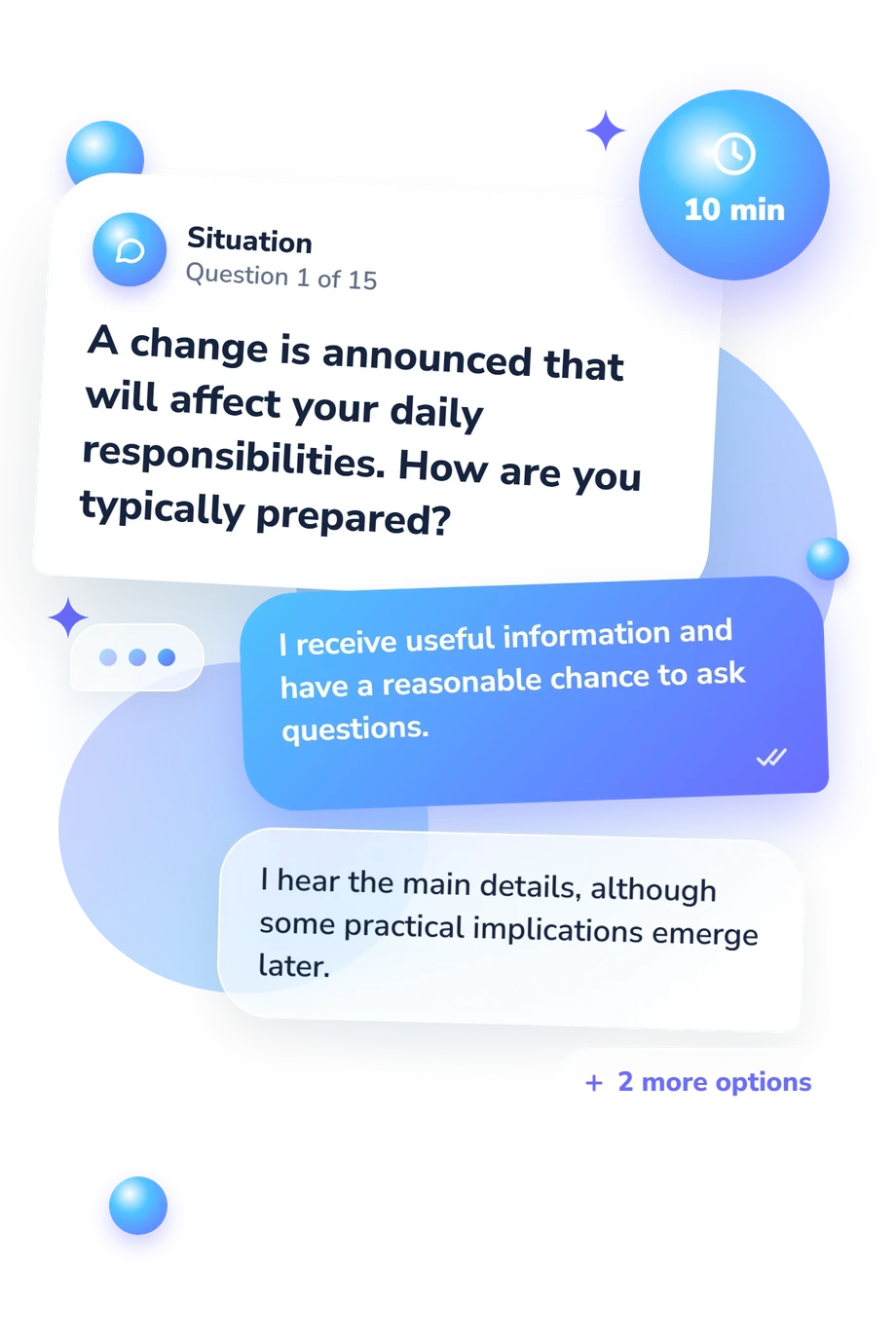
Example Questions From the Test
- I receive useful information and have a reasonable chance to ask questions.
- I hear the main details, although some practical implications emerge later.
- I learn about it late and must adapt with important questions unanswered.
- Information arrives in pieces, requiring me to work out several effects myself.
- The response varies: some mistakes lead to learning, while others bring blame.
- Mistakes are examined constructively, with accountability and room to improve.
- The focus is often on embarrassment or punishment rather than solving the problem.
- Most mistakes are handled fairly, though reactions can become tense under pressure.
- There are intense periods, but they are usually followed by room to recover.
- The pace is demanding on many days, with only occasional opportunities to reset.
- The pace is generally sustainable within my available time and energy.
- The pace feels continuously urgent, with little or no meaningful recovery time.
Stress in the Workplace Quiz - Description and methodology of the test
People who feel stretched, uncertain, or unsupported at work can use the Stress in the Workplace Quiz to examine the conditions surrounding that strain. It suits employees reflecting on recent experiences, preparing for a conversation about work demands, or looking for practical patterns rather than a single label. The workplace stress quiz focuses on situations involving changing responsibilities, unclear priorities, interpersonal tension, and limited recovery.
What This Assessment Explores
Questions cover changes, mistakes, priorities, conflict, speaking up, recognition, pace, breaks, unfinished tasks, and switching off. This workplace stress assessment groups related experiences into dimensions, showing whether strain is concentrated in one area or distributed across several. Higher scores indicate more difficulty in the relevant dimension.
The three displayed dimensions are:
- Control and Role Clarity (0-15) reflects influence and certainty; Clear footing (0-5) means workable clarity, Friction and uncertainty (6-10) signals recurring ambiguity, and Persistent lack of control (11-15) indicates low influence.
- Support and Workplace Climate (0-15) reflects help, respect, communication, and speaking up; Supportive foundation (0-5) means support is usually available, Uneven climate (6-10) signals inconsistency, and Strained environment (11-15) indicates persistent pressure.
- Workload and Recovery (0-15) reflects demands and recovery; Manageable rhythm (0-5) means balance is often possible, Recurring strain (6-10) signals repeated pressure, and Sustained overload pattern (11-15) indicates limited recovery.
Methodology and Scientific Basis
Each item describes a workplace situation with four response options representing different experiences. The respondent chooses the option that best matches recent conditions, keeping the result grounded in self-report. The questionnaire presents three banded scale summaries, and its stated scoring method does not provide a per-option response-to-score conversion.
The framework is conceptually consistent with the Management Standards Indicator Tool (Cousins et al., 2004), which examines demands, control, support, relationships, role, and change. The HSE user manual describes application of the HSE Management Standards Indicator Tool, while Edwards et al. (2008) analyzed the published tool’s psychometric properties. This questionnaire is not presented as a direct adaptation; it organizes related experiences for reflection.
These bands help interpret stress at work by connecting a higher result with the specific circumstances behind it, such as workload, recovery, or workplace relationships. Results can frame questions about priorities, workload, boundaries, or communication for a manager, colleague, union, employee service, or healthcare professional. Because this is an unvalidated reflective summary, its bands are not standardized clinical cutoffs. Current mood, recent conflict, memory, and openness can influence self-report, so interpret the result alongside wider circumstances.
- Rosanna Cousins, Colin J. MacKay, Simon D. Clarke, Chris Kelly, Peter J. Kelly, Ron H. McCaig. 'Management Standards' work-related stress in the UK: practical development. Work & Stress. 2004;18(2):113-136. 10.1080/02678370410001734322.
- Health and Safety Executive. HSE Management Standards Indicator Tool User Manual. HSE; 2004.
- Julian A. Edwards, Simon Webster, Darren Van Laar, Simon Easton. Psychometric analysis of the UK Health and Safety Executive's Management Standards work-related stress indicator tool. Work & Stress. 2008;22(2):96-107. 10.1080/02678370802166599.
Updated: