
Software Quiz
How the Scales are Structured
Who Usually Takes This Test?
See How You Compare
Below is a preview of how scores are typically distributed across each scale.
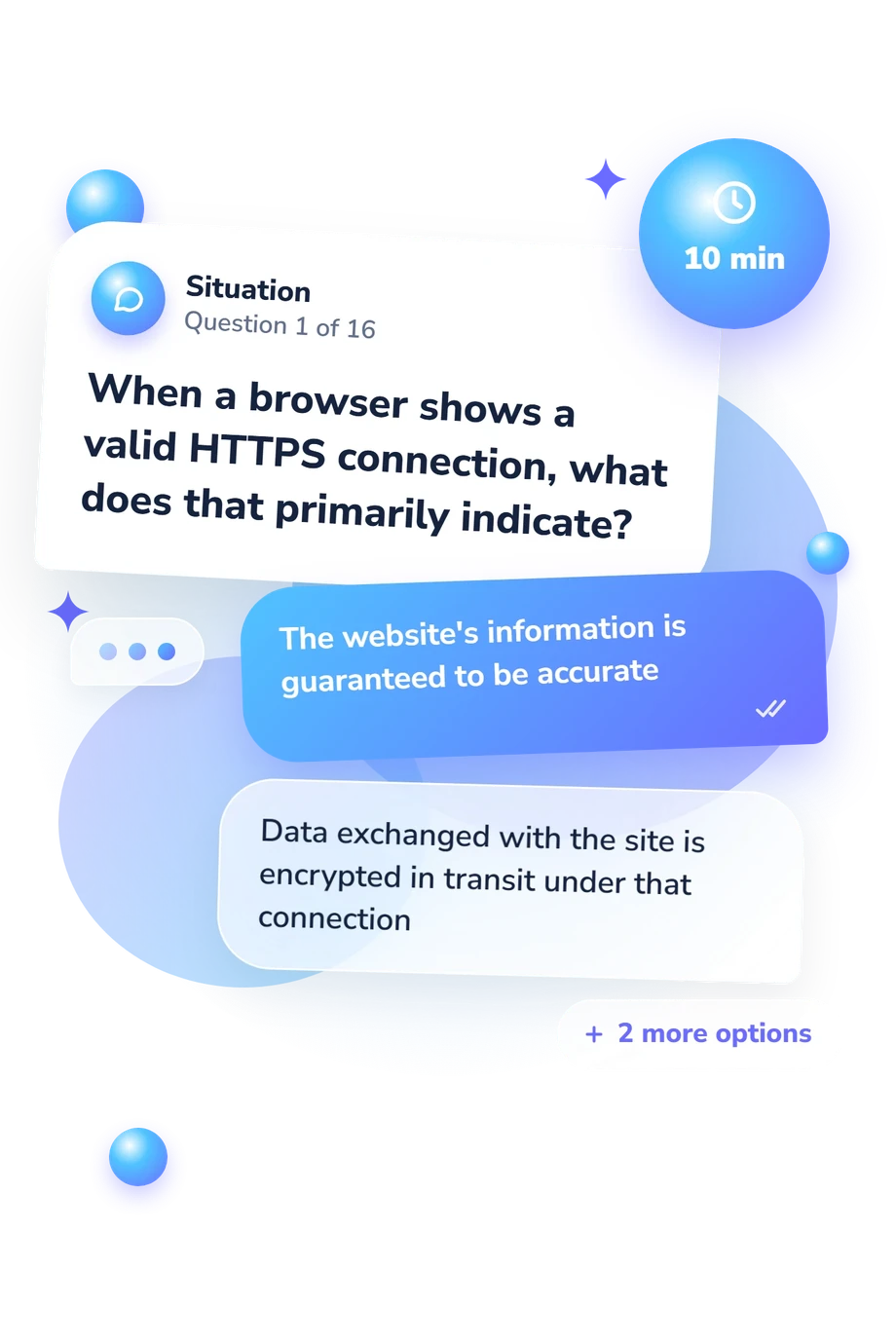
Example Questions From the Test
- The website's information is guaranteed to be accurate
- Data exchanged with the site is encrypted in transit under that connection
- The website cannot contain malicious downloads
- The visitor is completely anonymous to the website
- Adding more RAM
- Installing a larger monitor
- Replacing the keyboard
- Adding more long-term file storage
- UPDATE
- INSERT
- SELECT
- DROP
Software Quiz - Description and methodology of the test
For people who want a clear check of practical computing knowledge, software quiz questions in this assessment examine how they handle familiar concepts, everyday problems, and basic development ideas. It suits learners, workers, and curious users seeking a software knowledge test rather than a narrow programming exam. The result highlights areas of confidence and topics that may deserve further study.
What This Assessment Explores
The questionnaire measures broad computing knowledge rather than a specialist skill. Questions and answers in the software quiz connect terminology with action across security, troubleshooting, programming, development, databases, and system use. It suits anyone seeking a general competence profile, not a judgment of one specialty.
The main item groups are:
- Security and maintenance show safer handling of connections, updates, backups, and downloads.
- Systems and troubleshooting indicate understanding of resources, operating systems, compatibility, and unresponsive applications.
- Development and data concepts cover iteration, compilers, version control, testing, APIs, hosted services, licensing, and SQL.
The single Software Knowledge scale runs from 0-16: Foundations to build (0-6) marks concepts worth reviewing; Developing knowledge (7-12) reflects many usable ideas with some gaps; Strong knowledge (13-16) indicates a reliable grasp of general software concepts. These bands summarize overall performance, not separate specialty scores.
Methodology and Scientific Basis
As a computer literacy quiz, the assessment uses short definitions and practical scenarios with several answer choices. Items cover HTTPS, RAM for a memory bottleneck, iterative delivery, targeted troubleshooting, and SQL commands such as SELECT and INSERT. The format tests recognition and application: the respondent chooses the option that best fits the situation.
The result is one combined score across the questionnaire. The bands summarize overall performance, not separate specialty scores. Because per-answer weighting is not documented, the total should be read as an educational summary rather than a reconstructed diagnostic formula.
Methodologically, the questionnaire is conceptually consistent with the Standardized Computer Literacy Test (Simonson et al., 1987). Lin (2011) provides a later example of computer-literacy scale development and validation, while DigComp 2.1 (Carretero, Vuorikari, and Punie, 2017) organizes related digital-competence areas. These sources support comparison of the domains, but this online test is not presented as an adaptation or standardized reproduction of any one instrument.
Self-report performance can vary with guessing, prior exposure, and current context, so the result is best used as an educational snapshot.
- Simonson, Michael R., Matthew M. Maurer, Mary Montag-Torardi, and Mary Whitaker. "Development of a Standardized Test of Computer Literacy and a Computer Anxiety Index." Journal of Educational Computing Research 3, no. 2 (1987): 231-247. 10.2190/7CHY-5CM0-4D00-6JCG
- Lin, Tung-Cheng. "A Computer Literacy Scale for Newly Enrolled Nursing College Students: Development and Validation." Journal of Nursing Research 19, no. 4 (2011): 305-317. 10.1097/JNR.0b013e318236d03f
- Carretero, Stephanie, Riina Vuorikari, and Yves Punie. "DigComp 2.1: The Digital Competence Framework for Citizens with Eight Proficiency Levels and Examples of Use." EUR 28558 EN. Luxembourg: Publications Office of the European Union, 2017. 10.2760/38842
Updated: