
Silly Quiz
How the Scales are Structured
Who Usually Takes This Test?
See How You Compare
Below is a preview of how scores are typically distributed across each scale.
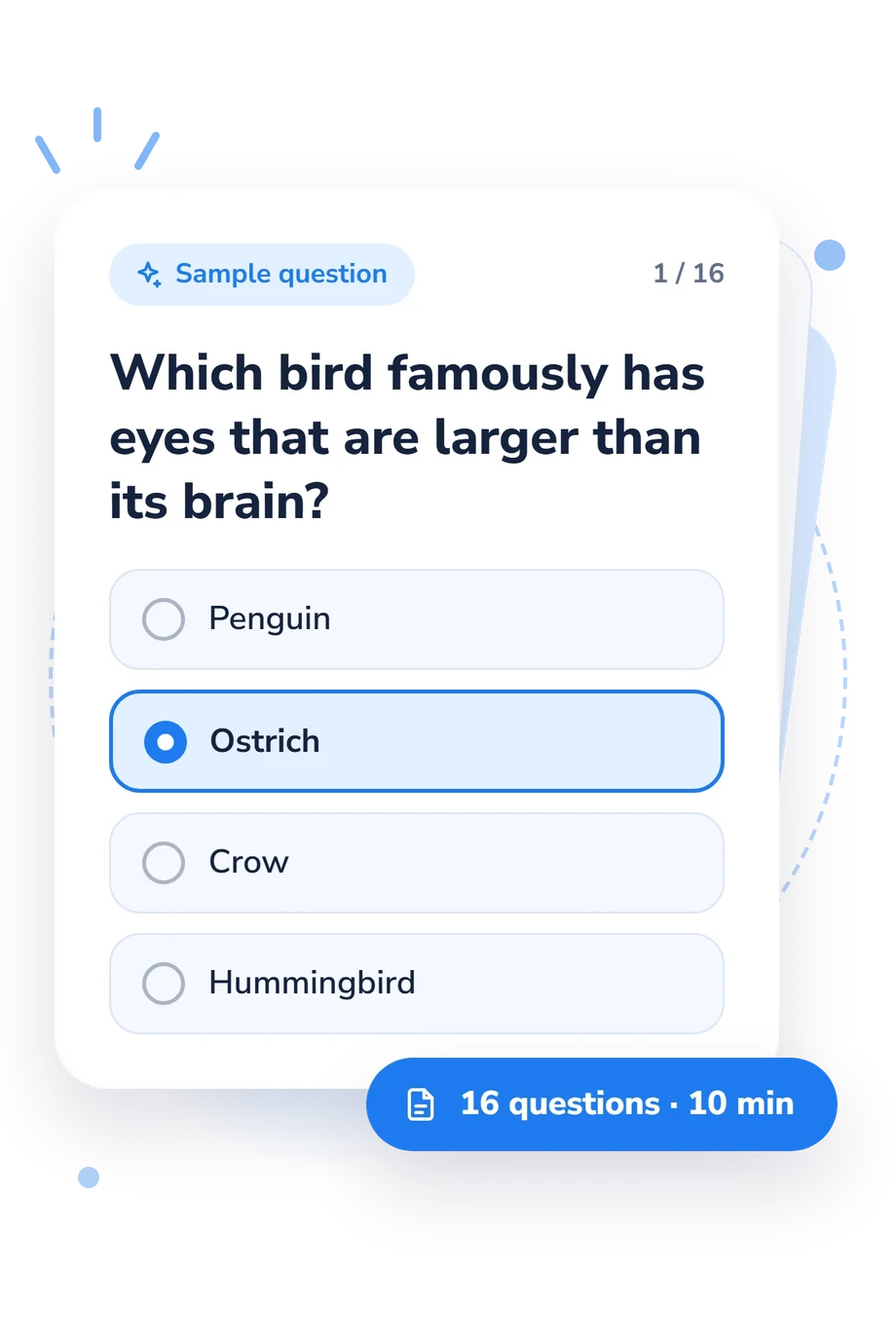
Example Questions From the Test
- Penguin
- Ostrich
- Crow
- Hummingbird
- Elephant
- Goat
- House cat
- Kangaroo
- Capybara
- Platypus
- Sea otter
- Armadillo
Silly Quiz - Description and methodology of the test
Anyone who enjoys odd facts, classroom-style curiosity, or a quick break from serious assessments can use this silly quiz to decide whether a short factual challenge suits the moment. The questions use direct recall and familiar scenarios, while the displayed result is the total number of correct answers. As a quirky quiz, it keeps the tone light while still rewarding careful thinking.
What This Assessment Explores
It measures recognition of unusual facts, not personality. Questions span animal anatomy, plant and food science, astronomy, chemistry, physics, and everyday observations. Some require direct identification; others apply knowledge to familiar events, so together they test recall and application.
Silly Trivia Knowledge (0-16) summarizes correct answers across the quiz. The bands are Curious Starter (0-6), Playful Fact Finder (7-12), and Silly Trivia Star (13-16). They describe this performance, not intelligence or general education. The playful subject matter gives this fun facts quiz a light tone, while its useful outcome is a focused picture of factual knowledge.
The main themes are:
- Animal biology shows knowledge of unusual structures, behaviors, and adaptations.
- Everyday science shows whether familiar events are explained accurately.
- Nature and food facts show recognition of classifications, properties, and processes.
This mix suits curious learners without expert training.
Methodology and Scientific Basis
The questionnaire is a general knowledge quiz using a multiple-choice format, with one best answer for each prompt. Some ask for direct identification; others present scenarios requiring applied knowledge, such as explaining onion tears or why a heated kernel bursts. Plausible distractors make careful reading important.
Scoring is answer-based: the displayed scale summarizes correct answers across the quiz. It does not establish a separate trait profile, weighting system, or clinical threshold, so the result is a compact knowledge snapshot rather than a psychological diagnosis.
The cited works cross-check selected topics: a trivia reference covers unusual general knowledge, one study examines the wombat item, and another explains onion tear chemistry. They do not validate this questionnaire's measurement properties or make it a standardized adaptation, and no broader norm group is implied.
A humorous trivia quiz can reward curiosity as well as recall, but performance may vary with attention, language, education, and prior exposure to unusual facts. Read the bands as descriptions of this attempt, not fixed measures of ability; repeated attempts may reflect memory of the questions rather than new knowledge.
- Lloyd, John, and John Mitchinson. The Book of General Ignorance. Faber and Faber, 2006. ISBN 9780571233687.
- Yang, Patricia J., Alexander B. Lee, Miles Chan, Michael Kowalski, Kelly Qiu, Christopher Waid, Gabriel Cervantes, Benjamin Magondu, Morgan Biagioni, Larry Vogelnest, Alynn Martin, Ashley Edwards, Scott Carver, and David L. Hu. "Intestines of non-uniform stiffness mold the corners of wombat feces." Soft Matter 17 (2021): 475-488. 10.1039/D0SM01230K.
- Imai, Shinsuke, N. Tsuge, M. Tomotake, Y. Nagatome, H. Sawada, T. Nagata, and H. Kumagai. "An onion enzyme that makes the eyes water." Nature 419 (2002): 685. 10.1038/419685a.
Updated: