
Self Awareness Test
How the Scales are Structured
Who Usually Takes This Test?
See How You Compare
Below is a preview of how scores are typically distributed across each scale.
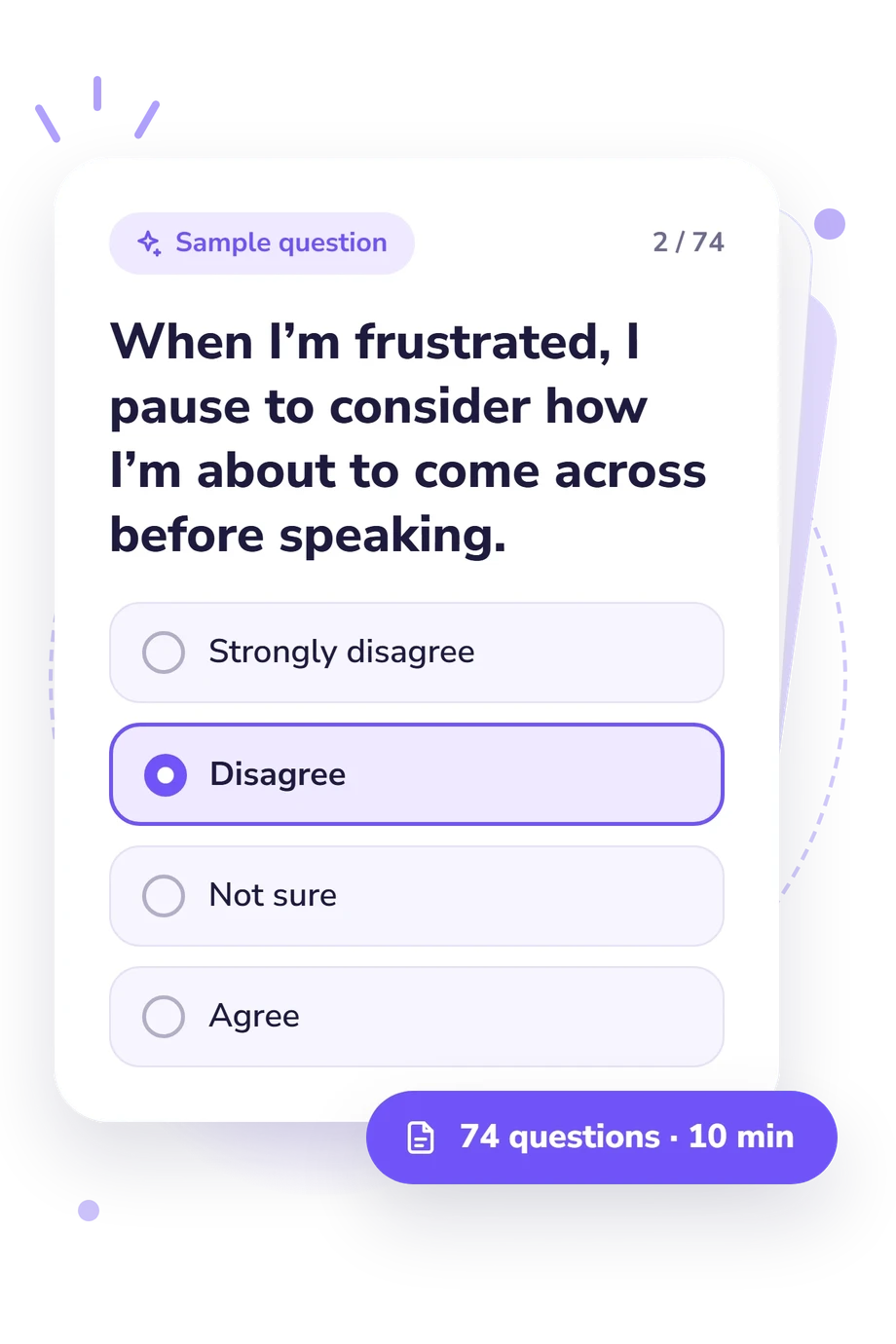
Example Questions From the Test
- Strongly disagree
- Disagree
- Not sure
- Agree
- Strongly disagree
- Disagree
- Not sure
- Agree
- Strongly disagree
- Disagree
- Not sure
- Agree
Self Awareness Test - Description and methodology of the test
People seeking a clearer understanding of their reactions, habits, and influence on others can use this self awareness test as a structured reflection exercise. Questions in this awareness test focus on practical moments in everyday behavior rather than abstract personality labels. The result shows how the three dimensions compare, helping the reader identify which area deserves closer reflection.
What This Assessment Explores
These items examine three related capacities: recognizing and naming emotions; noticing how behavior may affect other people; and examining motives, assumptions, values, and recurring habits. Statements about defensiveness, feedback, mixed feelings, avoidance, and stress connect inner experience with observable choices. This self-awareness assessment suits people who want more emotional clarity and more deliberate communication.
The result separates these themes into three dimensions:
- Emotional Insight (0-20) shows how clearly you notice, name, and understand feelings, including triggers and needs; bands are Developing 0-8, Moderate 9-14, and Strong 15-20.
- Feedback & Impact Awareness (0-20) shows how openly you receive feedback and recognize your effect on others; bands are Developing 0-8, Moderate 9-14, and Strong 15-20.
- Self-Reflection (0-20) shows how consistently you examine thoughts, motives, habits, and patterns; bands are Developing 0-7, Established 8-14, and Strong 15-20.
Methodology and Scientific Basis
Each statement uses four response options-Strongly disagree, Disagree, Not sure, and Agree-so the respondent marks how closely it matches usual experience. The self awareness quiz groups responses into the displayed dimensions and reports a score and band for each scale.
Because item-level point assignments are not specified, interpretation should follow those reported scores and bands rather than an assumed per-answer formula.
Conceptually, the questionnaire is consistent with the Self-Awareness Scale described by Ashley and Reiter-Palmon in 2012, which emphasizes awareness of internal states and interpersonal impact. Its reflective content also aligns with Grant, Franklin, and Langford's Self-Reflection and Insight Scale, while its emotion-focused content connects with Killian's Emotional Self-Awareness Questionnaire. Duval and Wicklund's objective self-awareness theory offers a broader account of how attention to the self can support self-knowledge. The questionnaire is conceptually consistent with these instruments and theory; it is not an adaptation or standardized version of them.
Across its three dimensions, the result offers a descriptive snapshot shaped by current mood, memory, social desirability, and willingness to acknowledge uncomfortable patterns. Comparing scores with concrete examples from daily life makes the feedback more useful.
- Ashley, Greg C., and Roni Reiter-Palmon. (2012). Self-Awareness and the Evolution of Leaders: The Need for a Better Measure of Self-Awareness. Journal of Behavioral and Applied Management, 14(1), 2-17. 10.21818/001c.17902
- Grant, Anthony M., John Franklin, and Peter Langford. (2002). The Self-Reflection and Insight Scale: A New Measure of Private Self-Consciousness. Social Behavior and Personality: An International Journal, 30(8), 821-835. 10.2224/sbp.2002.30.8.821
- Killian, Kyle D. (2012). Development and Validation of the Emotional Self-Awareness Questionnaire: A Measure of Emotional Intelligence. Journal of Marital and Family Therapy, 38(3), 502-514. 10.1111/j.1752-0606.2011.00233.x
- Duval, Shelley, and Robert A. Wicklund. (1972). A Theory of Objective Self-Awareness. New York: Academic Press.
Updated: