
Seduction Archetype Quiz
How the Scales are Structured
Who Usually Takes This Test?
See How You Compare
Below is a preview of how scores are typically distributed across each scale.
Example Questions From the Test
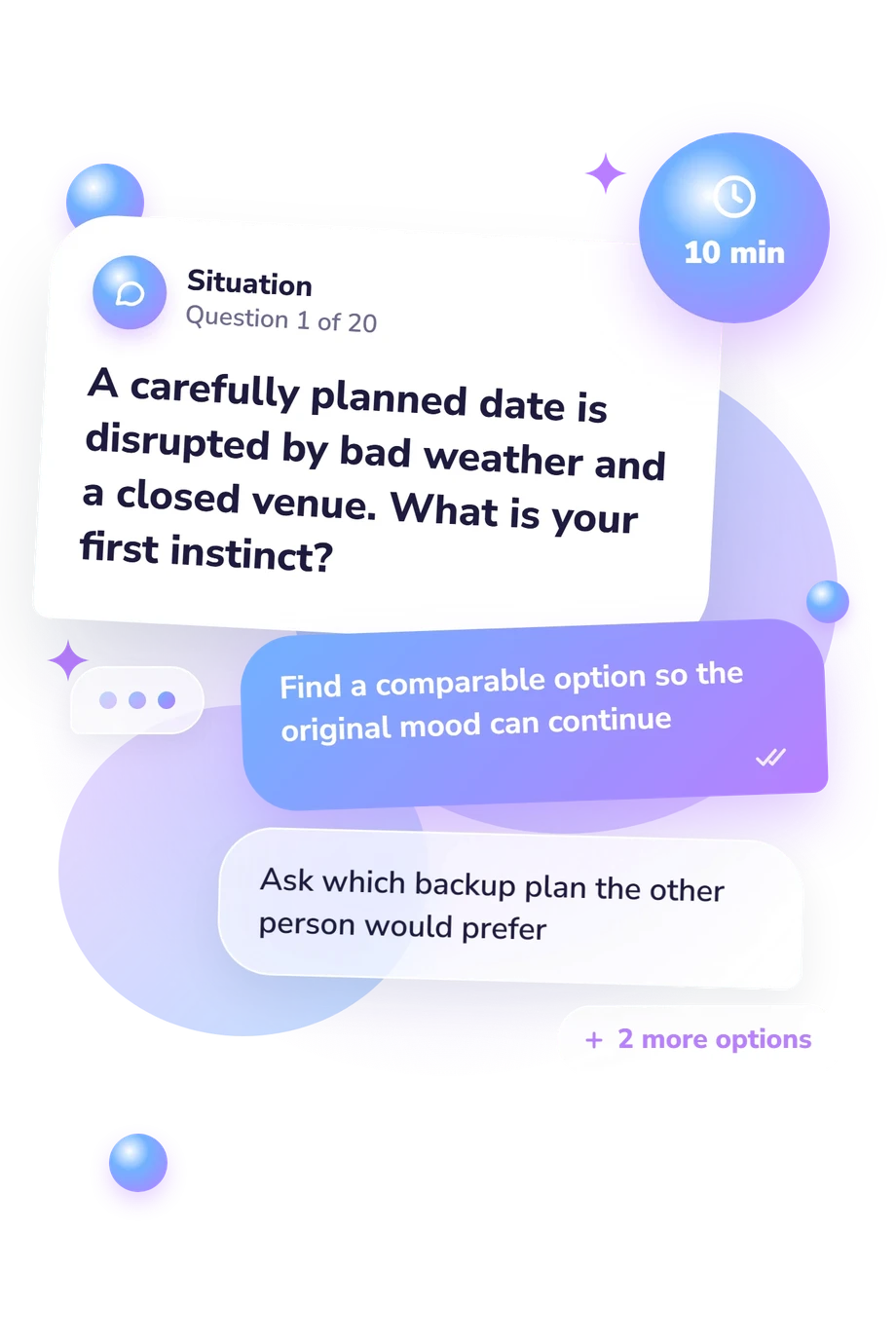
- Find a comparable option so the original mood can continue
- Ask which backup plan the other person would prefer
- Choose a simple nearby alternative and keep moving
- Turn the disruption into an improvised adventure or shared game
- Fit the code neatly so attention stays on the interaction
- Follow it but add one personal detail
- Mix expected elements with a deliberate contrast
- Interpret it entirely through my own aesthetic, even if I create a category of my own
- Fix it efficiently and return to the conversation
- Acknowledge it briefly so no one else feels awkward
- Make a light comment and carry on
- Laugh openly and turn the mishap into a memorable shared joke
Seduction Archetype Quiz - Description and methodology of the test
Readers who want to understand how they create attraction can use the Seduction Archetype Quiz Robert Greene to examine recurring choices in flirtation, presentation, attention, and romantic pacing. It suits anyone considering a seduction type quiz from Robert Greene who wants a reflective profile rather than a single label. The result highlights tendencies that appear when chemistry, uncertainty, or social pressure enters an interaction.
What This Assessment Explores
Each scenario presents a moment-such as a disrupted date, fading group mood, compliment, or another person’s preference. Choices distinguish autonomy, attunement, play, intensity, and social presence. As a seduction archetype test, it supports self-reflection about recurring styles rather than fixed identities.
The five displayed dimensions are:
- Coquette-Dandy Enigma (0-12) measures autonomy and selective revelation: Open Signal 0-4; Independent Edge 5-8; Compelling Enigma 9-12.
- Ideal Lover-Charmer Attunement (0-12) measures personalized attention and tact: Broad Focus 0-4; Responsive Attention 5-8; Enchanting Attunement 9-12.
- Natural Playfulness (0-12) measures spontaneity and mischief: Composed Style 0-4; Playful Spark 5-8; Irresistible Play 9-12.
- Rake-Star Dramatic Fascination (0-12) measures intensity and spectacle with consent and boundaries: Understated Expression 0-4; Vivid Interest 5-8; Dramatic Fascination 9-12.
- Siren-Charismatic Magnetism (0-12) measures presence and conviction: Quiet Current 0-4; Noticeable Presence 5-8; Magnetic Presence 9-12.
Methodology and Evidence Base
Each item describes a social or romantic situation and offers four responses. Choose the option closest to your first instinct; the format records a preference pattern, not a right answer. The alternatives commonly contrast directness, adaptation, independence, personalization, improvisation, intensity, and atmosphere.
Greene's seducer archetypes (2001) supply the conceptual comparison for this Robert Greene seduction quiz. The questionnaire uses related contrasts-mystery and autonomy, focused attention, playfulness, dramatic expression, and compelling presence-but it is not an adaptation or standardized administration of that work. It is an online profile that translates those themes into contemporary self-reflection.
Scores are read across the five profiles. The strongest score indicates the most pronounced tendency, while results within one point are treated as a blend. The displayed bands organize interpretation; they are not population norms or clinical cutoffs, and the questionnaire has not been presented as a standardized or normed measure.
Because answers are self-reported, impression management, current mood, social context, and limited self-awareness can affect the outcome. Paulhus's response-bias framework (1991) is relevant here: treat the result as a situational snapshot that can guide reflection, not a permanent verdict.
- Greene, Robert, and Joost Elffers. The Art of Seduction. Viking, 2001. ISBN 0-670-89192-4.
- Paulhus, Delroy L. "Measurement and Control of Response Bias." In Measures of Personality and Social Psychological Attitudes, edited by John P. Robinson, Phillip R. Shaver, and Lawrence S. Wrightsman, pp. 17-59. Academic Press, 1991. 10.1016/B978-0-12-590241-0.50006-X
Updated: