
Roaring 20s Quiz
How the Scales are Structured
Who Usually Takes This Test?
See How You Compare
Below is a preview of how scores are typically distributed across each scale.
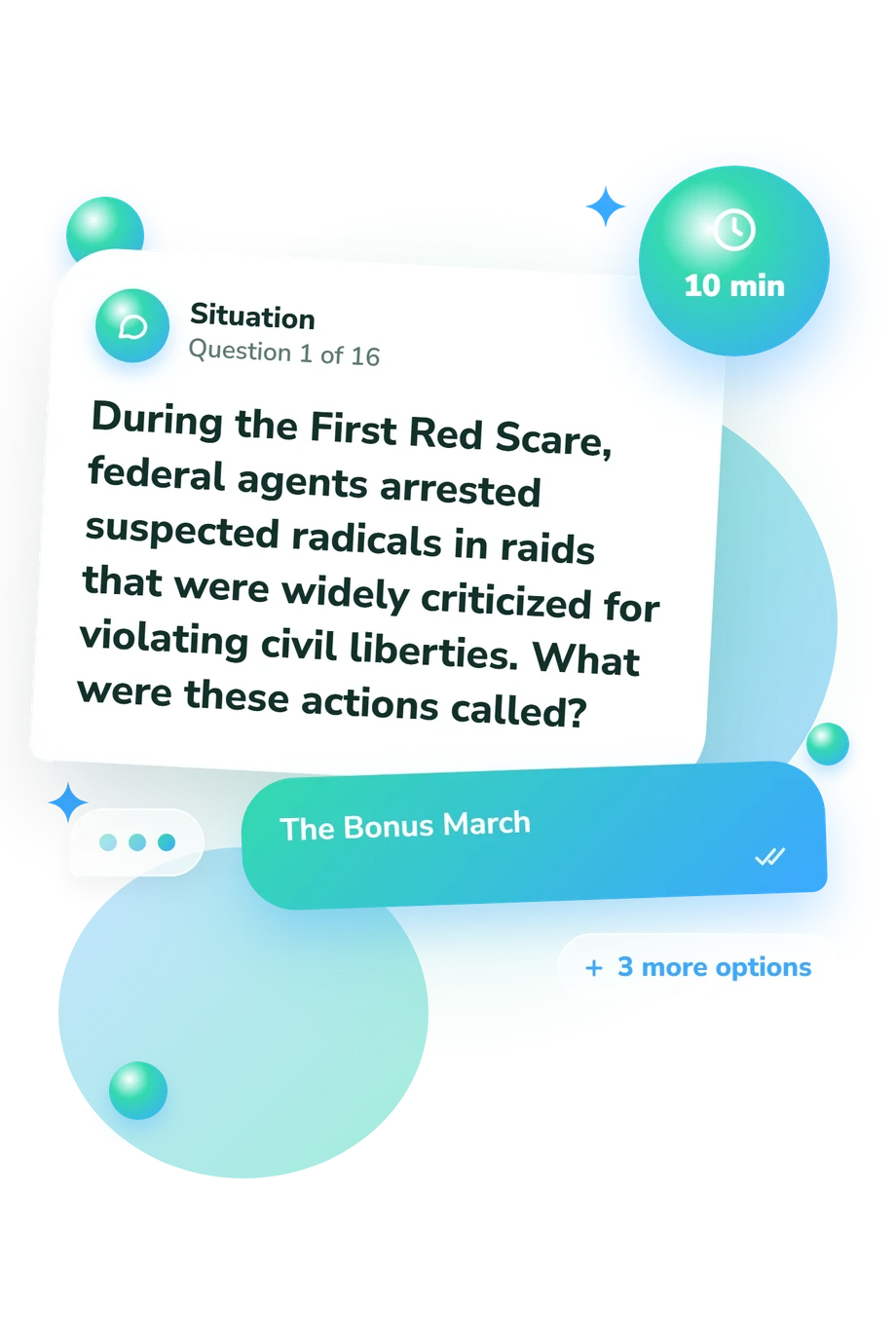
Example Questions From the Test
- The disappearance of national brand names
- A broad return to household production instead of factory goods
- Federal rationing of cars and household appliances
- Expanded advertising and greater use of installment credit
- A settlement house
- A vaudeville theater
- A speakeasy
- A company store
- The Eighteenth Amendment
- The Twentieth Amendment
- The Nineteenth Amendment
- The Twenty-First Amendment
Roaring 20s Quiz - Description and methodology of the test
Readers who want a focused way to revisit American life between 1919 and 1929 can use the roaring 20s quiz to check how well they connect major events with wider consequences. Learners, history enthusiasts, and reviewers can treat it as a 1920s history quiz covering political decisions, cultural movements, economic changes, and social tensions. The result provides a snapshot of historical knowledge rather than a personality profile or opinion measure.
What This Assessment Measures
The test connects factual recognition with larger historical patterns rather than treating the decade as a list of famous names. Together, the items connect events across political, cultural, economic, and social topics, giving the roaring twenties quiz a broader historical focus than one-topic recall. It covers the First Red Scare, Great Migration, Prohibition, Harlem Renaissance, Dawes Plan, Teapot Dome, immigration quotas, women’s voting rights, and the Scopes trial. The single result scale is Roaring 20s Knowledge (0-16): Foundations to Build (0-6), Developing Knowledge (7-12), or Strong Knowledge (13-16). The question themes cover these areas:
- Politics and government measure recognition of policies, scandals, rights, and regulation.
- Culture and media reflect knowledge of radio, arts, entertainment, and changing behavior.
- Economy and consumption connect taxes, farming, credit, stocks, and production.
- Social change and inequality link migration, race, gender, and uneven prosperity.
Methodology and Evidence Base
Each item presents a short historical scenario or direct question with four answer choices. Selecting the best-supported answer makes this structured multiple-choice knowledge assessment measure recall and recognition across the tested content, not self-rated confidence. The choices distinguish events, policies, movements, and consequences. The questionnaire reports the result through the displayed descriptive bands, which indicate levels of historical knowledge and understanding across the tested areas.
Historical books by Corbett, Goldberg, and Allen provide content context for the period’s politics, economy, culture, and social conflict rather than psychometric validation, and the online assessment is not claimed to be a standardized adaptation of one source.
A band is best read as a level of historical knowledge across the tested areas, ranging from foundational understanding through developing knowledge to strong command. A high result suggests broad command, while a lower result identifies areas for review rather than fixed historical ability. Memory, wording, guessing, and recent study can affect performance, so the result remains a snapshot. Learners can use this historical knowledge quiz for structured review but it cannot represent every perspective or issue.
- Corbett, P. Scott, Volker Janssen, John M. Lund, Todd Pfannestiel, Sylvie Waskiewicz, and Paul Vickery. "The Jazz Age: Redefining the Nation, 1919-1929." In U.S. History. Houston, TX: OpenStax, 2014.
- Goldberg, David J. Discontented America: The United States in the 1920s. Baltimore: Johns Hopkins University Press, 1999. 10.56021/9780801860041.
- Allen, Frederick Lewis. Only Yesterday: An Informal History of the Nineteen-Twenties. New York: Harper & Brothers, 1931.
Updated: