
Best Friend Forever Quiz
How the Scales are Structured
Who Usually Takes This Test?
See How You Compare
Below is a preview of how scores are typically distributed across each scale.
Example Questions From the Test
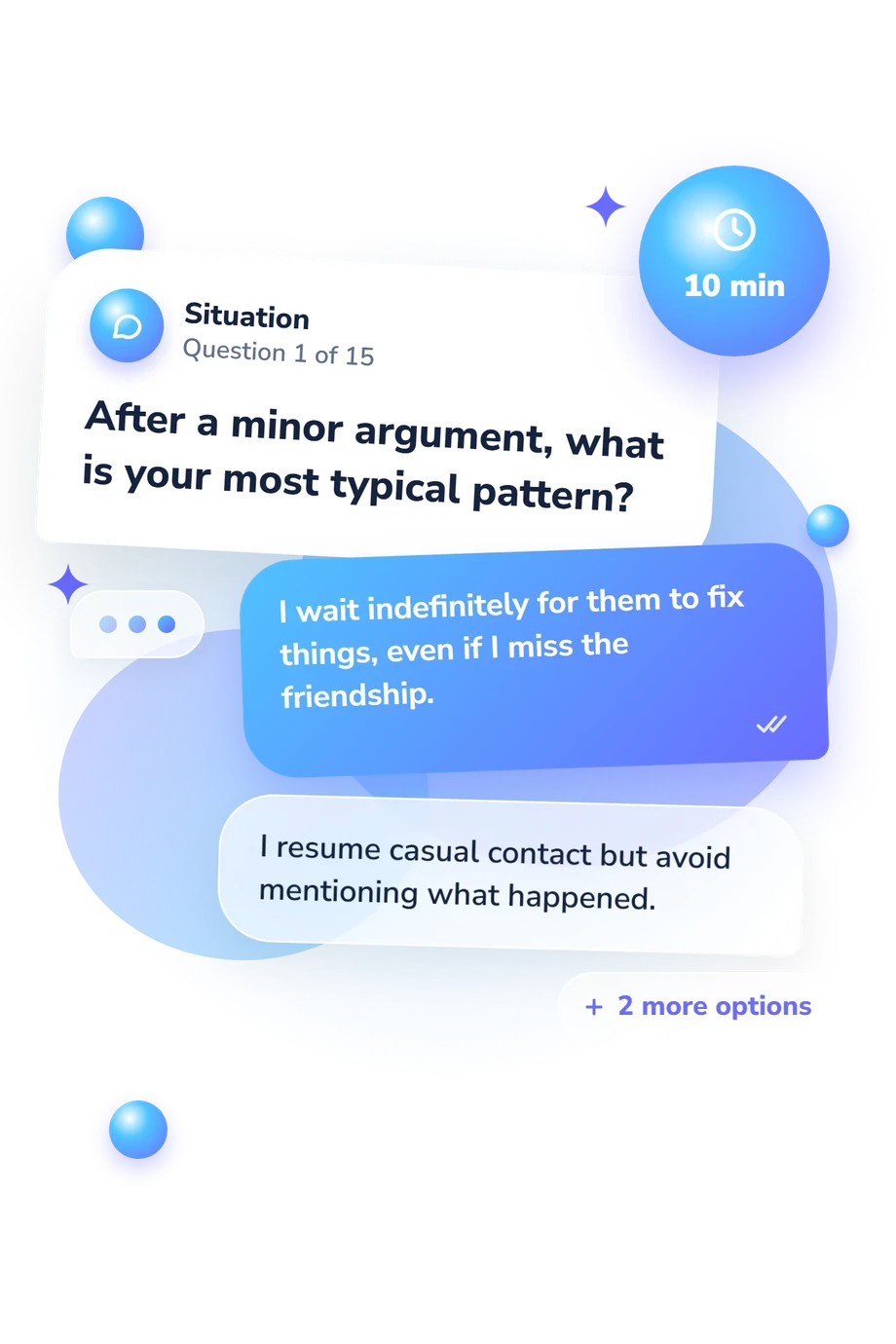
- I wait indefinitely for them to fix things, even if I miss the friendship.
- I resume casual contact but avoid mentioning what happened.
- I attempt a conversation once emotions settle, although I may struggle to own my part.
- I help reopen the conversation, acknowledge my contribution, and work toward a workable repair.
- I treat the change as evidence that our friendship is being replaced.
- I keep my distance from that part of their life and wait for things to return to normal.
- I show some curiosity while needing time to adjust to the changed dynamic.
- I support their growth and look for ways our friendship can evolve without forcing identical interests.
- They happen mostly by chance, with little initiative from either of us.
- The same person usually initiates while the other mainly follows.
- Both of us contribute, although effort becomes uneven during busy periods.
- We both initiate and adapt plans so the connection has room in our changing lives.
Best Friend Forever Quiz - Description and methodology of the test
Anyone wondering how a close friendship is functioning can use this Best Friend Forever Quiz to reflect on everyday patterns rather than chase a simple yes-or-no verdict. Rather than offering a flattering label, this quiz for best friends organizes shared effort, emotional availability, honesty, and repair into a profile that can help you notice strengths and discuss strain.
What This Assessment Explores
Its friends forever quiz name suggests permanence, but this assessment examines present-day habits rather than predicting the future. It covers contact, change, disagreement, boundaries, celebration, and care, making the result useful for reflecting on a friendship that feels important or difficult to read.
The three displayed scales organize the result areas:
- Connection and Repair (0-15) shows shared effort and reconnection; Fragile connection (0-5) means tension may linger, Adaptable at times (6-10) shows mixed resilience, and Resilient connection (11-15) shows collaborative repair.
- Reciprocal Support (0-15) shows whether care and help move both ways; Uneven support (0-5) suggests one-sided giving, Situational support (6-10) varies, and Mutual support (11-15) is dependable.
- Trust and Openness (0-15) shows how honesty and boundaries are handled; Guarded (0-5) is selective, Emerging trust (6-10) is partial, and Strong trust (11-15) is candid and respectful.
Methodology and Scientific Basis
Each item presents a friendship situation with four ordered responses, moving from guarded or uneven patterns toward clearer communication, mutuality, and repair. Responses create a profile across three dimensions, with a separate 0-15 result for each. The questionnaire does not define how individual choices are weighted, so read the result through the displayed bands rather than reconstructing a point formula.
The structure is conceptually consistent with the Friendship Quality Questionnaire associated with Parker and Asher in 1993. It also aligns with the McGill Friendship Questionnaires associated with Mendelson and Aboud in 1999 and the Friendship Qualities Scale associated with Bukowski, Hoza, and Boivin in 1994, but is not presented as an adaptation or validation of them.
The cited instruments offer context for companionship, support, trust, conflict, and closeness but do not establish standardized norms, validation, or clinical cutoffs for this online questionnaire. As a self-report friendship quiz, results may shift with mood, memory, expectations, and comfort with candid answers. The profile can prompt reflection or conversation; a high score cannot guarantee permanence, and temporary lack of support may reflect circumstances rather than the whole bond.
- Parker, Jeffrey G., and Steven R. Asher. "Friendship and friendship quality in middle childhood: Links with peer group acceptance and feelings of loneliness and social dissatisfaction." Developmental Psychology 29, no. 4 (1993): 611-621. 10.1037/0012-1649.29.4.611
- Mendelson, Morton J., and Frances E. Aboud. "Measuring friendship quality in late adolescents and young adults: McGill Friendship Questionnaires." Canadian Journal of Behavioural Science / Revue canadienne des sciences du comportement 31, no. 2 (1999): 130-132. 10.1037/h0087080
- Bukowski, William M., Betsy Hoza, and Michel Boivin. "Measuring Friendship Quality During Pre- and Early Adolescence: The Development and Psychometric Properties of the Friendship Qualities Scale." Journal of Social and Personal Relationships 11, no. 3 (1994): 471-484. 10.1177/0265407594113011
Updated: