
Universe Quiz
How the Scales are Structured
Who Usually Takes This Test?
See How You Compare
Below is a preview of how scores are typically distributed across each scale.
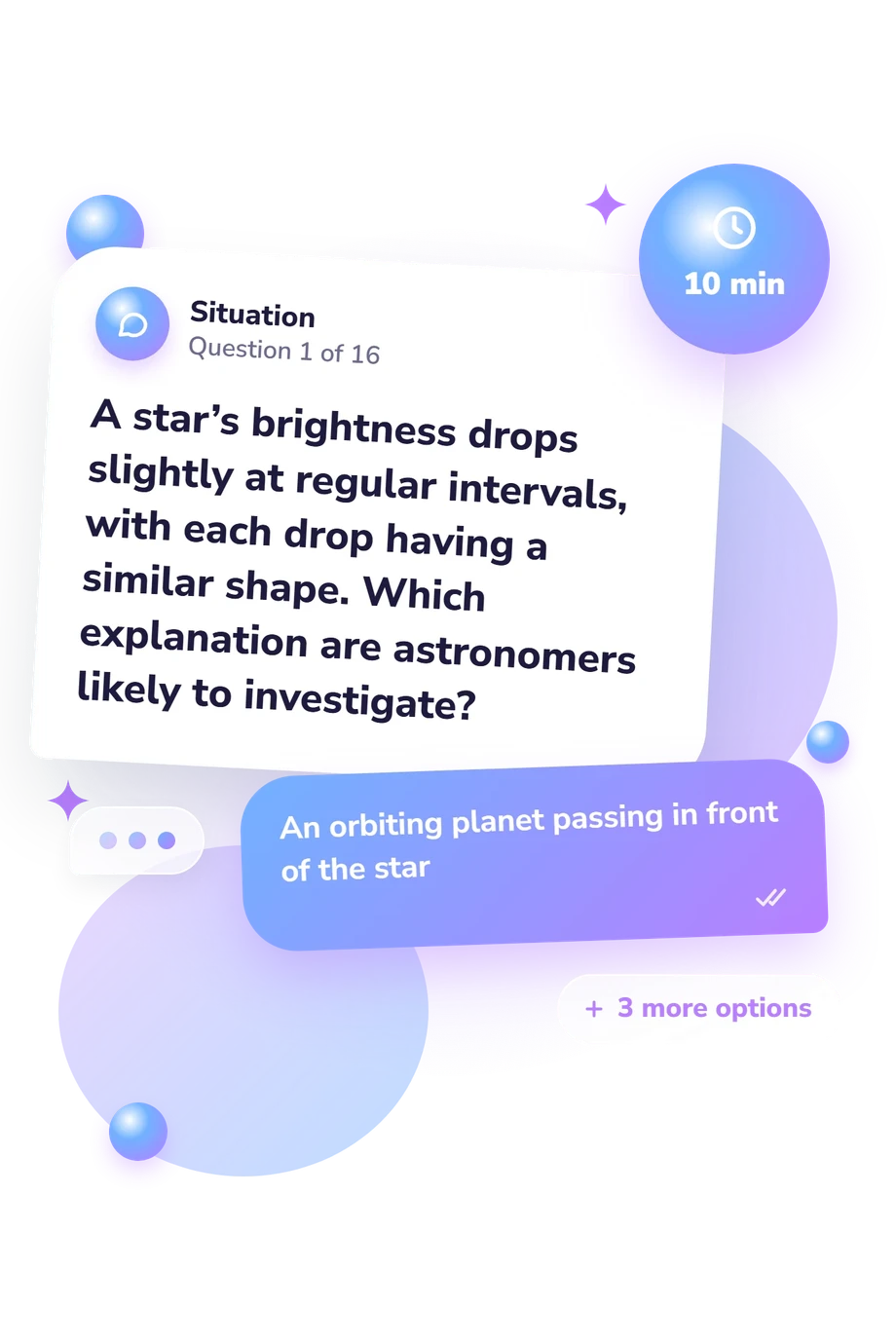
Example Questions From the Test
- Earth, Moon, Sun, with the Moon between Earth and the Sun
- Moon, Sun, Earth, with the Sun between the Moon and Earth
- Earth and Moon at right angles to the Sun
- Sun, Earth, Moon, with Earth between the Sun and Moon
- Nuclear fusion in its core
- Chemical burning across its visible surface
- Friction caused by planets orbiting around it
- Radioactive decay occurring mainly in its atmosphere
- The time Earth takes to complete one orbit of the Sun
- The time required for sunlight to reach the outer planets
- The amount of light a star produces during one year
- The distance light travels through a vacuum in one year
Universe Quiz - Description and methodology of the test
People who want a clear starting point for astronomy can use this assessment to gauge their overall foundation in basic science. The Quiz About Universe offers a focused self-check for learners and people revisiting basic science. The universe quiz questions cover stars, planets, light, gravity, cosmic history, and the systems that organize space.
What This Assessment Explores
Items test explanations involving stars, galaxies, light, gravity, motion, cosmic history, and the Earth-Moon-Sun system. The result is the total number of correct responses across these concepts, indicating a descriptive astronomy knowledge level. This universe knowledge test focuses on core ideas, not terminology.
The question themes are:
- Stellar evidence shows what color, spectra, brightness changes, and fusion can reveal about stars.
- Cosmic structure covers solar systems, galaxies, expansion, the cosmic microwave background, and black holes.
- Motion and light examine orbits, light-years, look-back time, and changes during travel.
- Sky cycles address constellations, lunar phases, eclipses, and seasons.
The Universe Knowledge scale runs from 0-16 and equals the number of correct answers. Foundations to build (0-6) signals core concepts to strengthen; Developing knowledge (7-12) reflects many major ideas with connections still developing; Strong knowledge (13-16) indicates a well-rounded grasp applicable across situations.
Methodology and Scientific Basis
Each item presents a short astronomy scenario or definition with four answer choices. The score is the number of correct responses, so a higher total reflects more correct answers across the tested concepts.
Content is conceptually consistent with TOAST (Slater, 2015), a published astronomy assessment instrument. Related Astronomy Diagnostic Test research by Hufnagel (2002) and Brogt et al. (2007) shows how plausible alternatives can reveal common misconceptions. This online questionnaire is a separate self-report knowledge check, not a norm-referenced administration of the cited instruments.
The format can serve as an astronomy quiz for beginners while also suiting returning learners who want to revisit core ideas. Its displayed bands are descriptive levels rather than published population norms. Prior exposure, wording familiarity, guessing, and attention can affect performance. It is a knowledge indicator, not a diagnosis or a substitute for broader assessment.
- Slater, Stephanie J. (2015). The Development And Validation Of The Test Of Astronomy STandards (TOAST). Journal of Astronomy & Earth Sciences Education, 1(1), 1-22. 10.19030/jaese.v1i1.9102
- Hufnagel, Beth. (2002). Development of the Astronomy Diagnostic Test. Astronomy Education Review, 1(1), 47-51. 10.3847/AER2001004
- Brogt, Erik, Darrell Sabers, Edward Prather, Grace Deming, Beth Hufnagel, and Timothy F. Slater. (2007). Analysis of the Astronomy Diagnostic Test. Astronomy Education Review, 6(1), 25-42. 10.3847/AER2007003
Updated: