
Telugu Quiz
How the Scales are Structured
Who Usually Takes This Test?
See How You Compare
Below is a preview of how scores are typically distributed across each scale.
Example Questions From the Test
- Kandukuri Veeresalingam
- Gurajada Apparao
- Viswanatha Satyanarayana
- Srirangam Srinivasa Rao, known as Sri Sri
- Right to left
- Left to right
- Top to bottom
- In alternating directions on each line
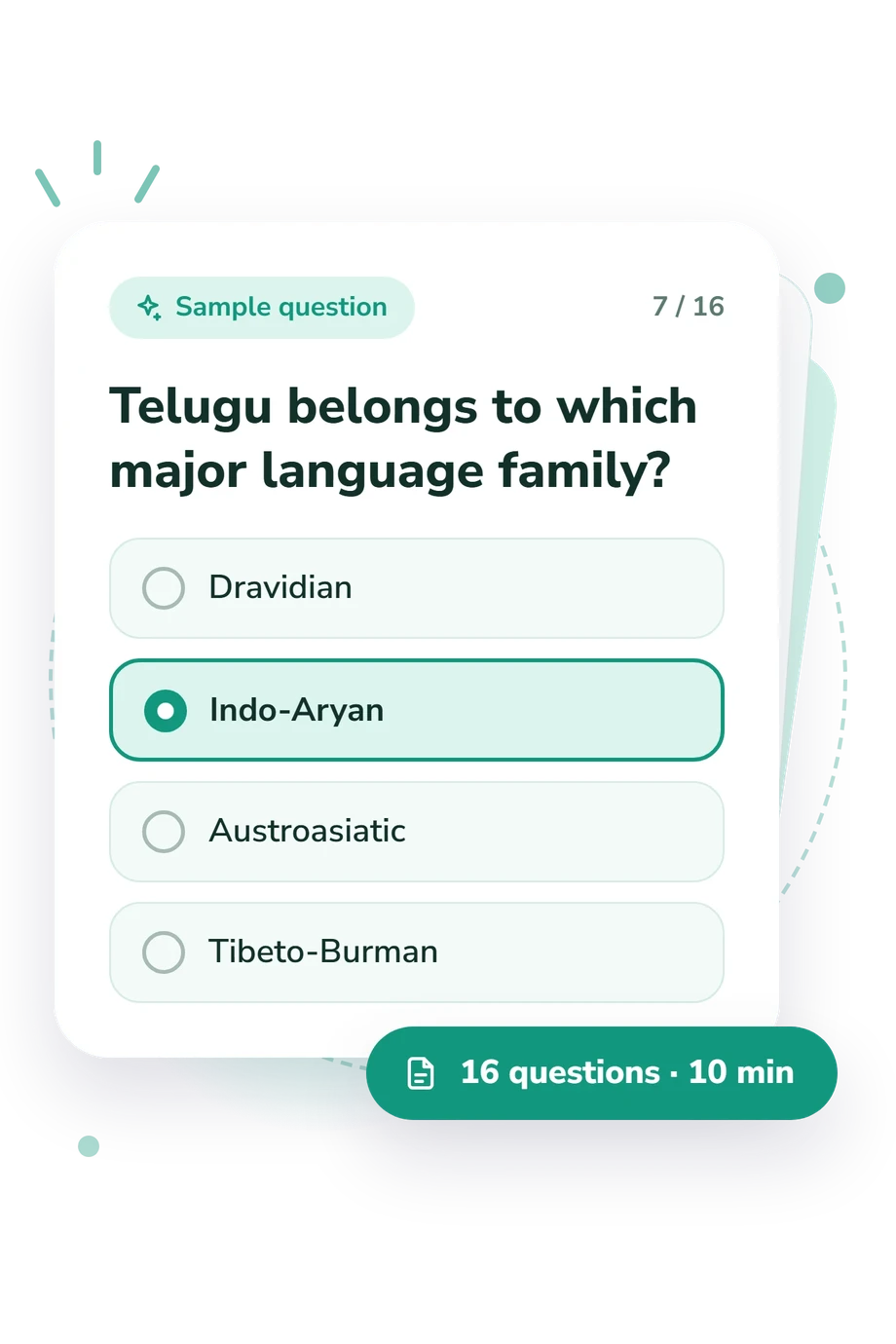
- Dravidian
- Indo-Aryan
- Austroasiatic
- Tibeto-Burman
Telugu Quiz - Description and methodology of the test
For learners seeking a focused way to explore Telugu language and heritage, telugu quiz questions offer a practical check of what they already recognize and where further study may help. As a Telugu language quiz, it suits curious learners beginning or revisiting Telugu. The result offers a useful profile of knowledge rather than claiming formal proficiency.
What This Assessment Explores
The questions join language and cultural knowledge, so the assessment suits learners beginning or revisiting Telugu. In this format, a Telugu culture quiz checks recognition of forms, facts, people, places, and traditions rather than conversational fluency or writing performance.
The main thematic groups are:
- Language structure shows whether you recognize inclusive and respectful pronouns, word order, agglutinative patterns, and basic script conventions.
- Literary knowledge reflects familiarity with major poets, landmark works, and the Kavitrayam of Telugu literature.
- Cultural knowledge covers Ugadi, Telugu-speaking states, Hyderabad’s Charminar, and related heritage contexts.
- Performing-arts knowledge shows whether you can place Kuchipudi within the tradition and location named by the question.
The displayed scale, Telugu Knowledge (0-16), reflects performance on this quiz only. Foundation (0-6) indicates some facts to review; Developing (7-12) suggests broad working knowledge; Strong (13-16) indicates accurate knowledge across Telugu language and heritage topics.
Methodology and Evidence Base
Each item uses a short prompt followed by four answer choices, asking the respondent to select the best fit rather than produce a translation or essay. This Telugu knowledge quiz therefore functions as a recognition task: the format samples vocabulary, grammar, literature, geography, festivals, and arts without requiring equal skill in every area.
Scoring aggregates the keyed responses into one displayed performance result; the questionnaire presents a single overall scale rather than separate subscores. Krishnamurti and Gwynn (1985) provide the grammatical frame for pronouns, word order, script, and agglutinative structure. Chenchiah and Bhujanga Rao Bahadur (1928) and Narayana Rao (2002) support the literary and historical references, while Putcha (2013) supplies focused scholarly context for Kuchipudi.
Together, these sources make the content consistent with language, literary, and cultural scholarship; this questionnaire is not an adaptation of one published instrument. No norms, reliability coefficients, or validated proficiency bands are stated. Because answers depend on study, memory, interpretation, and attention, the result is a snapshot for reflection and next learning steps, not a complete measure of Telugu mastery.
- Krishnamurti, Bhadriraju, and John Peter Lucius Gwynn. A Grammar of Modern Telugu. Delhi and New York: Oxford University Press, 1985. ISBN 0195616642.
- Chenchiah, P., and Raja M. Bhujanga Rao Bahadur. A History of Telugu Literature. Calcutta: The Association Press; London: Oxford University Press, 1928.
- Narayana Rao, Velcheru, editor and translator. Twentieth Century Telugu Poetry: An Anthology. New Delhi: Oxford University Press, 2002. ISBN 0195652215.
- Putcha, Rumya S. “Between History and Historiography: The Origins of Classical Kuchipudi Dance.” Dance Research Journal 45, no. 3 (2013): 91-110. 10.1017/S0149767713000260.
Updated: