
Am I Just a Hookup Quiz
How the Scales are Structured
Who Usually Takes This Test?
See How You Compare
Below is a preview of how scores are typically distributed across each scale.
Example Questions From the Test
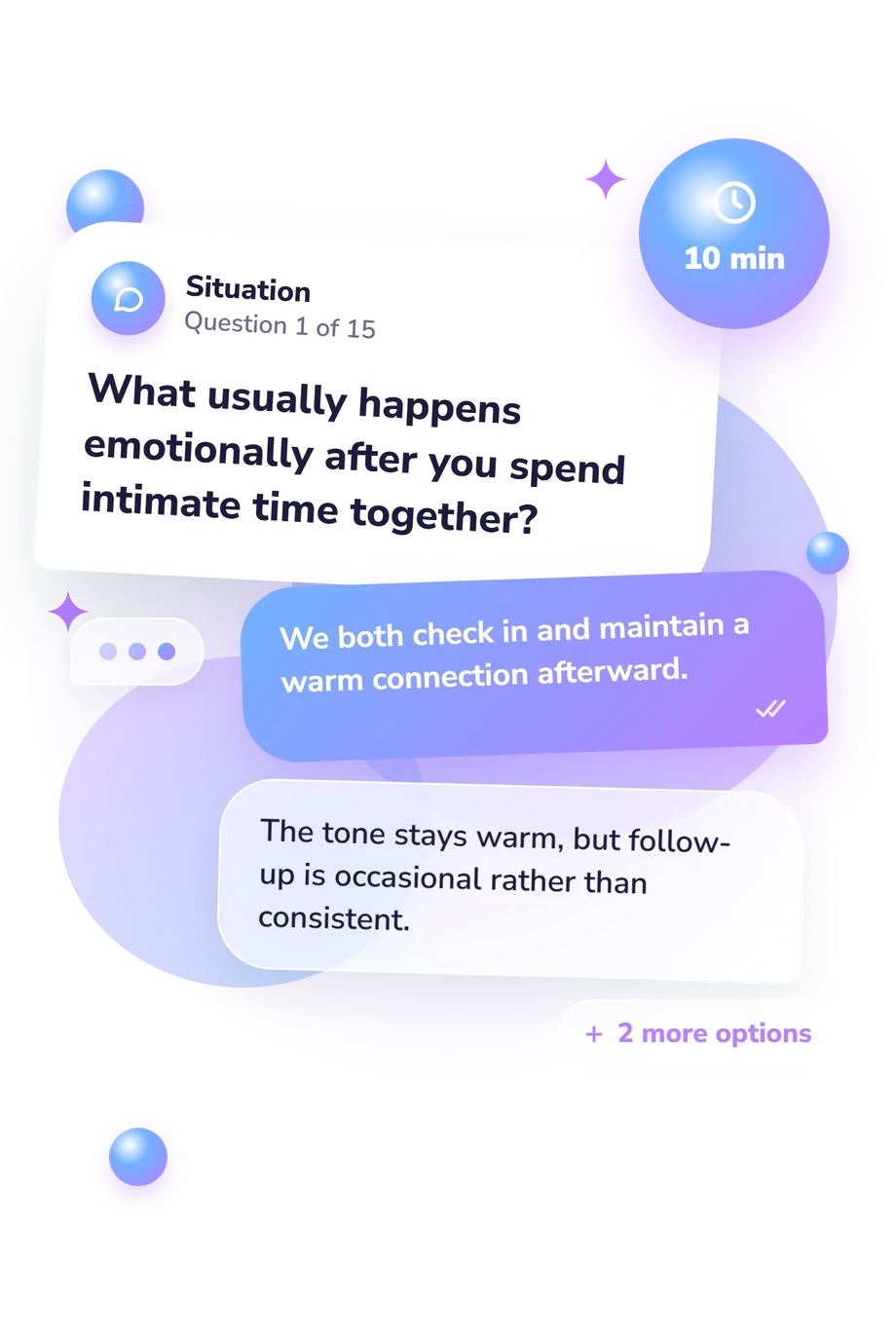
- We both check in and maintain a warm connection afterward.
- The tone stays warm, but follow-up is occasional rather than consistent.
- There is little contact until someone wants to arrange another meeting.
- I often feel abruptly dismissed, and they reconnect mainly for the next hookup.
- We communicate consistently about daily life as well as plans.
- We have genuine conversations, but the rhythm can be irregular.
- Most contact concerns availability or arranging the next meeting.
- Contact usually appears only when a hookup is immediately possible.
- They want to explore a committed relationship with me.
- They are open to more but are not ready to define it yet.
- They have stayed vague, so I mainly rely on hints.
- They have said they only want something casual or sexual.
Am I Just a Hookup Quiz - Description and methodology of the test
People uncertain whether a sexual connection is becoming more mutual, emotionally engaged, or relationship-oriented may use the Am I Just a Hookup Quiz to organize what they observe. This sexual connection quiz focuses on whether the connection is only sexual or includes broader involvement, organizing contact, effort, and communication for anyone weighing mixed signals or unclear expectations.
What This Assessment Explores
This assessment examines whether a connection extends beyond sexual contact. It looks at ordinary-life involvement, mutual consideration, and whether agreements point toward casual involvement or development, giving a picture of hookup dynamics. It suits anyone interpreting mixed signals about contact, follow-through, shared plans, and responses when sex is unavailable.
The result separates three dimensions:
- Investment Beyond Sex (0-15) shows whether effort extends beyond sexual access: Broad Investment (0-5) is broad involvement, Selective Investment (6-10) is uneven involvement, and Hookup-Centered Investment (11-15) is sex-focused.
- Reciprocity and Personal Regard (0-15) shows whether attention and accommodation feel mutual: Mutual Regard (0-5) reflects shared care, Uneven Regard (6-10) reflects inconsistency, and One-Sided Pattern (11-15) reflects mainly one-person convenience.
- Stated Commitment Intent (0-15) shows how strongly communication favors casual involvement: Relationship Direction (0-5) points toward development, Unresolved Direction (6-10) reflects mixed expectations, and Casual-Only Direction (11-15) reflects explicit casual signals.
Methodology and Evidence Base
Four ordered response options move from broader mutual involvement toward hookup-centered, one-sided, or explicitly casual patterns. Items cover contact after intimacy, communication between meetups, ordinary-life overlap, nonsexual plans, follow-through, convenience, sexual preferences, and future direction. Respondents choose the description that best matches the connection.
Displayed scale ranges do not show how many points each response contributes or reveal a weighting formula. This structured online self-report questionnaire has domains conceptually consistent with Rodrigue et al. (2015), the closest source for casual-sex relationship patterns, and Rodrigue et al. (2018) on passion, intimacy, and commitment. Sternberg’s triangular theory of love separates intimacy, passion, and commitment; here it provides context rather than establishing validity. This framework helps respondents discuss expectations and distinguish intimacy, regard, and commitment direction from sexual activity when clarifying casual connection expectations.
Read the bands as descriptive categories for reported treatment and communication, not validated population norms, clinical cutoffs, proof of private motives, or relationship status. Current context, memory, candor, and self-awareness can shape answers. Respectful casual relationships may score well on regard, while committed relationships may score poorly.
- Rodrigue, C., Blais, M., Lavoie, F., Adam, B. D., Magontier, C., & Goyer, M.-F. (2015). The structure of casual sexual relationships and experiences among single adults aged 18-30 years old: A latent profile analysis. The Canadian Journal of Human Sexuality, 24(3), 215-227. 10.3138/cjhs.243-A1
- Rodrigue, C., Blais, M., Lavoie, F., Adam, B. D., Goyer, M.-F., & Magontier, C. (2018). Passion, intimacy, and commitment in casual sexual relationships in a Canadian sample of emerging adults. The Journal of Sex Research, 55(9), 1192-1205. 10.1080/00224499.2017.1399195
- Sternberg, R. J. (1986). A triangular theory of love. Psychological Review, 93(2), 119-135. 10.1037/0033-295X.93.2.119
Updated: