
Animal Brain Quiz
How the Scales are Structured
Who Usually Takes This Test?
See How You Compare
Below is a preview of how scores are typically distributed across each scale.
Example Questions From the Test
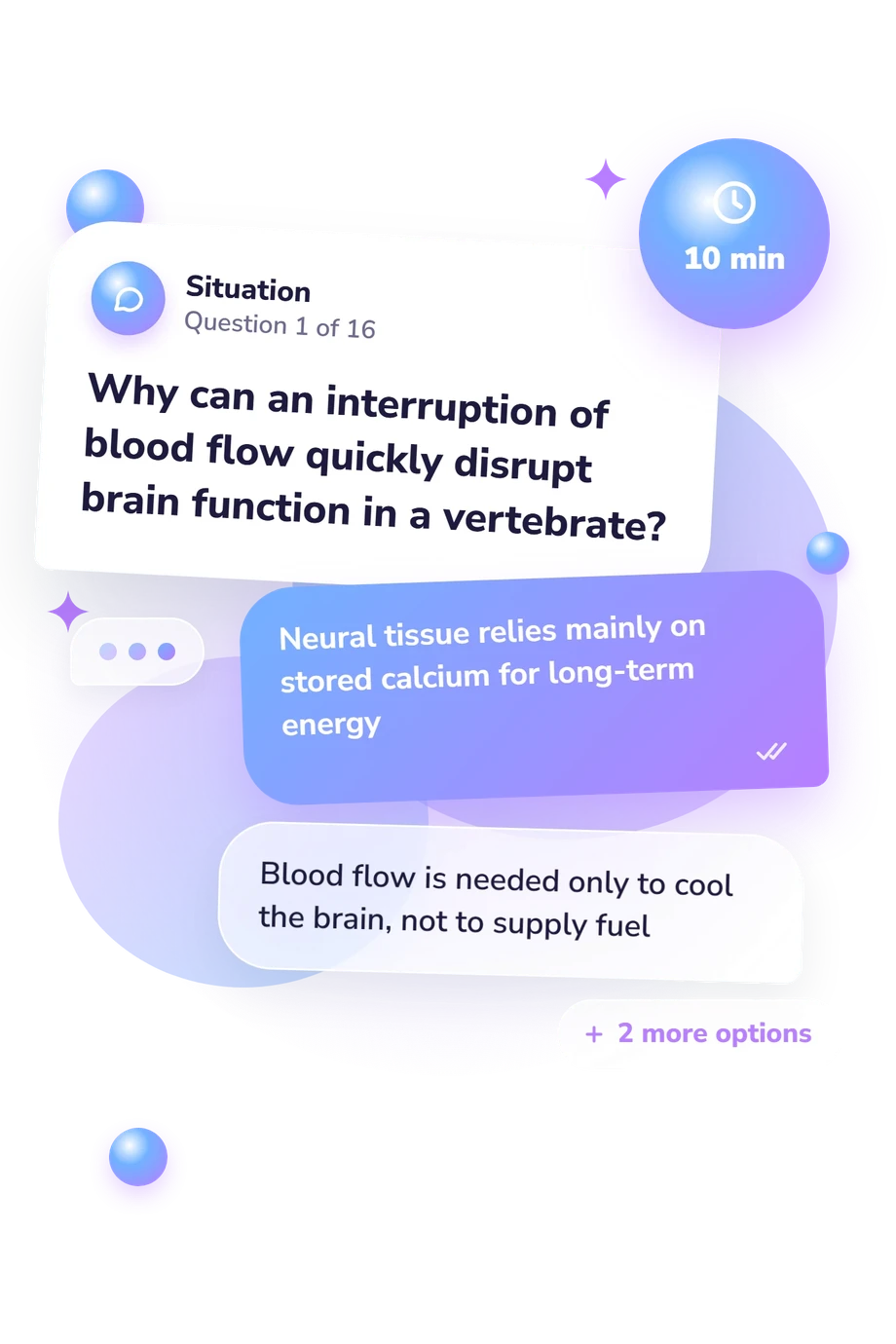
- Neural tissue relies mainly on stored calcium for long-term energy
- Blood flow is needed only to cool the brain, not to supply fuel
- Active brain tissue requires a continuing supply of oxygen and glucose
- Neurons must be replaced by new blood cells every few minutes
- The visual cortex
- The hypothalamus
- The cerebellum
- The olfactory bulb
- The amygdala
- The hypothalamus
- The cerebellum
- The olfactory bulb
Animal Brain Quiz - Description and methodology of the test
Students, educators, and curious readers who want to connect brain biology with animal behavior can use this assessment as a structured check of comparative knowledge. The animal brain quiz offers a focused check of comparative understanding. It suits anyone seeking an animal brain knowledge check beyond isolated vocabulary. The result gives a broad indication of overall animal neurobiology knowledge and can point to topics for focused reading or study.
What This Assessment Explores
Rather than narrowing animal neurobiology to one ability, the questionnaire samples comparative neurobiology through links between neural structures, signaling, behavior, learning, and adaptation. The scenarios ask readers to apply concepts across vertebrates and invertebrates, so the result reflects comparative understanding rather than a single species or brain region.
The main knowledge areas are:
- Brain structures show how regions support regulation, movement, memory, sensory processing, and communication.
- Neural signaling covers energy supply, myelin, synapses, receptors, and lasting changes in connections.
- Comparative adaptations explain specialized solutions such as electrosensation, unilateral sleep, and distributed octopus processing.
- Learning and behavior connect feedback, food caching, odor rewards, and skilled movement with neural organization.
The catalogue reports one scale, Animal Brain Knowledge, from 0-16: Foundation (0-6), Developing (7-12), and Strong (13-16).
Methodology and Scientific Basis
Each item uses a four-option multiple-choice format with one best answer, turning short scenarios into applied questions about brain function. That structure lets the questionnaire's animal neurobiology questions test reasoning across species rather than vocabulary recall.
Its conceptual framework is consistent with Butler and Hodos' work on comparative vertebrate neuroanatomy, especially links among neural structure, evolution, and adaptation; this questionnaire is not presented as an adaptation of that book. The octopus examples are consistent with a 2022 study by Kuuspalu, Cody, and Hale, while song learning and food caching connect with work by Brainard and Doupe and by Clayton.
Responses are summarized on the displayed bounded scale, with bands indicating increasing mastery. The questionnaire does not specify how individual answers are weighted. No norm group, reliability coefficient, or validated clinical cutoff is stated for this questionnaire, so the band is best read as a guide to current learning priorities in animal neurobiology. Because selected-answer formats sample limited concepts and are affected by prior study and guessing, the result cannot represent all animal-brain knowledge or fixed ability.
- Ann B. Butler and William Hodos, Comparative Vertebrate Neuroanatomy: Evolution and Adaptation, 2nd ed. (Hoboken, NJ: Wiley-Liss, 2005), 10.1002/0471733849
- Adam Kuuspalu, Samantha Cody, and Melina E. Hale, "Multiple nerve cords connect the arms of octopuses, providing alternative paths for inter-arm signaling," Current Biology 32, no. 24 (2022): 5415-5421.e3, 10.1016/j.cub.2022.11.007
- Michael S. Brainard and Allison J. Doupe, "What songbirds teach us about learning," Nature 417 (2002): 351-358, 10.1038/417351a
- Nicola S. Clayton, "Memory and the hippocampus in food-storing birds: a comparative approach," Neuropharmacology 37, nos. 4-5 (1998): 441-452, 10.1016/S0028-3908(98)00037-9
Updated: