
Would Anyone Care If I Disappeared Quiz
How the Scales are Structured
Who Usually Takes This Test?
See How You Compare
Below is a preview of how scores are typically distributed across each scale.
Example Questions From the Test
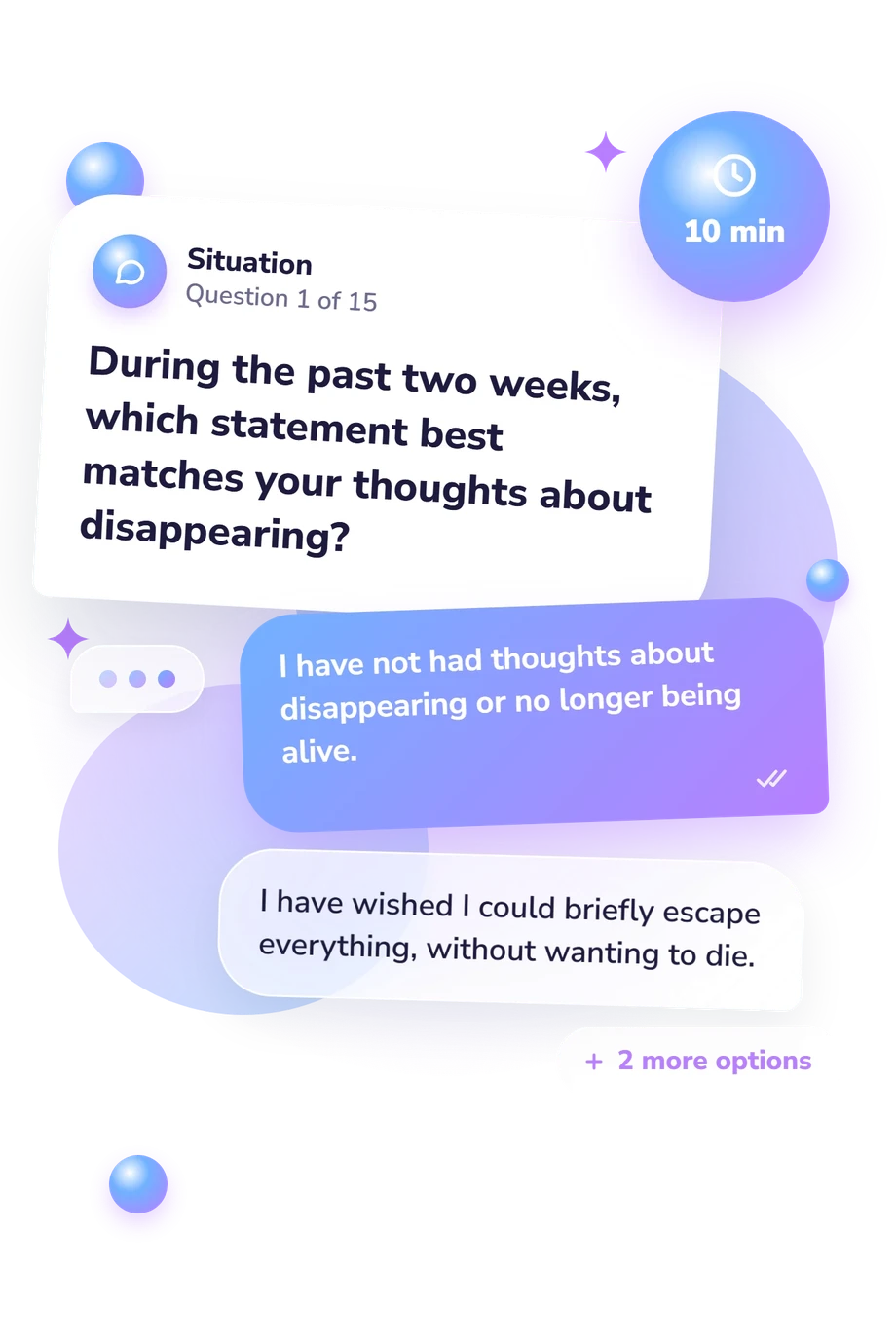
- I have not had thoughts about disappearing or no longer being alive.
- I have wished I could briefly escape everything, without wanting to die.
- I have wished I could disappear permanently or not wake up.
- I have thought about ending my life.
- I do not generally see my existence as a burden to others.
- I sometimes worry that my needs inconvenience people.
- I often feel that people would have easier lives without my needs.
- I believe people would be better off if I were no longer alive.
- I know a person, crisis service, or emergency setting I could contact promptly.
- I know support exists, but I would need time to locate the right contact.
- I would struggle to identify where to turn or how to begin.
- I would avoid crisis help because I would not want anyone to stop me.
Would Anyone Care If I Disappeared Quiz - Description and methodology of the test
People who are questioning whether they matter to others can use this questionnaire to examine that fear with more structure. The Would Anyone Care If I Disappeared Quiz brings together perceived care, thoughts of escape or death, access to urgent help, and present safety. The concern captured by would anyone miss me if i died quiz is treated as a signal to explore, not a verdict about your relationships.
What This Assessment Explores
Rather than judge whether others care, this assessment examines how care is perceived during distress and how that perception connects with withdrawal or suicidal thinking. Items cover unanswered messages, being overlooked, burdensomeness, help access, and safety. It may help when feeling like nobody cares shapes relationship interpretations.
The result separates three dimensions so the feedback can distinguish interpersonal interpretation, barriers to help, and direct safety signals:
- Perceived Disconnection (0-15) reflects beliefs about mattering, burden, and being missed: No scored signal (0), Signal to notice (1-2), Reach outward (3-15).
- Support Barriers and Withdrawal (0-15) reflects limited access, hesitation, isolation, or resisting intervention: No scored signal (0), Signal to notice (1-2), Create contact now (3-15).
- Thoughts of Disappearing (0-15) reflects escape wishes, suicidal thoughts, preparation, or action: No scored signal (0), Signal to notice (1-2), Act now (3-15).
Methodology and Scientific Basis
Most prompts offer four ordered statements, moving from no indicator or accessible support toward concern, withdrawal, preparation, or action.
Conceptually, safety items align with the Columbia-Suicide Severity Rating Scale (Posner et al., 2011). Interpersonal content corresponds with thwarted belongingness and perceived burdensomeness in the Interpersonal Needs Questionnaire (Van Orden et al., 2012), while some behavioral content overlaps with the Suicidal Behaviors Questionnaire-Revised (Osman et al., 2001). These sources are conceptual reference points, not proof that this questionnaire adapts or validates those instruments. Thus, do people care about me is treated as a perception, not a verdict.
Scores combine within the displayed dimensions, but the bands are unvalidated reflective summaries, not severity ratings or clinical cutoffs. A concerning response matters independently, and one 3-point red flag overrides the total. Current context, honesty, and self-awareness can shape this self-report, so it is a snapshot, not a diagnosis or proof of safety. If you may act or cannot stay safe, move away from possible means, stay with someone, and call or text 988, or contact local emergency support.
- Posner, K., Brown, G. K., Stanley, B., Brent, D. A., Yershova, K. V., Oquendo, M. A., Currier, G. W., Melvin, G. A., Greenhill, L., Shen, S., and Mann, J. J. (2011). The Columbia-Suicide Severity Rating Scale: initial validity and internal consistency findings from three multisite studies with adolescents and adults. American Journal of Psychiatry, 168(12), 1266-1277. 10.1176/appi.ajp.2011.10111704
- Van Orden, K. A., Cukrowicz, K. C., Witte, T. K., and Joiner, T. E. (2012). Thwarted belongingness and perceived burdensomeness: construct validity and psychometric properties of the Interpersonal Needs Questionnaire. Psychological Assessment, 24(1), 197-215. 10.1037/a0025358
- Osman, A., Bagge, C. L., Gutierrez, P. M., Konick, L. C., Kopper, B. A., and Barrios, F. X. (2001). The Suicidal Behaviors Questionnaire-Revised (SBQ-R): validation with clinical and nonclinical samples. Assessment, 8(4), 443-454. 10.1177/107319110100800409
Updated: