
What Color Wig Should I Get Quiz
How the Scales are Structured
Who Usually Takes This Test?
See How You Compare
Below is a preview of how scores are typically distributed across each scale.
Example Questions From the Test
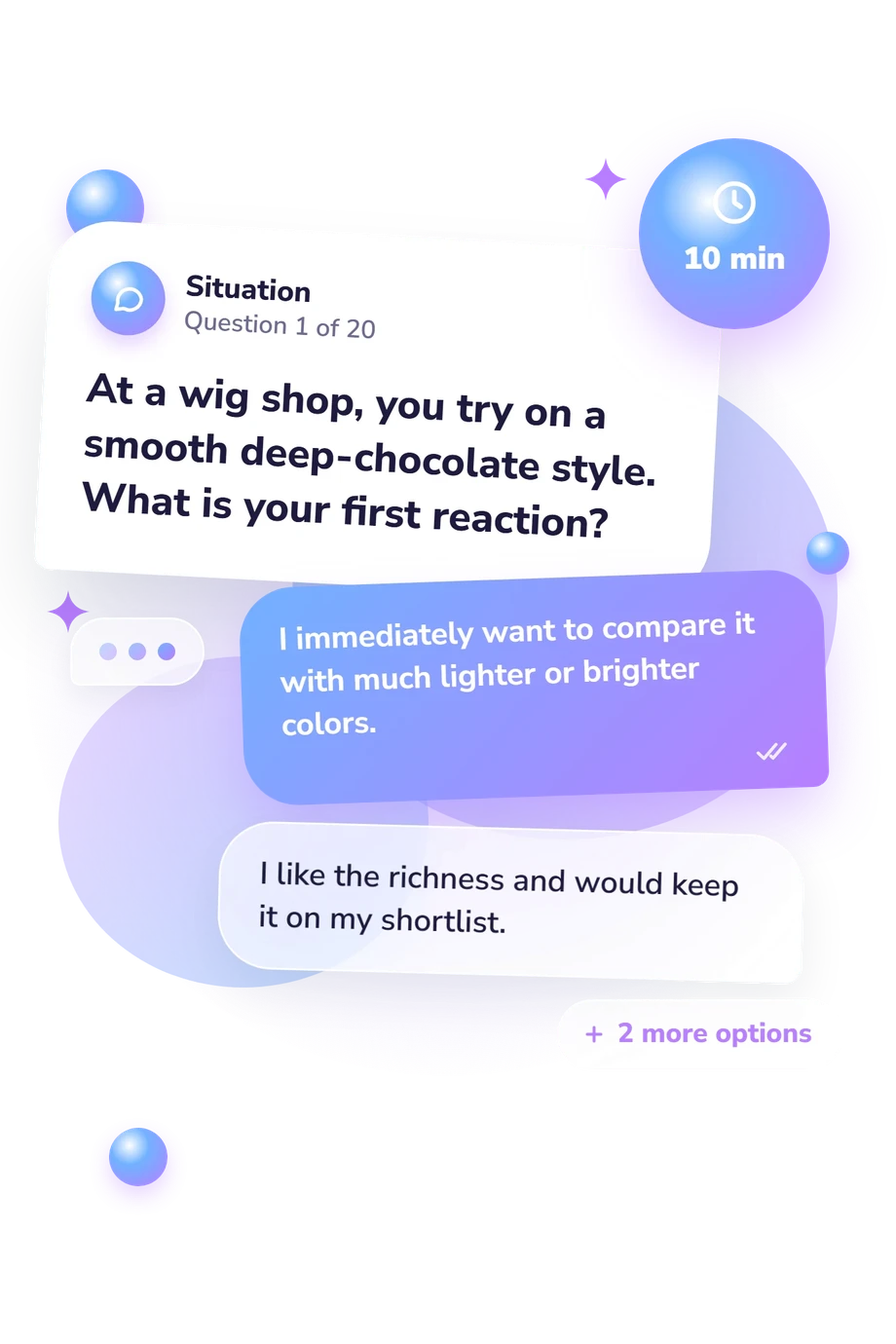
- I immediately want to compare it with much lighter or brighter colors.
- I like the richness and would keep it on my shortlist.
- It feels like an immediate front-runner for me.
- It looks polished, though I would probably choose it only for certain outfits.
- Order it after checking customer photos and the seller's color swatches.
- Replace it with a clearly lighter or more colorful choice.
- Feel confident checking out because deep shades are what I naturally reach for.
- Keep considering it as a useful alternative rather than my main look.
- I can picture a few combinations, mainly for a change of pace.
- It would work with many pieces and add the warmth I often want.
- I struggle to see it supporting the image I want to create.
- It feels naturally at home with my wardrobe and overall style.
What Color Wig Should I Get Quiz - Description and methodology of the test
For people comparing color families, the What Color Wig Should I Get Quiz turns an open-ended styling decision into a structured preference profile. It suits someone asking which wig is right for me while weighing natural polish, warmth, icy contrast, or imaginative change. The result can narrow a shortlist, clarify why certain shades appeal, and show whether a blended direction may fit better than one dramatic answer.
What This Assessment Explores
The test treats color as a choice about visual effect, self-expression, and practical commitment. Its scenarios probe warmth, depth, brightness, coolness, novelty, attention, coordination, and care.
This profile helps identify the best wig color for me without treating appearance as a fixed rule.
The five dimensions are:
- Copper & Auburn (0-12) marks red-toned warmth as Different Direction (0-4), Occasional Spark (5-8), or Strong Copper-Auburn Affinity (9-12).
- Deep Black & Brunette (0-12) marks rich neutrals as Different Direction (0-4), Versatile Possibility (5-8), or Strong Dark-Neutral Affinity (9-12).
- Fantasy Colors (0-12) marks vivid shades as Different Direction (0-4), Creative Accent (5-8), or Strong Fantasy-Color Affinity (9-12).
- Golden Blonde (0-12) marks warm blonde as Different Direction (0-4), Selective Golden Interest (5-8), or Strong Golden-Blonde Affinity (9-12).
- Platinum & Silver (0-12) marks icy tones as Different Direction (0-4), Cool-Tone Curiosity (5-8), or Strong Icy-Neutral Affinity (9-12).
Methodology and Evidence Base
Each item presents a styling scenario with four response options. Choices emphasize priorities such as making a shade central, reserving it for occasions, preferring another family, or accepting maintenance. Responses contribute to color-family scores, while outcomes within one point of the highest score form a blended result.
The profile also helps explain how to choose a wig color when several options seem plausible. Its online self-report format is not presented as a clinical or norm-referenced assessment; the ranges organize tendencies rather than establish universal cutoffs.
Saegusa and Watanabe (2014) provide the closest subject-specific comparison through work on hair-color suitability and perceived attractiveness, but this questionnaire is conceptually consistent with that study rather than a reproduction or validated adaptation. Palmer and Schloss’s ecological valence theory connects preferences with experience, while Elliot and Maier’s review supports cautious discussion of color effects without deterministic claims.
Lighting, screen rendering, seller swatches, mood, self-awareness, and wig familiarity can shape answers. Read the result as a shortlist aid, then test promising shades in realistic lighting and consider maintenance, wardrobe compatibility, and desired attention.
- Saegusa, Chihiro, and Katsumi Watanabe. “Hair Color Suitability and Perceived Attractiveness: Self-evaluation versus Evaluation by Others.” Transactions of Japan Society of Kansei Engineering 13, no. 1 (2014): 253-258. 10.5057/jjske.13.253
- Palmer, Stephen E., and Karen B. Schloss. “An Ecological Valence Theory of Human Color Preference.” Proceedings of the National Academy of Sciences 107, no. 19 (2010): 8877-8882. 10.1073/pnas.0906172107
- Elliot, Andrew J., and Markus A. Maier. “Color Psychology: Effects of Perceiving Color on Psychological Functioning in Humans.” Annual Review of Psychology 65 (2014): 95-120. 10.1146/annurev-psych-010213-115035
Updated: